
An aircraft begins its descent. The view outside changes slowly, but your ears seem to notice something sooner: a growing fullness, perhaps a dulling of nearby voices. Then you swallow. There is a small pop, and the room seems to sound normal again.
Swallowing can briefly open a passage between the middle ear and the back of the nose. Air can then move through that passage, reducing a pressure difference across the eardrum. The relief comes from restoring a balance on its two sides. MedlinePlus explains this connection between swallowing and pressure equalisation.
Two air spaces, separated by a membrane
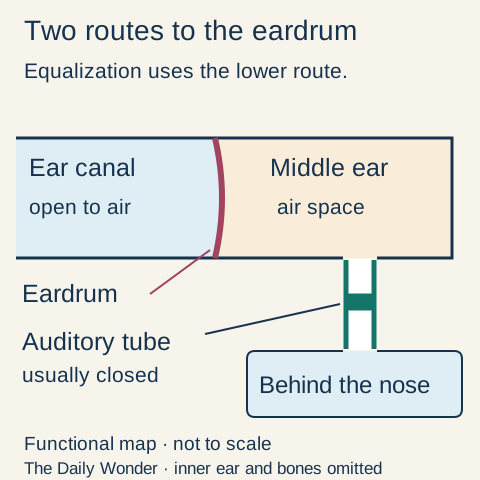
The opening you can see in an ear leads along the ear canal to the eardrum, a thin membrane. Beyond that membrane lies the middle ear, an air-filled space containing three small hearing bones. The canal and middle ear are separate spaces: air does not normally pass straight through an intact eardrum.
The middle ear has another connection. A narrow passage runs from it to the upper throat behind the nose. This is the Eustachian tube, also called the auditory tube. Each ear has its own. Its opening is behind the nose, rather than at the visible entrance to the ear. The NIDCD describes these parts and their arrangement.
That arrangement gives the eardrum two different neighbours. Air in the canal is exposed to the surroundings. Air behind the eardrum depends on a less direct route to exchange with those surroundings.
Why a small difference can feel large
Pressure means force spread over an area. Air presses against both faces of the eardrum. When the pressures are approximately equal, their opposing pushes largely balance. If one side has higher pressure, it produces a net push towards the lower-pressure side. The important quantity is therefore the difference across the membrane, not just the pressure on one side. OpenStax explains pressure and the force it produces.
During descent, increasing cabin pressure reaches the outside face through the ear canal. If middle-ear pressure has not caught up, the higher outside pressure pushes the eardrum inward. The membrane becomes tense and vibrates less easily. Rotherham NHS explains how this can make sounds seem muffled.
That matters because the eardrum is part of the hearing mechanism. Incoming sound makes it vibrate; the three middle-ear bones pass the vibration onwards to the fluid-filled inner ear. There, specialised cells help convert movement into electrical signals. A change in how freely the eardrum moves can therefore affect the sound delivered along this chain. Follow the normal hearing pathway with the NIDCD.
What a swallow changes
The auditory tube is normally closed. Swallowing and yawning can open it briefly, allowing the middle ear to exchange air. Rotherham NHS describes this ordinary opening and closing.
The link is muscular. Movements around the soft palate, the flexible back of the roof of the mouth, help move the tube's walls apart during a swallow. Air can then pass through when a pressure difference exists. The swallow makes an opening available; the pressure difference determines the direction of net airflow. Research on tube movement describes this coordinated muscular action.
Picture two moments during the same descent. First, the tube is closed, outside pressure is higher, and the eardrum bows inward. Second, a swallow opens the tube and air enters from behind the nose. Middle-ear pressure moves closer to outside pressure, so the inward push diminishes. This is an illustrative sequence, not a prediction of how much any person's eardrum moves. Air enters through the auditory tube, not through the eardrum.
During descent, air must enter by the auditory tube
1 · Tube closed
Cabin pressure rises. Air in the ear canal presses the eardrum towards the lower-pressure middle ear.
2 · Tube opens
The green arrow shows air movement from behind the nose into the middle ear. The pressure difference falls.
The pink eardrum separates the two air spaces in both panels. Air does not pass through it. Swallowing can briefly open the auditory tube below the middle ear, letting air take the other route. The ear canal remains open to cabin air throughout.
Functional schematic, not to scale or an anatomical cross-section. Tube direction and chamber shapes are simplified; eardrum displacement is exaggerated. Hearing bones and the inner ear are omitted. No pressure values or treatment thresholds are implied; not every swallow opens the tube.
Sources: NIDCD: ear compartments; Merck Manual: pressure difference and eardrum displacement. Original diagram by The Daily Wonder.
Going up reverses the pressure difference
As cabin pressure decreases during ascent, the middle-ear air can instead be at higher pressure than the air outside. Air then needs to leave the middle ear. That outward pressure can push the auditory tube open, letting air escape towards the back of the nose.
On descent, the middle ear needs incoming air. The tube must open to admit it, and a growing pressure difference can make opening harder. This helps explain why an uneventful climb can be followed by uncomfortable ears on the way down. The FAA distinguishes these ascent and descent mechanisms.
The relevant surroundings are the aircraft cabin. The ear responds to the pressure reaching it, rather than directly measuring the aircraft's height above the ground. Pressure equalisation therefore depends on both the changing environment and whether the connecting passage opens.
Watching the opening happen
Scientists can investigate this hidden movement directly. In a 2016 study, researchers recorded 33 adults without middle-ear disease as each swallowed three times. A small viewing instrument placed through the nose showed movements at the tube's opening. At the same time, a sound source in a nostril and microphones in the ear canals measured how much test sound passed through the route.
Across the 99 swallows, measurements of the visible opening were associated with measurements of transmitted sound. These were observations of movement and sound transmission, not a test of whether every swallow prevented discomfort on a flight. They nevertheless connect the familiar action to a physical passage that changes shape. Read the study's methods and findings.
Why the passage does not stay open
A permanently open tube would create other problems. Closing helps protect the middle ear from sounds and drainage arriving from behind the nose. When the tube remains unusually open, people may hear their own voice or breathing too loudly. Successful function involves opening and closing at appropriate times. Johns Hopkins explains the different problems caused by too little or too much opening.
Colds and allergies can produce swelling that interferes with this exchange. A swallow cannot guarantee that an obstructed tube will open. Pressure differences can also cause injury, called barotrauma, rather than just a fleeting blocked sensation. MedlinePlus describes these limits and symptoms.
A pop is not a pressure measurement
The ordinary little pop draws attention to a connection we usually overlook. A movement in the throat briefly changes an air route beside the ear, helping a delicate membrane return towards pressure balance.
YOUR PERSPECTIVE
Join the discussion
What surprised you? Have a question or a correction? Share your thinking.
No comments yet. Start the conversation.
Sign in with ChatGPT to commentAnyone can read the discussion. Sign-in helps limit spam.