
Imagine watching a deep-ocean camera feed. A soft, translucent animal passes through the lights, moving without any visible armour. Around it, the water pressure is enormous. The camera carrying its image to the surface needs carefully engineered protection. The animal appears to need none.
That contrast makes the familiar question almost unavoidable: why does the creature not get crushed?
The answer is not that deep-sea life has somehow escaped physics. It is that we tend to picture the wrong object. A living body full of water is not the same mechanical problem as a hollow chamber full of air. Yet solving that problem is only the beginning: high pressure also reaches the molecules that keep a cell alive.
A heavier world with every metre
Water has weight. As you descend, more water lies above you, so the surrounding pressure increases. This is hydrostatic pressure: pressure in a fluid at rest. It acts in every direction, not only downward. A surface facing sideways still experiences the push of the surrounding water.
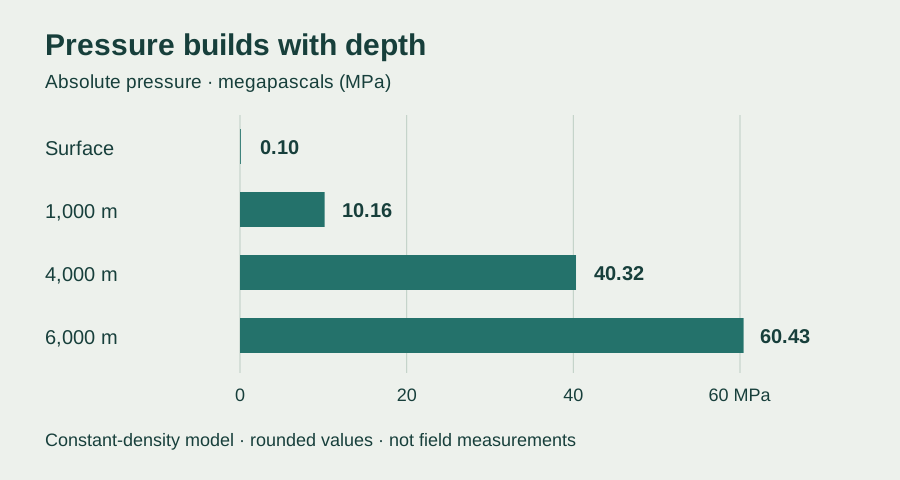
A useful ocean rule is roughly one additional atmosphere, about the air pressure at sea level, for every ten metres of descent. At the surface, there is already atmospheric pressure; it does not disappear when you enter the water. NOAA explains this steady increase in its guide to pressure and depth.
Using the constant-density calculation in our diagram, a depth of 4,000 metres gives about 40 megapascals of absolute pressure, measured from zero pressure and including the atmosphere above the ocean. One megapascal is a million pascals; a pascal is one newton of force per square metre. Those units sound abstract until you compare the two sides of a wall.
An air-filled chamber kept at surface pressure would have almost that entire 40-megapascal difference across its boundary. Pressure is therefore not just a number describing the ocean. If the outside pressure is much greater than the inside pressure, the walls must resist a strong inward push. The pressure difference tells us how large that push is. OpenStax develops the underlying fluid-pressure equation.
Why softness can be an advantage
Gas compresses readily. Water changes volume much less under the same conditions. Many deep-sea animals are largely water and lack the large gas-filled spaces that make pressure such a conspicuous difficulty for us. Their internal fluids experience pressure too, instead of remaining at a comfortable surface value behind a rigid wall.
That does not mean every part of the animal has exactly identical pressure, or that water is perfectly incompressible. It means the animal is not maintaining a vast pressure difference across an air-filled passenger compartment. A flexible, water-rich body can therefore be a successful starting point, without an immensely thick shell. NOAA describes why gas-filled spaces matter.
The same depth can mean a very different pressure difference
Compare the pressures on the two sides of a boundary, rather than depth alone
Water-rich tissue: nearly balanced
Outside: high surrounding water pressure
Inside: internal-fluid pressure rises with the outside
Across the boundary: a small pressure difference. Near balance is not protection from molecular effects
Air chamber: a large difference
Outside: the same high surrounding water pressure
Inside: air held at surface pressure in this example
Across the boundary: a large inward pressure difference that the chamber wall must resist
Outside arrows point inward; inside arrows point outward. They represent opposing pressure forces on the boundary, not water flow. Both cases still experience high outside pressure
Qualitative cutaways, not to scale. Arrow lengths compare near balance with a large difference; they are not measured forces. Water is not perfectly incompressible and real tissues are not perfectly pressure-balanced. High absolute pressure still affects proteins and membranes; pressure tolerance is not one universal ingredient. The low-pressure chamber is an illustrative maintained compartment, not an animal, a hull design or a diving model.
Sources: NOAA: water-rich bodies and gas-filled spaces; MBARI: pressure, proteins and membranes
This is also why “strong enough to withstand pressure” can be a misleading description of adaptation. Sometimes success means resisting a difference. Sometimes it means allowing pressure to be transmitted through the system. Those are different solutions to different problems.
Optional physics: what happens to trapped gas?
First, scientists had to find the inhabitants
During the nineteenth century, the deep ocean was not simply difficult to reach. Scientists disagreed about whether it could support life. Cold, darkness and pressure made an apparently persuasive case against abundant life far below the surface.
The Challenger expedition of 1872–1876 helped replace that speculation with an extraordinary collection of evidence. Charles Wyville Thomson led its civilian scientific team. Sailors and scientists lowered collecting equipment, measured conditions and preserved specimens for later examination. The ocean became something that could be systematically sampled rather than imagined from shore.
The results were not contained in one dramatic discovery. They accumulated across stations, specimens and years of analysis. Thomson and later John Murray oversaw publication of the extensive scientific reports. Royal Museums Greenwich traces the expedition and its discoveries.
Finding animals answered one question. It left another open: what made their bodies function there?
The pressure problem inside a cell
A cell needs more than an intact outline. Its proteins must perform chemical tasks, and its membranes must maintain working boundaries. Pressure can alter molecular behaviour even when there is no large gas bubble to collapse.
Researchers at the Monterey Bay Aquarium Research Institute compare deep-living organisms with shallow relatives to investigate differences in proteins and the fatty molecules called lipids that make up cell membranes. Proteins carry out many of a cell’s chemical tasks; membranes form the boundaries that control what enters and leaves. Comb jellies are particularly useful because deep and shallow habitats have been occupied independently by different lineages. These comparisons help separate a general family resemblance from changes associated with an environment. MBARI explains its physiology research.
One 2019 study compared genetic information from 34 comb-jelly species and examined patterns in four enzymes, proteins that help chemical reactions proceed. Computer analysis identified candidate molecular changes associated with temperature and depth. Crucially, those associations were not proof that a particular change caused pressure tolerance. Testing the proposed mechanism requires experiments. Read MBARI's account of the study and its limitations.
That distinction matters. There is no single universal “deep-sea ingredient” explaining every animal. Adaptation involves different organisms, different histories and multiple interacting constraints.
Pressure is only one part of the habitat
Being pressure-tolerant does not provide dinner. Deep habitats also present low temperatures, limited sunlight and often scarce food. Communities at hydrothermal vents and cold seeps, places where chemical-rich fluids escape from the seabed without high vent temperatures, introduce another possibility: food production based on chemical energy rather than sunlight. Their energy story deserves its own article. NOAA outlines these interacting deep-ocean conditions.
Nor is bringing a deep-sea animal upward automatically a rescue. Conditions familiar to us can be unsuitable for a species adapted to the deep. Scientists must consider the environment in which they observe or study it, not merely the convenience of collecting it.
Try changing depth and pressure balance in the model below. The ocean pressure remains the same for either selected case; the pressure difference does not. That is the first lesson of the translucent animal passing the camera: survival need not look like armour. Sometimes it begins by living in balance with the very condition that seems impossible to resist.
EXPLORE THE IDEA
Same ocean, different pressure balance
The air is held at surface pressure. The boundary must resist the growing difference; no hull thickness or failure depth is predicted.
Scroll the diagram sideways to see every label.
Calculated illustration, not an animal, hull-design or diving-safety model. Seawater density is fixed at 1,025 kg/m³; gravity is 9.81 m/s²; surface air pressure is 101,325 Pa. Real density varies with temperature, salinity and pressure. The fluid case assumes perfect pressure balance; real tissues still face biochemical effects. Fixed graph scale; no animation.
YOUR PERSPECTIVE
Join the discussion
What surprised you? Have a question or a correction? Share your thinking.
No comments yet. Start the conversation.
Sign in with ChatGPT to commentAnyone can read the discussion. Sign-in helps limit spam.