
Switch on active noise cancellation during a flight and the engine drone can seem to retreat. A nearby voice may remain clear. A sudden clatter may still break through. The headphones have not removed sound from the cabin, so why does one kind of noise fade while another survives?
The answer is stranger than soundproofing. The headphones add another sound. They aim that added pressure so precisely that, near your eardrum, it opposes part of the incoming pressure. The useful quiet is therefore not an empty room. It is a small meeting place where two disturbances add to less.
Quiet is made at a location
Sound in air is a travelling change in pressure. At one instant, the air pressure at the eardrum may be slightly above its resting value; a moment later it may be slightly below. When two sounds arrive together, their pressure changes add like signed numbers.
Suppose an outside wave contributes +1 pressure unit while the headphone speaker contributes −1 unit at the same place and time. Their total is zero in that ideal instant. Half a cycle later, −1 and +1 can cancel again. Engineers call this destructive interference, meaning that overlapping waves produce a smaller result. OpenStax explains why pressures from separate sound sources add and subtract.
The phrase “opposite sound” can mislead. Reversing a recorded waveform is not enough. The added wave must reach the eardrum with the right size and timing after passing through a microphone, electronics, a loudspeaker and the small air space inside the earcup.
The earcup runs a control loop
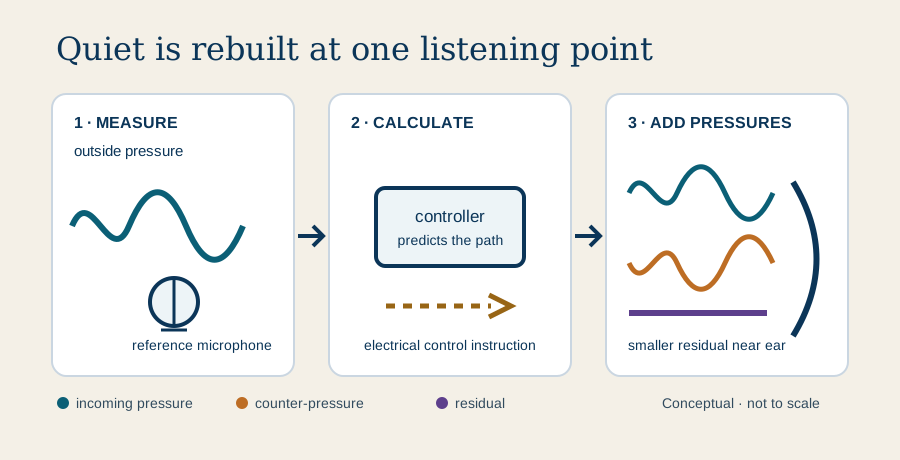
A common feedforward design places a reference microphone on the outside of the earcup. It hears some noise before that noise reaches the ear. A controller estimates what the pressure will become after travelling through the cup and drives the headphone speaker to create a counter-wave.
Many designs also use a microphone inside the cup. It measures the remaining sound, called the error signal, so the controller can adjust. Feedforward information says what is coming; feedback reports what was left behind. A hybrid design can use both. Research on adaptive active-noise-control headphones describes how these microphone, controller, speaker and error-measurement paths work together (Patel and Cheer, 2022).
The counter-wave must arrive at the right place and time
A physical pressure path and an electrical control path meet near the eardrum
- 1. Measure what is comingBlue curve: incoming pressure propagation →
- 2. Calculate a counter-signalGold dashed arrow: electrical control instruction →
- 3. Add pressures at the earPurple line: smaller residual pressure at this point
Conceptual and not to scale. One path and one listening point are shown. Real systems contain frequency-dependent microphones, filters, speakers and seals; adaptive designs also update their control filters.
Sources: OpenStax: pressure-wave interference; Zhang and Qiu: headset path delay
Adaptive designs commonly use an estimate of the secondary path, the combined delay and frequency response between the controller’s electrical output and the error microphone. That estimate may be measured beforehand or updated during operation; not every headphone continually learns it. The speaker, earcup, seal and listener all shape that path. The algorithm is correcting a physical system, not editing an abstract audio file.
A short delay becomes a large phase error
Timing explains why a steady low drone is an easier target than a sharp, high-pitched event. A 100-hertz tone repeats 100 times each second, so one cycle lasts 10 milliseconds. A processing error of 0.5 millisecond shifts that cycle by 18 degrees. The counter-wave is imperfect, but it can still oppose much of the tone.
A 1,000-hertz tone completes a cycle in 1 millisecond. The same 0.5-millisecond delay is now half a cycle, or 180 degrees. Because the controller already intended to reverse the sound, that extra half-cycle can reverse the reversal: the added wave may reinforce the noise instead of reducing it.
Laboratory work on feedforward headsets confirms the broader engineering point. Electrical and acoustic delay narrows the usable cancellation bandwidth and can reduce the maximum attenuation (Zhang and Qiu, 2014). The University of Southampton likewise notes that active control is most effective for low-frequency noise and becomes much harder across a large, complex high-frequency sound field (Southampton’s train-acoustics project).
What the model can and cannot show
EXPLORE THE IDEA
When does the counter-wave make quiet?
1. Incoming noise pressure
2. Speaker counter-pressure
3. Pressure left at the listening point
14.4°Delay as phase
25.1%Pressure amplitude left
-12.0 dBLevel change
The calculation is remaining amplitude = |1 − r·e−iφ|, where r is the counter-wave amplitude ratio and φ is the delay expressed as phase. Sound-level change is 20 log10(remaining amplitude).
One steady sine wave at one point. The counter-wave is already polarity-inverted, then delayed. The same delay can line up again after a full cycle, which is possible for a repeating tone but does not solve changing broadband noise. Values are illustrative, not measurements or a headphone rating. No animation.
The quiet does not fill the room
Cancellation that works at one point need not work at another. Moving the ear changes the distances travelled by the outside sound and the speaker sound. Different path lengths change their relative phase. This is why large “zones of silence” are difficult: many microphones and speakers may be needed to control a complicated sound field over space.
The earcup makes the problem smaller. It gives the controller a confined region close to one ear. The cushions also provide passive attenuation, meaning they physically block or absorb some sound without calculating anything. Passive materials are especially useful at higher frequencies, while active control can attack low-frequency pressure variations that would otherwise need bulky barriers.
Real noise is not one perfect sine wave. Engines contain many frequencies. Speech and impacts change rapidly. Adaptive controllers update filters to follow those mixtures; other designs use fixed filters. A 2023 technical review identifies latency, non-stationary noise and broadband control as continuing design challenges, even after decades of progress (Shi and colleagues).
The idea began in a pipe
Paul Lueg’s 1936 United States patent described a microphone hearing a sound before a loudspeaker produced a wave of opposite phase. Its clearest example was a tone travelling through a pipe, where direction and distance could be arranged. The patent itself also recognised the harder case of irregular noise and the need to create opposition within a limited region.
Digital processors later made it practical to adapt the counter-signal in real time. Yet the old pipe remains a useful warning. Active control works best when the path from measurement to correction is known well enough, and when the correction arrives before the unwanted pressure has already passed the listening point.
Quieter is not automatically protected
Noise cancellation can improve comfort, but it is not automatically certified hearing protection. The US National Institute for Occupational Safety and Health says headphones or earbuds with active cancellation should not be treated as hearing protectors unless they carry an appropriate noise-reduction rating (NIOSH guidance). A pleasant reduction in a cabin drone does not prove adequate protection from hazardous workplace noise or impulse sounds.
The technology’s most surprising lesson is also its most precise. Quiet is not produced by deleting a wave that already exists everywhere. Designs differ: a feedforward system uses a reference microphone, a feedback system measures the remaining sound, and a hybrid can combine both. A controller drives the speaker to produce an opposing wave. At a carefully managed listening point, added sound pressure can reduce the total. This local effect depends on timing, frequency, fit and the sound itself.
YOUR PERSPECTIVE
Join the discussion
What surprised you? Have a question or a correction? Share your thinking.
No comments yet. Start the conversation.
Sign in with ChatGPT to commentAnyone can read the discussion. Sign-in helps limit spam.