
For a few minutes, the Sun can become a brilliant ring around a black centre. The popular name, ring of fire, sounds like a different mechanism from a total eclipse. It is not. The same three bodies are involved, in the same order: Sun, Moon, Earth.
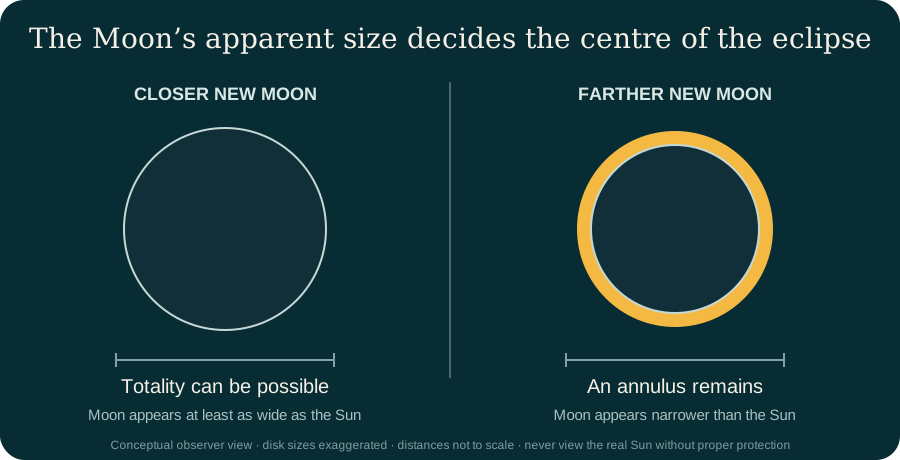
The difference is a narrow margin in apparent size. At one eclipse the Moon looks just large enough to cover the Sun. At another it looks slightly too small. The remaining photosphere, the Sun’s intensely bright visible surface, surrounds the lunar silhouette as an annulus: a ring.
The Moon’s changing distance controls how large it looks. That small change in apparent size decides whether we see darkness or a ring.
Two objects can share an apparent size
The Sun is about 400 times wider than the Moon, but it is also roughly 400 times farther from Earth. Those two ratios are close enough that both disks span about half a degree in our sky. Their physical diameters are vastly different; their angular diameters, the angles they occupy at an observer’s eye, can nearly match.
Angular size depends on an object’s diameter divided by its distance. A coin close to your eye can hide a distant lamp for the same reason. Move the coin away and its physical diameter does not change, but the angle it covers becomes smaller.
The Moon’s orbit supplies that change naturally. It is not a perfect circle. NASA gives representative centre-to-centre distances of about 363,300 kilometres at perigee, the closer part of the orbit, and about 405,500 kilometres at apogee, the farther part. The exact extremes vary from orbit to orbit. NASA’s Moon-distance explanation includes an animation and an apparent-size comparison.
At the nearer distance, the Moon can appear a little larger than the Sun. At the farther distance, it can appear smaller. That small swing is enough to change the central eclipse from total to annular.
Alignment and distance answer different questions
An eclipse first requires the new Moon to pass near a node, the place where its tilted orbit crosses the plane of Earth’s path around the Sun. That alignment question explains why a solar eclipse does not happen every month.
Once the centres are aligned closely enough, a second question remains: which disk appears larger?
If the Moon’s angular diameter exceeds the Sun’s, its dark central shadow, the umbra, can reach Earth. An observer inside it can see totality, when the Moon completely covers the Sun’s bright surface. If the Moon appears smaller, the umbra narrows to a point before reaching the surface. Beyond that point lies the antumbra, the narrow region where the Moon looks smaller than the Sun and sits inside its bright disk. An observer there sees the Moon entirely within the solar disk, with sunlight visible all around it: annularity.
NASA’s guide to eclipse types distinguishes total, annular, partial and hybrid eclipses. A hybrid event exposes how fine the margin can be. Because Earth is curved, observers along one part of the path may be close enough to the Moon’s shadow for totality while observers elsewhere see an annular phase.
A little deeper: magnitude is not brightness
Kepler’s ellipse belongs in this story
For centuries, astronomers tried to represent celestial motion with combinations of circles. Johannes Kepler’s early-seventeenth-century work replaced a planet’s circular path with an ellipse and described changing orbital speed. His laws were developed for planets around the Sun, but the broader lesson matters here: orbital distance is not fixed merely because an orbit repeats. The High Altitude Observatory’s historical timeline explains Kepler’s move to elliptical paths.
Modern eclipse calculations use ephemerides, detailed tables or calculations of where celestial bodies will be at particular times. A single ideal ellipse is not enough. They account for the changing positions of Sun, Moon and Earth, as well as Earth’s rotation and shape. Predicting the start and end times very precisely also requires the mountains and valleys along the Moon’s edge. The simple phrase “the Moon is near apogee” gives the physical idea, not a complete prediction.
This also corrects a common misconception: apogee does not automatically create an annular eclipse. Most distant new Moons pass above or below the Sun in our sky. The orbital nodes must first provide the alignment, and the observer must lie within the narrow path where the geometry is central enough to form a ring.
The ring is still the Sun
The nickname “ring of fire” can make the annulus sound like a thin decorative border. It is exposed photosphere. Even a slender arc is intensely bright, and annularity never becomes totality.
NASA’s safety guidance is unambiguous: during a partial or annular eclipse, safe solar-viewing glasses or a safe handheld solar viewer are required for direct viewing at all times. Ordinary sunglasses are not sufficient. Cameras, binoculars and telescopes require purpose-designed solar filters secured over the front of the optics. Wearing eclipse glasses while looking through an unfiltered instrument is unsafe. The concentrated sunlight can damage the filter and your eyes. Read NASA’s complete annular-eclipse eye-safety guidance.
Indirect projection is another option. With the Sun behind the observer, a small opening can project the solar image onto a surface. One looks at the projection, never through the hole. The American Astronomical Society notes that many small openings, even gaps between leaves, can project tiny rings during annularity. Its projection guide explains the safe geometry.
A moving boundary, not a frozen picture
Only observers inside the antumbra see a complete ring. People outside that narrow track see a partial eclipse because the disks are off-centre from their location. As Earth rotates and the Moon moves in orbit, the antumbra sweeps a path across the curved surface.
The ring itself therefore changes. It begins when the lunar disk moves fully inside the Sun’s apparent edge, becomes most symmetric near the local maximum, and ends when the edges meet again. Lunar mountains can break the narrow ring into bright points near those contacts, a reminder that the Moon is a rocky world rather than a mathematically perfect circle.
Explore the apparent-size margin
An annular eclipse does not reveal that the Moon is too small. It reveals how delicately its apparent size is balanced against the Sun’s. Tens of thousands of kilometres of orbital distance change a black disk by only a few hundredths of a degree, yet that is enough to replace total darkness with a circle of sunlight.
EXPLORE THE IDEA
When does a ring remain?
0.504°Moon angular diameter
0.533°Illustrative Sun diameter
0.946Moon / Sun diameter ratio
Keep the centres aligned and move the Moon outward. The classification changes when its apparent diameter falls below the Sun’s.
Scroll the diagram sideways to see every label.
Observer-view geometry with a fixed 3,474.8 km Moon and illustrative 0.533° Sun. Moon angular diameter = 2 × atan(diameter ÷ 2 distance). Distance is centre-to-centre; offset is measured in apparent solar radii. Ideal circular disks only. The model omits orbital timing, observer coordinates, parallax, refraction and lunar topography; it cannot predict an eclipse or make solar viewing safe.
YOUR PERSPECTIVE
Join the discussion
What surprised you? Have a question or a correction? Share your thinking.
No comments yet. Start the conversation.
Sign in with ChatGPT to commentAnyone can read the discussion. Sign-in helps limit spam.