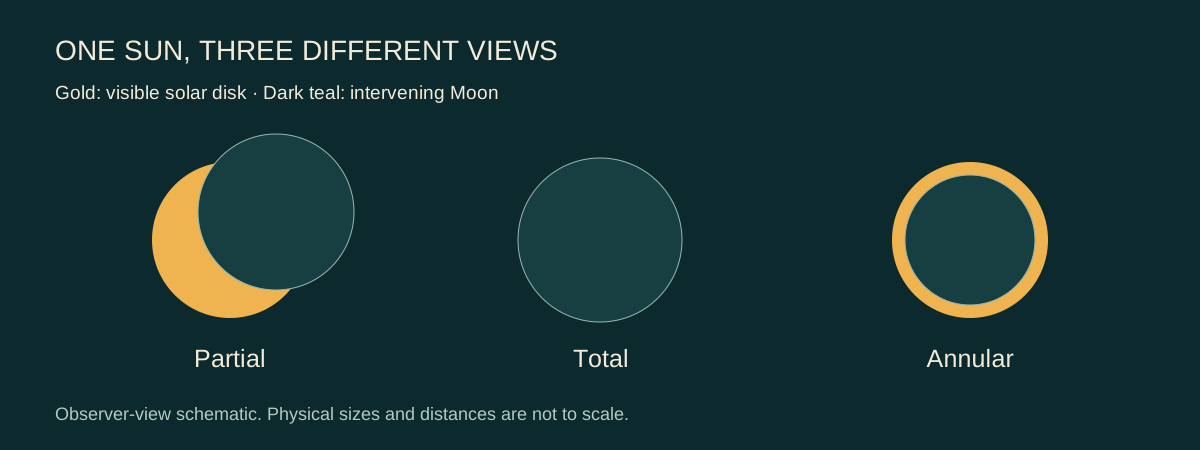
The Moon does not need to rival the Sun in size to interrupt our view of it. It only needs to occupy the right patch of sky. That sounds like a small distinction until a bright afternoon loses its familiar light and a dark disk appears where a star should be.
A total solar eclipse is an event in perspective. The Sun continues shining. Most of Earth continues receiving its light. But for observers inside a moving region of shadow, the Moon temporarily conceals the bright solar face. The remarkable part is how closely the sizes and distances cooperate.
The size that matters is the size you see
An object's physical diameter and its apparent diameter answer different questions. One describes the object itself; the other describes how much of your field of view it occupies. A nearer object can cover a farther one without being remotely as large.
The Sun is roughly 400 times the Moon's diameter, but it is also roughly 400 times farther from Earth. Those two ratios nearly cancel in our view. The enormous Sun and comparatively small Moon therefore look surprisingly similar in size. These are approximate relationships, not a perfectly fixed arrangement. NASA's explanation of eclipse geometry.
Think of this as a comparison of directions. Your eye receives sunlight from a small range of directions across the solar disk. If the Moon blocks all those directions, the bright face disappears. It does not have to stop the Sun shining anywhere else.
A little deeper: angular diameter
One alignment, different views
During a solar eclipse, the Moon is between Earth and the Sun. The umbra is the region of shadow where the bright solar disk is completely hidden; the penumbra is the surrounding region where it is only partly hidden. An observer in the first can experience totality while someone outside it sees a partial eclipse.
If the Moon looks too small to cover the whole Sun, a bright ring remains even at central alignment. That is an annular eclipse. A partial eclipse instead leaves the disks incompletely overlapping. The diagram above compares these appearances; it does not depict the bodies' actual dimensions or their separation. NASA's guide to eclipse types.
This makes “there is an eclipse today” an incomplete description. The important follow-up is where you are. An eclipse map tells you which view the geometry permits at your location. Travelling across a boundary on that map can change the experience dramatically even though the celestial event is the same.
The alignment is possible only around new moon. It does not happen at every new moon because the lunar orbit is tilted relative to Earth's orbital plane: the Moon usually passes above or below the required line. The detailed rhythm deserves its own story; the essential point here is that being on the Sun's side of Earth is necessary but insufficient. NASA explains the occasional alignment.
Darkness became a scientific instrument
In 1868, the French astronomer Pierre Jules César Janssen observed an unfamiliar spectral line during an eclipse. A spectrum separates light into its component wavelengths; particular atoms can produce characteristic bright lines. Here was a clue to the Sun's composition that did not match an element then recognised on Earth.
The investigations that followed identified helium, named after the Greek word for the Sun. Helium was subsequently identified on Earth in 1895. The striking historical reversal is that evidence for an element appeared in sunlight before chemists established its presence here. NASA's solar-science timeline follows the discovery.
The eclipse had made an observation possible by removing overwhelming brightness. That is a different kind of scientific advantage from making a telescope larger. Sometimes the obstacle is not that the signal you want is absent, but that another signal is much stronger.
Totality also reveals the corona, the Sun's faint outer atmosphere, around the covered disk. It exists in ordinary daylight too; the bright solar face normally overwhelms our view. The pale structure belongs to the Sun, rather than being an atmosphere suddenly produced around the Moon. NASA describes what becomes visible during totality.
An eclipse helped test gravity
On 29 May 1919, another eclipse became a laboratory for a very different question. British expeditions observed from Príncipe and Sobral in Brazil to investigate whether starlight passing near the Sun appeared displaced by its gravity.
Einstein's general relativity predicted that the Sun's mass would bend the path of light. Normally, nearby stars on the sky are lost in sunlight. During totality, astronomers could photograph them and compare their apparent positions with reference observations. The reported results supported Einstein's prediction and helped bring his theory worldwide attention. The European Space Agency recounts the expeditions.
This was evidence from a difficult measurement, not a magical moment that ended all testing. Its lasting appeal is the connection: the Moon blocked our view of the Sun, allowing scientists to study what the Sun did to light arriving from beyond it.
A view that requires preparation
For direct viewing during partial and annular phases, use a safe solar viewer complying with ISO 12312-2; ordinary sunglasses are unsuitable. Never look through binoculars, a telescope or a camera while wearing eclipse glasses: concentrated sunlight can damage the viewer and your eyes. Optical equipment needs appropriate front-mounted solar filters and expert guidance.
NASA permits unfiltered viewing only during the brief complete totality of a total eclipse, when the bright solar face is entirely covered. Protection must return before it reappears. If you cannot reliably identify that interval, keep using a safe viewing method. Read NASA's full observation guidance before watching.
Understanding the geometry does not make totality ordinary. It makes the darkness more specific: a nearby rocky world, a distant star and your particular position have briefly lined up. The Sun has not changed its nature. For a moment, our view has changed enough to teach us something new.
EXPLORE THE IDEA
Move the Moon across the Sun
Centre the Moon, then make its apparent diameter smaller than the Sun's. Watch a total eclipse become an annular one.
Observer-view model using apparent disk sizes. Position is measured in solar radii, not kilometres. This illustrates overlap, not an orbital prediction, eclipse timetable or safe-viewing guide. Use proper solar-viewing protection for real observations.