
Every new moon places the Moon roughly between Earth and the Sun. Every full moon places Earth roughly between the Sun and Moon. It sounds as though a solar eclipse should follow each new moon and a lunar eclipse each full moon.
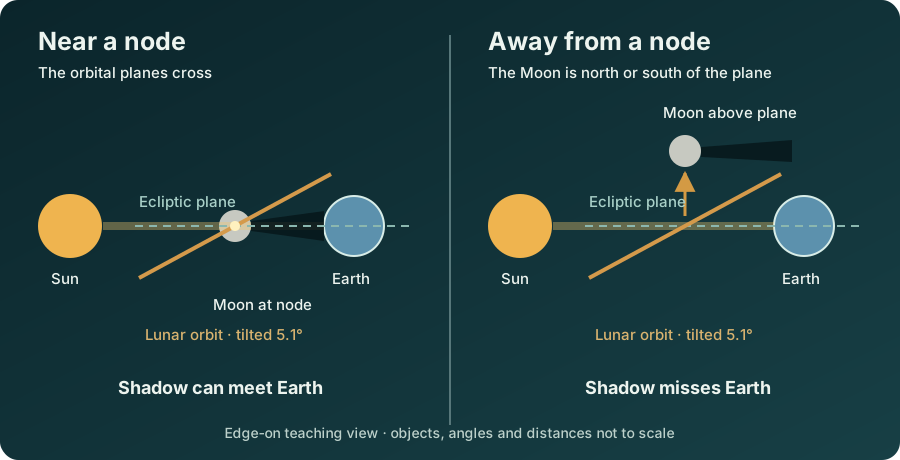
But “between” is not the same as “perfectly in line.” Most months the three bodies line up when viewed from above Earth's orbit, yet fail to line up in the vertical direction. The Moon passes a little north or south of the required path. A shadow crosses empty space instead of the world waiting for it.
The missing ingredient is a pair of orbital crossing points called nodes.
Two almost-flat systems
Earth travels around the Sun in a plane called the ecliptic plane. It is useful to picture that plane as an enormous, imaginary sheet passing through the Sun and Earth's orbit. The Moon travels around Earth in another plane, tilted by about five degrees to the ecliptic.
Five degrees sounds small. On the scale of the Moon's orbit, however, it is enough to move the Moon tens of thousands of kilometres above or below the ecliptic plane. NASA explains that a new moon therefore usually passes north or south of the Sun in our sky; its shadow passes above or below Earth. NASA's eclipse geometry guide shows how the tilted planes prevent monthly solar eclipses.
The same tilt prevents most full moons from entering Earth's shadow. Earth can sit between Sun and Moon in the broad sense while the Moon passes above or below the long shadow extending behind our planet.
Where the two planes cross
Two tilted planes intersect along a line. The Moon crosses the ecliptic at two opposite points on its orbit. These are the ascending node, where it moves from south of the ecliptic to north, and the descending node, where it moves the other way.
Near either node, the Moon is close to the Sun–Earth plane. If new moon occurs there, the Moon's shadow may reach Earth and produce a solar eclipse. If full moon occurs near a node, the Moon may enter Earth's shadow and produce a lunar eclipse. NASA's eclipse catalog uses the same nodal language to organise eclipse families and defines the two crossings explicitly. See the node definition in NASA's Saros catalog.
Three conditions have therefore replaced one:
Solar eclipse: new moon, near a node, with the shadow close enough to Earth.
Lunar eclipse: full moon, near a node, with the Moon close enough to Earth's shadow.
The Moon therefore needs the right phase, its new-moon or full-moon arrangement, but that alone cannot produce an eclipse. The lunar calendar tells us when Sun, Earth and Moon are arranged in the correct order. The nodes tell us whether that ordering also works in three dimensions.
A little deeper: latitude around a tilted orbit
Eclipse seasons, not eclipse months
The Sun appears to travel around the ecliptic over a year. An eclipse season arrives when the Sun is close to one of the Moon's nodes, making the geometry favourable for both new-moon and full-moon alignments.
NASA describes each season as lasting about 35 days and returning just short of six months later. Because 35 days is longer than one lunar phase cycle, a season usually contains at least one solar eclipse and one lunar eclipse, and sometimes an additional eclipse near an edge. Globally, NASA counts anywhere from four to seven solar and lunar eclipses in a year. NASA summarises the seasons and annual range and its Moon guide distinguishes the new-moon and full-moon cases.
The dates do not remain fixed in our calendar. The line joining the two lunar nodes slowly rotates, or regresses, under gravitational influences, especially that of the Sun. The geometry that defines an eclipse season therefore returns a little sooner than half a calendar year. This shifting schedule is one reason eclipse prediction needs orbital mechanics rather than a permanent pair of dates.
Explore the tilted orbit
Why eclipses still arrive in families
The phase cycle and node-crossing cycle are not the same length, but they periodically return to nearly the same relationship. After about 223 lunar phase cycles (roughly 18 years, 11 days and 8 hours), the Sun, Earth and Moon have similar relative geometry. This is the Saros cycle.
Ancient observers could recognise such recurrence without knowing Newtonian gravity or computing a three-dimensional orbit. Modern predictions go far beyond pattern matching, but the repeating cycle preserves the importance of the nodes: eclipses in one Saros family occur near the same node. NASA explains the 223-month recurrence and its limits. The companion article How we learned to predict eclipses follows that history in more detail.
A flat diagram creates the misconception
Many textbook drawings place Sun, Earth and Moon on one straight horizontal line. That view is excellent for explaining shadows but quietly removes the five-degree tilt. If it is mistaken for the arrangement every month, monthly eclipses seem unavoidable.
The correct picture needs depth. At new moon, the Moon can line up with the Sun from side to side in the sky, yet pass above or below it. At full moon, it can be opposite the Sun yet miss Earth's shadow vertically. A node is where those two descriptions finally agree.
If you observe a solar eclipse, the geometry does not make direct sunlight safe. Except during the brief total phase of a total solar eclipse, use proper solar-viewing protection; ordinary sunglasses are not sufficient. Lunar eclipses are safe to watch without eye protection. NASA gives the complete viewing guidance.
An eclipse is therefore not a monthly phase that occasionally fails. It is a precise three-dimensional appointment. The Moon must reach the correct phase and the correct crossing of its tilted road at nearly the same time. Most months it keeps the first appointment and misses the second.
EXPLORE THE IDEA
How far from the ecliptic is the Moon?
+3.64°Ecliptic latitude
+24,375 kmVertical component
The Moon is north of the ecliptic in this simplified orbit. Move toward 0° to reach the node.
Scroll the diagram sideways to see every label.
Circular teaching orbit with fixed 5.145° inclination and 384,400 km radius. The control is angular distance along the orbit from a node. The model isolates vertical displacement from the ecliptic; it does not include phase timing, eccentricity, parallax, shadow size, Earth rotation or node regression and cannot predict an eclipse. No animation.
YOUR PERSPECTIVE
Join the discussion
What surprised you? Have a question or a correction? Share your thinking.
No comments yet. Start the conversation.
Sign in with ChatGPT to commentAnyone can read the discussion. Sign-in helps limit spam.