
A map can show a strip of future darkness across towns where the Sun is still shining. People can arrange a journey around it years before the event. That is an extraordinary promise: not merely that the Moon will cover the Sun, but that it will do so for particular people standing on particular ground.
The promise has several layers. First comes recognising a recurring event. Then comes calculating the positions of celestial bodies. Finally, astronomers must work out where the shadow falls as Earth rotates, allowing for the shape of the ground. Eclipse prediction became powerful because astronomers learned to distinguish these tasks and improve each separately.
A prediction that invited a reply
In 1715, Edmond Halley published a pamphlet showing the predicted path of a forthcoming solar eclipse. It helped turn the event into something the public could anticipate and observe. Reports from observers then helped him refine his calculations and produce a more accurate map for the eclipse of 1724. Royal Museums Greenwich documents that exchange.
The important historical lesson is not that one astronomer suddenly made prediction perfect. It is that a prediction could be printed, compared with what happened, and corrected. A map makes an error visible: a boundary drawn in the wrong place is something another observer can challenge.
This gives astronomy a productive loop. A calculation tells people where and when to look; their observations test the calculation. Better predictions are not substitutes for observations. They are one of the ways to organise them.
The Moon keeps more than one calendar
Long before detailed geographical maps, repeated observations offered another kind of foresight. A useful recurrence, now called the Saros, was known to ancient Chaldean observers in connection with lunar eclipses. The same cycle is useful for solar eclipses. It is approximately 6,585.3 days, or a little over eighteen years. NASA explains the historical cycle.
Its structure is a near-agreement between three rhythms: 223 returns of the lunar phase, 242 returns to the same orbital node, and 239 returns to perigee. A node is where the Moon's orbit crosses Earth's orbital plane; perigee is its closest approach to Earth. These counts bring the alignment and lunar distance back close to an earlier arrangement.
Close is not identical. A Saros includes roughly eight hours beyond a whole number of days. Earth turns during that extra time, so successive solar-eclipse paths in a series shift roughly 120 degrees westward. The cycle predicts a family resemblance, not a repeat performance over the same house. The small mismatches also accumulate: a series changes over time rather than continuing unchanged forever.
Why an orbit is not a clockwork circle
Those different lunar rhythms are not arbitrary labels. The orbit is tilted and elliptical, shaped like a stretched circle. The direction of that ellipse also changes. The Sun's gravitational influence distorts the Moon's motion around Earth. Even the interval from one perigee to the next varies around its average. NASA's detailed orbital guide explains why a single fixed period cannot describe every aspect of the Moon's journey.
For prediction, this means that drawing two perfect circles and advancing them at constant speed is a useful introduction, not a finished calculation. Position, distance and orbital orientation must remain consistent with one another. Improving just one while freezing the others can give a convincing-looking picture with the wrong shadow.
The basic geometry is covered in our related eclipse stories. Here the extra question is accuracy: how closely does the model represent the actual positions at the moment that matters?
Turning motion into a calculation
Astronomers use an ephemeris, a description of celestial positions at specified times. Such positions can be calculated from mathematical models whose terms account for the bodies' complicated motion. They are not simply copied forward from the previous eclipse.
A recurrence clue needs a calculation to become a local prediction
1. Records reveal recurrence
Input: recorded eclipses
Output: a cycle such as the Saros suggests a similar future alignment. The extra fraction of a day changes which part of Earth faces it
2. Calculate positions and geometry
Input: orbit models constrained by measurements
Output: an ephemeris gives positions at specified times. Sun–Moon–Earth geometry then determines the shadow in space
3. Place it on a turning Earth
Input: shadow geometry and Earth’s orientation
Output: a geographical path. Delta-T relates the orbital time scale to time tied to Earth’s rotation
4. Refine local boundaries and times
Input: the Moon’s rugged edge and observing-site elevation
Output: finer predictions of shadow boundaries and when sunlight disappears or returns at a site
Navy arrows carry information from each panel’s input to its output, not light rays. The three disks symbolise Sun, Moon and Earth. The curved amber arrow means Earth’s turning; the two jagged lines symbolise lunar and Earth terrain. Predictions guide new observations, whose discrepancies test the calculations again
Conceptual information chain, not to scale, a generated eclipse track or a calculator. A Saros alone cannot determine exact local paths. The numbered layers span different historical methods: ancient recurrence records, observation-tested maps such as Halley’s, and modern terrain-aware predictions. No date, location or safe-viewing advice is calculated here.
Sources: NASA: Saros recurrence and its limits; NASA: ephemerides and calculation accuracy; NASA: orbital time and Earth rotation; NASA: lunar and terrestrial terrain; Royal Museums Greenwich: Halley’s observation-tested maps
For example, NASA's Five Millennium Canon describes its use of separate solar and lunar theories. The underlying lunar theory contains tens of thousands of repeating mathematical corrections, called periodic terms; the catalogue leaves out effects smaller than stated limits. Crucially, it also estimates how much error that simplification introduces. The published calculation notes make the assumptions inspectable.
This is a useful engineering principle: accuracy is not the same as including every imaginable detail. A small omitted effect may matter much less than uncertainty elsewhere. Knowing the size of those contributions helps researchers decide which measurements or calculations will genuinely improve the result.
Earth must face the right way
Calculating the alignment in space still leaves a moving surface beneath it. Earth's rotation is not perfectly uniform. Astronomers therefore distinguish the uniform time used for orbital calculations from time tied to Earth's turning. Their difference is called delta-T, expressed in seconds. Historical eclipse reports help reconstruct it for earlier centuries. NASA's delta-T explanation describes this connection between old observations and modern calculations.
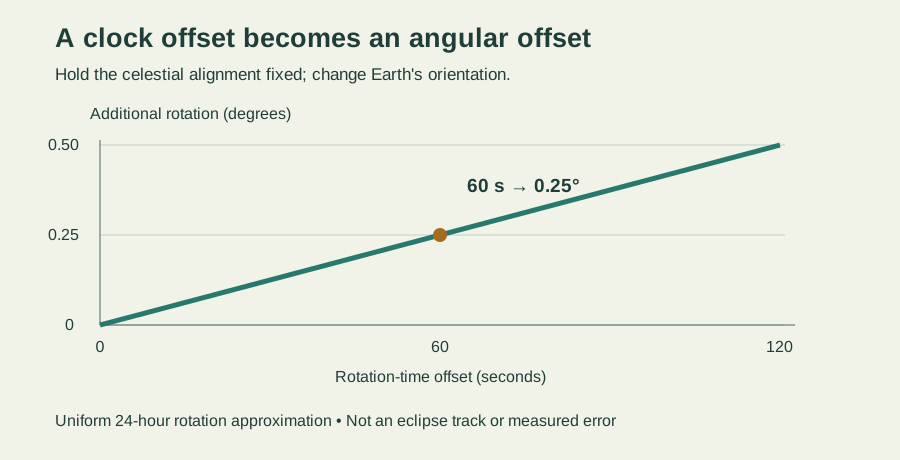
The model below shows one consequence. Keep the Sun and Moon’s alignment fixed, but turn Earth a little farther or less far. A different east–west location, or longitude, now faces the shadow. This does not necessarily mean the alignment happened later in space. It means the conversion between an orbital clock and Earth's orientation has changed.
Explore the approximation
The last refinement is a landscape
Even excellent positions do not make the Moon a smooth ball. Mountains and valleys along its apparent edge change when the last sunlight disappears. For the 2017 eclipse, NASA visualizer Ernie Wright combined lunar elevation data from the Lunar Reconnaissance Orbiter with Earth's terrain data. This produced a changing shadow boundary rather than a perfectly smooth ellipse. NASA describes the terrain-aware calculation.
The accompanying NASA animation shows why finer measurements still matter after the broad path is already known. A map for travelling across a continent and a prediction of the final seconds at one observing site demand different levels of detail.
Prediction is not eye protection. For direct viewing whenever any bright part of the Sun remains visible, use a safe solar viewer; ordinary sunglasses are unsuitable. Never use eclipse glasses to look through binoculars or a telescope. Follow NASA's complete viewing guidance.
That strip of darkness on a map is therefore more than an astronomical appointment. It is a compact record of observations, tested mathematics, careful clocks and measured landscapes. Each particular eclipse arrives once. The knowledge that lets us wait in the right place has been assembled across generations.
EXPLORE THE IDEA
What if Earth's rotation clock is offset?
Zero is the reference, not a claim that real delta-T is zero. A change in orientation changes which longitude lies beneath a fixed direction in space.
Scroll the diagram sideways to see every label.
Illustrative uniform rotation: 360° in 24 hours; angle = seconds ÷ 240. Positive means additional eastward rotation, negative means less. This is not a delta-T forecast, an eclipse path, or a local timing calculator. Celestial alignment is held fixed; orbital motion, terrain and precise Earth-orientation conventions are omitted. No animation.
YOUR PERSPECTIVE
Join the discussion
What surprised you? Have a question or a correction? Share your thinking.
No comments yet. Start the conversation.
Sign in with ChatGPT to commentAnyone can read the discussion. Sign-in helps limit spam.