
The kitchen is quiet. You have put away your phone and started washing a cup. Then a chorus arrives, complete with the singer's phrasing. A few moments later, the same bit starts again. You did not press play. You may not even like the song very much.
The everyday name is an earworm. Researchers call music that comes to mind without a deliberate decision to recall it involuntary musical imagery. “Imagery” here means an experience in the mind, not a picture. An earworm usually involves remembered music repeating, rather than sound still travelling from a speaker. A 2014 study describes this ordinary form of spontaneous musical recall.
The best-supported answer is not that a song has become physically trapped. Recent listening, familiarity and reminders can make musical memories return without an intentional search. Explaining why one fragment keeps returning is harder than explaining how it first arrived. Those are related questions, but they are not the same question.
A reminder without a request
Imagine hearing a short jingle several times during a journey. Later, a phrase in a conversation resembles its words, and the tune returns. This is an illustrative example, not a reported participant's story. The important distinction is between choosing to remember and encountering something that brings a memory to mind.
In a study published in 2012, Victoria Williamson and colleagues classified accounts from radio listeners and an online survey. The circumstances included musical exposure, memory reminders, emotional states and periods of low attention. People's reports supplied clues about beginnings, not a recording of the process inside their brains. Someone can notice what happened before an earworm without proving what caused it. Read the study record and abstract.
Experiments can go further. Timothy Byron and Lucinda Fowles played participants an unfamiliar song either twice or six times, then sampled their experiences over three days. More exposure produced more reports of the tune returning involuntarily. Because the researchers changed the amount of listening, this is stronger evidence for an effect of repetition than a survey association alone. It does not mean that six hearings are a universal threshold. The study reports the repetition and recency experiment.
The experiment gives the kitchen scene a testable prediction: more encounters with a song can increase its chance of returning later. It does not tell us exactly when it will return, or promise that every listener will have the same experience.
Why does the fragment go round again?
A song is an ordered sequence. In one proposed account, remembering a small part can help bring the next part to mind because the parts have been learned together. A reminder starts the sequence; relationships within the remembered music help carry it onwards.
Music researcher Emery Schubert developed this idea in a 2023 theoretical paper. He proposed that repetition already present in music can help explain repetition in the mind. That is a hypothesis about remembered connections, not a measured neural loop. Read the proposed account.
But explaining why phrase A brings back phrase B does not establish why the mind returns to A instead of continuing through the song. Researchers still need better evidence about what people repeat and how repetition unfolds. A circular diagram alone cannot close that gap.
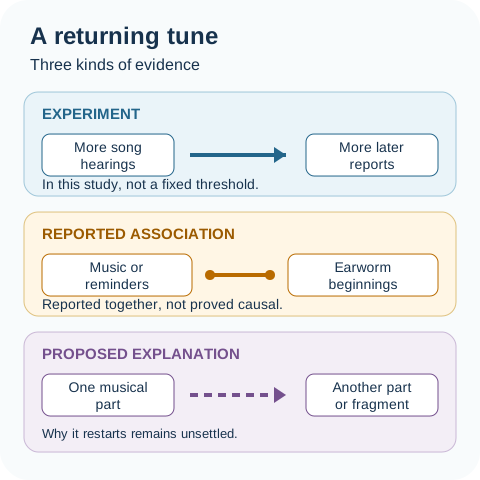
A returning tune: three different kinds of evidence
More hearings of an unfamiliar song
↓ increased in this studyMore later reports of that tune
No universal number of hearings.Music, reminders or low-attention moments
— reported around —Earworm beginnings
A reported trigger is not proof of a cause.One remembered musical part
⇣ may help bring to mindAnother part or a repeated fragment
Why a fragment keeps restarting is not fully established.Three evidence levels are compared. An experiment links additional listening with more subsequent earworm reports. Everyday reports associate earworm beginnings with music and reminders. A proposed memory model connects musical parts, but does not settle why a fragment repeats.
Schematic evidence map, not a brain scan or neural circuit. The solid arrow marks an experimental comparison, the line without an arrow marks a reported association, and the dashed arrow marks a proposed explanation.
Sources: Byron and Fowles: repetition experiment; Williamson and colleagues: reported circumstances; Schubert: proposed memory account. Original diagram by The Daily Wonder.
Another clue comes from experiments involving the movements used for speech. In 2015, C. Philip Beaman and colleagues found that chewing gum reduced reported musical recollections in laboratory tasks. Their results supported a connection between planning mouth movements and music appearing in awareness. That makes silent musical experience look less separate from the machinery used to produce sounds. Read the experiment's abstract.
But a task that interferes with an experience does not, by itself, identify its complete mechanism. This is evidence about a possible component of mental replay, not a guaranteed remedy or a reason to prescribe anything.
Is there an earworm recipe?
Some songs appear to return more readily than others. To investigate, Kelly Jakubowski and colleagues collected tunes named by 3,000 survey participants. Songs with greater chart success and more recent chart appearances were reported more often. Popularity, however, also means more opportunities to hear a song.
The researchers then compared 100 frequently named earworm songs with 100 songs not named in that survey, matched for popularity and style. The earworm group tended to be faster. Its melodies also combined relatively common overall shapes with less usual patterns in the steepness of rises and falls between turning points. The published paper explains the matched comparison.
Think of tracing a melody's movement up and down with your finger. Its broad outline can resemble familiar tunes while particular stretches move differently. That picture explains the kind of comparison the researchers made; it is not a formula for composing an irresistible chorus.
The study concerned a particular set of songs and listeners. “Not named” did not mean “incapable of becoming an earworm”. Nor did statistical differences establish that a faster tempo alone causes a song to repeat in your head.
More than a vague impression
The inner version can preserve surprisingly specific information. A 2024 study asked 30 volunteers to respond to prompts during a week and sing music they were experiencing in their heads. After exclusions, the pitch analysis used 132 recordings from 24 people.
About 45 percent matched the original recording's musical key after accounting for octave differences and rounding to the nearest semitone. The comparison measured pitch: how high or low notes sound. A semitone is the step between neighbouring piano keys, including the black keys. This measured memory accuracy, not merely people's confidence that their inner music sounded faithful. The open paper reports the recordings and analysis.
It does not mean that nearly half of people possess perfect pitch. These were recordings, not a population survey of that ability. Remembering a familiar song's pitch is also different from naming any isolated note. The small, self-selected sample and the difficulty of singing an internal experience limit what we can conclude.
A recording is one step removed
An uninvited guest need not be unwelcome
The phrase “stuck in your head” makes every episode sound irritating. Yet the 2014 analysis of people's accounts found many neutral or pleasant experiences, alongside unwanted ones. Repetition and a sense of lost control can be annoying, but an unsolicited musical thought is not automatically an unpleasant one. A six-person interview study also records both negative and positive evaluations.
Research has moved from collecting descriptions towards changing listening conditions and measuring what people reproduce. Each method answers a different question. Reports reveal the experience; experiments test contributing factors; sung recordings expose details of the memory. None alone supplies the entire explanation.
Back at the sink, the singer is still absent. What remains is a memory arriving without being summoned. Science can explain some of the conditions that invite it back. The small mystery is why, on this occasion, your mind chooses the same few seconds for an encore.
YOUR PERSPECTIVE
Join the discussion
What surprised you? Have a question or a correction? Share your thinking.
No comments yet. Start the conversation.
Sign in with ChatGPT to commentAnyone can read the discussion. Sign-in helps limit spam.