
In a study published in 2013, Trafton Drew, Melissa Võ and Jeremy Wolfe asked 24 radiologists to search medical images for lung nodules, small spots that may need medical investigation. In the final case, the researchers inserted something that did not belong in a lung scan: a gorilla.
Eighty-three per cent of the radiologists missed it. More unsettlingly, eye tracking showed that most of those who missed it had looked directly at its location. These were experienced observers doing familiar work. The published study’s abstract describes the experiment.
Keep three possible explanations in mind as we investigate: perhaps the object was hard to see; perhaps the observers lacked skill; perhaps looking and noticing are different achievements. The experiment challenges the first two without making the third a complete theory of consciousness. Its percentage belongs to this particular task and sample, not to everyday diagnostic error rates.
First suspect: the picture
Long before the radiology experiment, psychologists had a problem with their own evidence. Ulric Neisser and colleagues studied people watching overlapping, partly transparent activities. Observers concentrating on one activity could miss an unexpected event in the other. But perhaps those ghostly images were simply too strange to tell us much about ordinary seeing.
Daniel Simons and Christopher Chabris addressed that objection in their 1999 experiments. Alongside transparent displays, they used a scene of people passing basketballs without transparent overlapping images. While viewers counted selected passes, a person in a gorilla costume could move through the scene unnoticed. The surprise survived the removal of the ghostly display. Their original paper reports how task difficulty and similarity affected noticing.
This is what makes an experiment more useful than a trick. A trick astonishes you once. An experiment changes the conditions to ask which explanation survives.
Second suspect: the observer
The name for the failure is inattentional blindness: an unexpected, visible event goes unnoticed while attention is occupied elsewhere. “Blindness” here describes a failure of awareness in a task, not a diagnosis of an eye condition.
Concentration is doing something valuable. Following one conversation or tracking one team requires selecting relevant information among several sights or sounds arriving at once. The difficulty appears when something outside that selection turns out to matter. The instruction that makes the main task manageable can leave the unexpected event poorly served.
Simons’s researcher-written introduction also explains a quieter problem: we experience what we notice, while most unnoticed events never announce their absence. Our confidence therefore has an uneven evidence base. Remembering several surprising things we spotted does not tell us how many surprises passed undetected.
That makes “I would definitely have seen it” a prediction to test, not a reliable measurement of attention.
Change the question; keep the scene
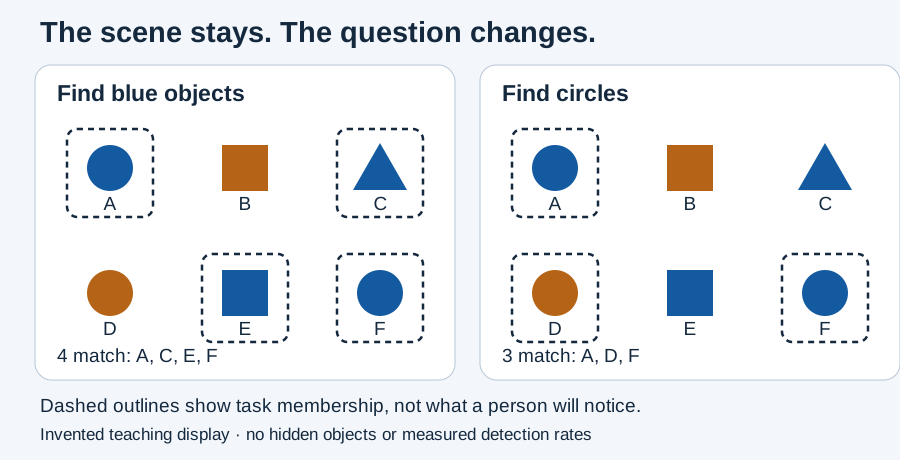
Now try a smaller thought experiment. A display contains blue and amber circles, squares and triangles. Ask one observer to follow the blue objects, another to follow the circles. A blue circle belongs to both tasks. An amber circle belongs to only one. The objects have not moved; their relevance has changed.
The interactive model below makes those rules visible. Choose a task and watch the outlines change. Nothing disappears. The point is to separate the contents of the scene from the selection rule applied to it.
This idea has experimental support. In work by Steven Most, Brian Scholl, Erin Clifford and Daniel Simons, people watched moving shapes under different instructions. An unexpected black circle was more likely to be noticed when it shared features with the shapes observers had been asked to follow. Yale’s demonstration page explains the conditions.
This attentional set is the collection of features or goals an observer is prepared to select. Brightness and novelty can matter, but “make it conspicuous” is not a universal recipe for entering awareness. Whether something draws attention and whether someone can later report noticing it are related but separate questions, explored in the team’s 2005 paper.
What the model can and cannot show
EXPLORE THE IDEA
Same scene, different question
Choose what the task asks you to find. All six objects stay visible; dashed outlines mark the ones that fit.
4 objects match: A, C, E, F.
D is a circle, but its amber colour excludes it from this task.
Invented, static teaching display. Outlines are explanatory annotations, not a simulation of vision or measured noticing rates. No timing, hidden object, animation or attention score. A and F are blue circles; B is an amber square; C a blue triangle; D an amber circle; E a blue square.
Third suspect: not knowing the trick
Perhaps one lesson is enough: learn about the gorilla, and become a better observer of everything. Daniel Simons tested a version of that hope in 2010. A new video included a gorilla and other events, including a curtain changing colour and a player leaving.
People familiar with the earlier demonstration consistently noticed the gorilla. That knowledge did not improve detection of the other events. The study distinguishes anticipating one surprise from noticing surprises generally.
Knowing the answer can change the task rather than solve the underlying limitation. You may become excellent at finding the thing you have been warned about while the next unexpected thing falls outside that preparation.
What the evidence does not let us conclude
Failure to report something does not, by itself, establish that the brain processed absolutely nothing about it. Researchers need to distinguish several things: processing visual information, directing attention, consciously noticing something and reporting it later. Measuring one does not automatically measure all the others.
A neighbouring phenomenon, change blindness, concerns missing a difference between one view and another. Inattentional blindness concerns missing an unexpected object or event. Simons describes that distinction in his research overview. Both can surprise us, but they need not have identical explanations.
Simons and Ronald Rensink’s review of change blindness explicitly warns against drawing extreme conclusions from striking demonstrations. A missed change is evidence about a particular failure; it is not permission to declare that vision is empty or that every confident observer is wrong.
The question here also differs from how memories become unreliable. Before asking whether a remembered event was reconstructed accurately, we must ask what became available to report in the first place.
Return to the radiologists’ task. The disturbing possibility is that a person can be working carefully, using real expertise, and still miss something outside the search they are performing. Looking at a place is one fact. Knowing what happened there is another. Between them lies the question that this story leaves open for every act of observation: what, exactly, were you looking for?
YOUR PERSPECTIVE
Join the discussion
What surprised you? Have a question or a correction? Share your thinking.
No comments yet. Start the conversation.
Sign in with ChatGPT to commentAnyone can read the discussion. Sign-in helps limit spam.