
Another person brushes a sensitive patch of skin and the touch can feel ticklish. Make a similar movement yourself, and much of that quality often disappears. Your skin has not switched off. What changes is the relationship between the touch and the action that produced it.
A leading explanation is that the brain has advance information about movements you make. It can use that information to predict some of the resulting touch and reduce its perceptual impact. Researchers call this reduction sensory attenuation. The sensation becomes less prominent; it does not vanish.
There is an important qualification. The light, sometimes itchy sensation called knismesis is not identical to gargalesis, the stronger tickling that can produce squirming and laughter. Much of the best-known self-touch research used light palm stimulation, taps or pressure. It gives strong evidence about how people perceive their own touch, but it does not completely explain every ticklish response. A 2025 review separates these questions.
A movement comes with advance information
When you voluntarily move a hand, the nervous system sends motor commands to the muscles. Information about those commands is also available to predictive processes in the brain. Researchers call this information an efference copy: a copy of an outgoing movement command, not a copy of the sensation itself.
An internal forward model uses this information, together with information about the body, to estimate what the movement will cause. If one hand is approaching the other, the model can predict contact, including where and when it is likely to happen.
When the incoming touch corresponds closely to that prediction, its perceptual impact can be reduced. Someone else's movement does not provide the brain with the same copy of your own motor command. Their touch therefore lacks this particular route to attenuation. Seeing another hand approach is not equivalent to producing the movement yourself.
One experiment separated moving yourself from being moved. In 2020, researchers made a touch on one index finger follow either an active movement or a passive movement of the other hand. The touch felt weaker after the active movement, but not after the passive one. In this task, the outgoing motor command mattered beyond the mere fact that two body parts moved towards each other. Read the study in iScience.
A matching prediction can soften self-generated touch
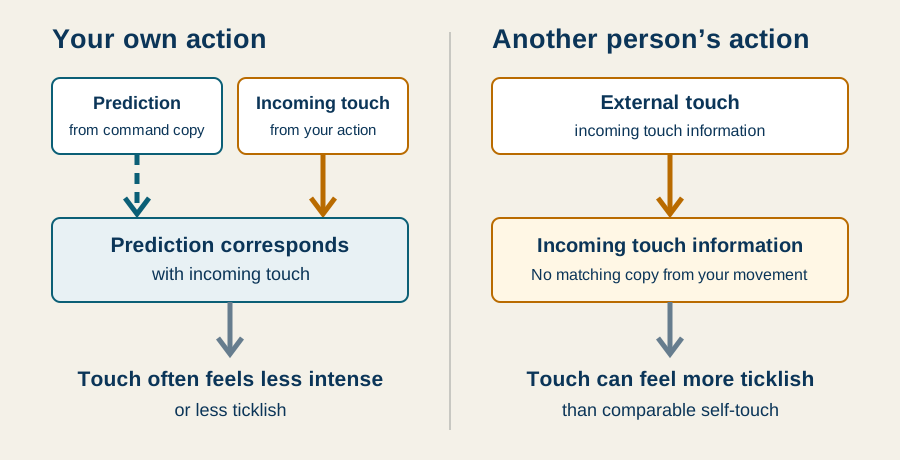
The motor-command copy informs a prediction; it is not the prediction or the touch itself.
Your own action
Another person’s action
No matching command copy from your own movement
In the first panel, predictive information from a copy of the command that moved your own hand meets incoming touch information. When the two correspond, the touch can be perceptually attenuated. In the second panel, externally produced touch arrives without that matching copy from your own movement, so this particular attenuation route is unavailable.
Sources: Blakemore, Frith and Wolpert (1999); Kilteni, Engeler and Ehrsson (2020). Limitation: Kilteni (2025).
The robot that changed the timing
Sarah-Jayne Blakemore, Chris Frith and Daniel Wolpert tested the prediction account with two linked robotic devices. Participants moved one device with the left hand. The other delivered a tactile stimulus to the right palm. The arrangement let the researchers alter the relationship between an action and its consequence without taking the initiating movement away from the participant.
Their 1999 paper reported that delaying the resulting touch made it feel more ticklish. Changing its movement direction also increased ticklishness ratings. The participant still started the action, but the resulting sensation no longer matched it as closely. This is more specific than saying that movement merely distracts a person from touch. The researchers changed the action-to-sensation relationship and observed the experience change with it. Read the original paper.
The brain can also adjust. In a 2019 study, repeated exposure to delayed self-touch shifted the timing at which attenuation occurred. Participants began to attenuate the delayed touch more and the immediate touch less. The prediction is therefore not a permanent stopwatch setting. It can be updated by experience. Read the eLife study.
Where the cerebellum enters the story
Behavioural experiments reveal what changes a sensation. Brain imaging asks which neural processes accompany that change.
In 1998, Blakemore, Wolpert and Frith used functional magnetic resonance imaging to compare self-produced and externally produced tactile stimulation. External touch produced stronger activity in the somatosensory cortex, regions involved in processing bodily sensation. They also found a pattern of activity in the cerebellum, a structure at the lower back of the brain, that was consistent with predicting the consequences of movement. Read the Nature Neuroscience study.
The cerebellum is therefore an important candidate in this account. It is not a single tickle switch. A later study found that stronger perceptual attenuation was associated with stronger functional coupling between cerebellar and somatosensory regions. Here, coupling means a statistical relationship between their activity, not a cancellation message seen travelling along one wire. Read the 2020 imaging study.
A 2024 study also observed changes in somatosensory and cerebellar activity while people adapted to delayed self-touch. Together, these findings support the cerebellum's involvement in prediction and updating. Imaging alone, however, cannot establish every step in the proposed mechanism or show that one structure acts independently of the rest of the brain. Read the Communications Biology study.
Why this is not the whole tickling story
A weaker touch and a less ticklish touch are related observations, but they are not interchangeable measurements. A faint tap may never have been ticklish. Laughter-inducing tickling also involves more than judging pressure on a fingertip.
The 2025 review argues that experiments designed specifically around gargalesis are still needed before predictive attenuation can be said to explain why that stronger form is difficult to produce on oneself. That gap does not overturn the evidence for motor-based prediction in ordinary self-touch. It sets a boundary around the claim.
Other results reveal extra complexity. A 2022 study found that touching oneself while another person tickled could reduce the externally produced ticklishness. Self-contact produced more suppression than making the movement without contact. The experience therefore depends on more than a simple label of “me” or “someone else.” Read the study.
People also differ, and body location matters. Research published in August 2026 collected reports from 448 participants across Chinese, Dutch and Greek groups. Their body maps showed shared patterns of ticklishness, but those patterns differed from maps of touch sensitivity, pain and pleasure. No single theory in the study fully explained the map. Because this was a questionnaire-based mapping study, it did not test the neural cause of self-touch suppression. Read the Nature Human Behaviour study.
The best everyday answer is narrower, and more interesting, than “the brain ignores its own touch.” Your actions supply information that can help the brain predict and soften some sensory consequences. Change the timing or relationship, and the experience can change. Why some touches grow into a full tickling response, and why that response varies so much, remains open.
Why there is no ticklishness slider here
YOUR PERSPECTIVE
Join the discussion
What surprised you? Have a question or a correction? Share your thinking.
No comments yet. Start the conversation.
Sign in with ChatGPT to commentAnyone can read the discussion. Sign-in helps limit spam.