
On 12 September 2001, psychologists Jennifer Talarico and David Rubin asked 54 Duke University students to record how they had first heard about the previous day’s attacks. The students also described a recent everyday event. Researchers returned to these accounts after intervals of one, six or 32 weeks.
The striking result was not that the extraordinary event vanished. It was that the special feeling attached to its memory survived better than consistency did. Details changed in both kinds of account, but confidence and vividness remained stronger for the emotionally charged memories. Their 2003 paper carefully separates these measurements.
Consistency with an earlier report is not a perfect measure of historical truth: the first report could contain mistakes too. Nevertheless, the experiment exposes a distinction that matters well beyond exceptional events. The feeling that a memory is clear is itself something to explain, not a certificate that every detail is correct.
What gets kept in the first place?
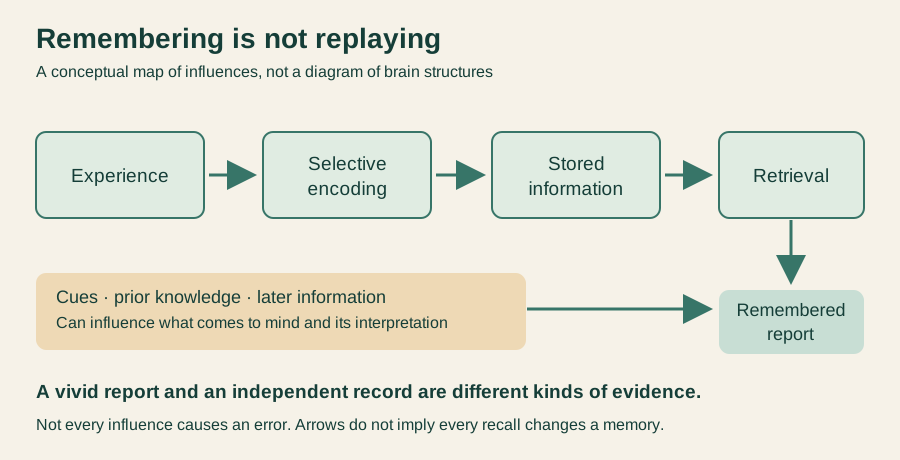
Psychologists distinguish encoding, taking information in; storage, maintaining it over time; and retrieval, bringing it back into use. These are interacting processes, not three sealed compartments. A retrieval cue, something that prompts a memory, works partly because of what we noticed during the original experience. A familiar place or phrase can be such a cue. Memory researchers Kathleen McDermott and Henry Roediger explain this framework.
Encoding is selective. Consider an ordinary, hypothetical encounter: you stop to ask someone for directions. You may concentrate on the turn after the bridge, barely noticing the speaker’s bag. Later, failing to describe that bag need not mean a detailed image was stored and subsequently erased. It may never have received much attention.
Remembering is therefore unlike replaying a complete recording. Knowledge and cues help assemble a useful account from what is available. That flexibility supports understanding, but an account can make sense even when some of its details came from somewhere other than the original event.
A word that was never there
A simple demonstration uses lists of related words. Researchers present associates of a common word while deliberately leaving that central word out. Later, people can recall or recognise the missing word as though it had appeared.
In a 1999 study, Michael Stadler, Henry Roediger and Kathleen McDermott tested 36 such lists. Their published norms showed a large variation between lists: some missing words were much more likely to be reported than others. The effect is not a universal error rate for human memory, and a list experiment does not tell us whether a particular autobiographical recollection is true.
The important experimental advantage is that the researchers know exactly what was presented. They can compare a report with a controlled record rather than settling a disagreement between two recollections. The missing word fits the meaning of the list; fitting the meaning is not the same thing as having been encountered. This is one reason an entirely sincere report can still be mistaken.
Knowing something, but losing its address
Another question follows: where did a remembered detail come from? Was it seen, read, heard from a friend, or imagined while trying to understand the situation?
Marcia Johnson, Shahin Hashtroudi and D. Stephen Lindsay’s 1993 source-monitoring framework describes how people judge a detail’s source from what the memory feels like and what they know about the situation. Familiarity alone does not provide a dependable label identifying its origin.
Imagine, as a simple illustration, hearing a colleague describe a red delivery van. Later you remember “red van” while recalling your own walk past the building. The detail is familiar, but the question is whether you actually saw it. Mistaking the source can turn information acquired afterward into an apparent part of the earlier event. This is not necessarily a lie: the person making the report may be doing their best to identify what they remember.
Later information can enter the story
Experiments on the misinformation effect introduce incorrect information after an event and then test memory. In work discussed by researchers Cara Laney and Elizabeth Loftus, participants saw an intersection with a stop sign, then some encountered a question suggesting a yield sign. Subsequent reports could favour the suggested detail. Their account explains the experimental logic.
The lesson is narrower, and more useful, than “memory cannot be trusted.” A later question is not always a neutral window into the past: its wording may supply information. Agreement between people who have discussed an event is also not automatically independent evidence that the memory is correct. The people may have picked up the same suggested detail from one another. These findings do not establish that every suggestion succeeds or that an outsider can diagnose a specific memory as false just by hearing it.
Saying yes is a decision too
Recognition involves another distinction: the available evidence versus the willingness to accept it. John Wixted’s account of signal-detection theory describes decisions made when evidence for different possibilities overlaps. A person chooses a criterion, a threshold for answering yes.
Our interactive model makes that tradeoff visible with invented evidence scores. Lowering the threshold accepts more previously encountered items, but also more new ones. Raising it rejects more new items, while missing more old ones. No information has been added merely by moving the threshold. The model illustrates a decision principle; it is not a memory test, a brain measurement or a reconstruction of the experiments above.
What the model counts
The practical intellectual habit is to separate questions that feel like one: What do I recall? How did I learn that detail? What independent record could check it? A dated note or original message is not infallible either, but it offers evidence beyond the strength of a feeling. This is a method of checking claims, not a diagnosis of anyone’s memory.
Remembering remains indispensable. The interesting discovery is not that we possess a broken recording device. It is that we do not possess a recording device at all. Understanding the difference lets us treat both our memories and other people’s accounts with greater care.
EXPLORE THE IDEA
When do you say: I have seen this before?
90%Hits · old items accepted
25%False alarms · new items accepted
10%Misses · old items rejected
75%New items correctly rejected
Lower the threshold: more hits, but more false alarms. The overlapping evidence has not become more informative.
Scroll the diagram sideways to see every label.
Synthetic decision model, not measured memory performance. Two fixed groups of 100 items; evidence scores 0–6 are arbitrary units, not brain signals. Accept an item when its score is at least the threshold. All proportions are within their own group. A threshold of 7 rejects everything. Changing the threshold changes decisions, not stored information. No animation.
YOUR PERSPECTIVE
Join the discussion
What surprised you? Have a question or a correction? Share your thinking.
No comments yet. Start the conversation.
Sign in with ChatGPT to commentAnyone can read the discussion. Sign-in helps limit spam.