
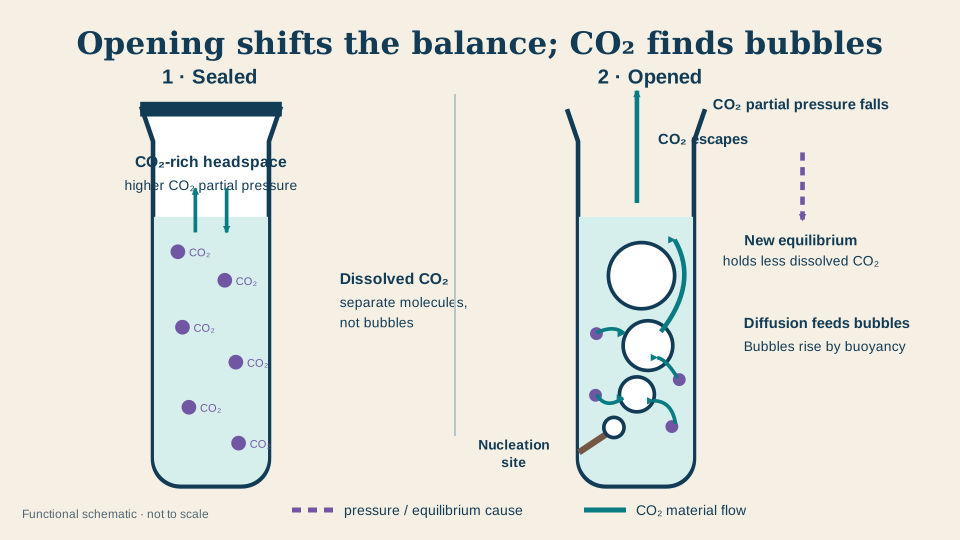
The hiss begins before you see the stream of bubbles. Twist a cap or pull a tab and gas in the space above the drink rushes out. Within moments, bubbles appear on the container and climb through the liquid. The carbon dioxide was already there, but most of it was not waiting as visible bubbles.
In a sealed fizzy drink, many carbon dioxide molecules are dispersed among the liquid's molecules. They are dissolved, much as sugar can be dissolved without remaining as grains. A gas bubble is different: it is a pocket containing many gas molecules, separated from the liquid by a surface. Opening the container changes which state the carbon dioxide tends to occupy.
A sealed bottle holds a balance
Manufacturers add carbon dioxide while the drink is in contact with carbon-dioxide-rich gas under pressure. Some molecules enter the liquid and some leave it. In a closed container at steady conditions, those opposing movements can reach dynamic equilibrium: molecules still cross the liquid surface in both directions, but the average dissolved amount stays roughly constant.
The relevant gas pressure is not simply the total pressure above the liquid. It is the partial pressure of carbon dioxide, the part of the total pressure contributed by CO₂. Henry's law says that, for an ideal dilute solution at a fixed temperature, the equilibrium concentration of a dissolved gas is proportional to that gas's partial pressure above the liquid. OpenStax explains the law and uses an opened carbonated drink as an example.
This distinction matters. A sealed bottle has a carbon-dioxide-rich headspace, the gas-filled space above the drink. After opening, the drink is exposed to air whose carbon dioxide partial pressure is far lower. The total atmospheric pressure is not zero, but ordinary air cannot maintain the former dissolved-carbon-dioxide equilibrium.
Opening moves the target
When the seal breaks, compressed headspace gas expands and escapes. The carbon dioxide partial pressure over the liquid falls sharply. The liquid still contains approximately its sealed-bottle amount of dissolved CO₂ at that first moment, so it now contains more than the new equilibrium can retain. Chemists call this state supersaturated.
The drink does not shed all that excess gas instantaneously. Some carbon dioxide escapes directly through the exposed liquid surface; some enters gas pockets that grow into bubbles. In both routes, molecules must travel before the drink can reach its new balance. The new equilibrium is a destination, not an immediate command.
Keep the cause separate from the material movement. A pressure change shifts the equilibrium. Carbon dioxide then has to travel as dissolved molecules feed bubbles and the bubbles carry gas upward.
A bubble needs a beginning
Making a brand-new bubble in perfectly uniform liquid costs energy because the liquid must create a new gas-liquid surface. Surface tension, the tendency of that surface to contract, makes a tiny bubble especially difficult to sustain. Existing microscopic gas pockets make the start easier. Scratches, particles and tiny hollow fibres can hold such pockets. A site that makes bubble formation easier is called a nucleation site.
This is why streams of bubbles often return to the same points on a glass. Researchers have modelled carbon dioxide diffusing into gas pockets trapped in cellulose fibres, which then release repeated bubbles. Their work does not imply that every bubble starts on cellulose; several kinds of surface cavity or particle can provide a starting pocket. The nucleation study identifies the trapped-pocket mechanism and its variables.
What researchers can measure
Dissolved molecules feed a growing bubble
Once a gas pocket is suitable for growth, nearby dissolved carbon dioxide can move into it. This spreading caused by molecular motion is diffusion. The bubble grows as it receives gas. Magnetic-resonance measurements in carbonated beverages show that the diffusion of dissolved CO₂ is an important part of bubble growth. The study measured that diffusion in several drinks.
A sufficiently large bubble is less dense than the surrounding liquid, so the surrounding liquid's upward lift, called buoyancy, carries it upward. While rising, it can continue receiving carbon dioxide from the supersaturated drink. At the surface it bursts or joins foam, and its gas reaches the atmosphere. Rising bubbles also stir liquid, bringing new dissolved CO₂ towards bubble surfaces and helping the drink lose gas.
One gas pocket can start a whole stream
After opening, the liquid is supersaturated with carbon dioxide.
1A pocket is already there
Glass wall and liquid. A suitable crevice holds trapped gas; purple dots symbolise dissolved CO₂.
2Dissolved gas joins it
Net CO₂ transfer into gas. Diffusion feeds the attached bubble. Arrows show material transfer, not force or liquid flow.
3The bubble rises; a pocket stays
Bubble motion upward. Buoyancy lifts the detached bubble. A smaller starting pocket can remain for another cycle.
The same wall crevice is shown at three later stages. First it holds trapped gas while separate carbon dioxide molecules remain dissolved in the surrounding liquid. Next, teal arrows point from the liquid into the pocket to show net molecular transfer, enlarging an attached bubble. Finally, the bubble has detached and moves upward, while gas left in the wall-connected crevice can begin another cycle. The gold arrow shows bubble movement, not molecular diffusion. Geometry, molecule symbols and intervals are schematic.
Not to scale. Dots do not show molecule counts or concentration, and the panels do not show bubble timing. Only suitable gas pockets support growth; bubbles can also form away from the glass wall.
Original explanatory schematic by The Daily Wonder, based on Physics Today’s bubble-growth account and research on bubble nucleation in carbonated liquids.
This sequence explains the visible fizz: a pressure change makes the old dissolved amount out of balance; nucleation sites provide beginnings; diffusion feeds the bubbles; and buoyancy carries gas upwards. A scientific review of sparkling drinks describes the corresponding stages of nucleation, ascent and growth, and bursting at the surface. The review follows a bubble through those stages.
Shaking changes the route, not the inventory
Shaking a closed drink does not manufacture extra carbon dioxide. It redistributes gas and liquid, breaks larger pockets into smaller ones, and can leave many gas pockets attached around the container. When the bottle is opened, those ready-made interfaces can grow at once. Rapid bubble growth and rising bubbly plumes mix the liquid and can carry it out as foam.
That is why a recently shaken bottle may gush even though it contains no more total CO₂ than it did before shaking. The difference is how quickly the existing carbon dioxide can gather into bubbles and escape. Fluid-mechanics experiments distinguish diffusion-driven bubble-cloud growth from the later buoyancy-driven motion that accelerates mixing. Physics Today explains these coupled stages in bubbly drinks.
Temperature, ingredients and the container also matter. At a fixed carbon dioxide partial pressure, warming generally reduces how much carbon dioxide water can retain at equilibrium. Viscosity and surface-active ingredients can change bubble growth and foam lifetime. Roughness and particles change the available nucleation sites. A gently opened cold drink and a warm shaken one therefore need not fizz alike.
From fixed air to controlled fizz
In 1772, Joseph Priestley published Directions for Impregnating Water with Fixed Air, using the period's name for carbon dioxide. The Wellcome Collection preserves a record and digitised copy of the original publication.
Today's bottle performs the complementary trick. It stores a drink under a carbon-dioxide-rich headspace, then lets the pressure condition change when you open it. The bubbles are not the carbon dioxide suddenly coming into existence. They are dissolved molecules finding gas pockets, joining them, rising, and leaving because the opened drink is moving towards a new equilibrium.
YOUR PERSPECTIVE
Join the discussion
What surprised you? Have a question or a correction? Share your thinking.
No comments yet. Start the conversation.
Sign in with ChatGPT to commentAnyone can read the discussion. Sign-in helps limit spam.