
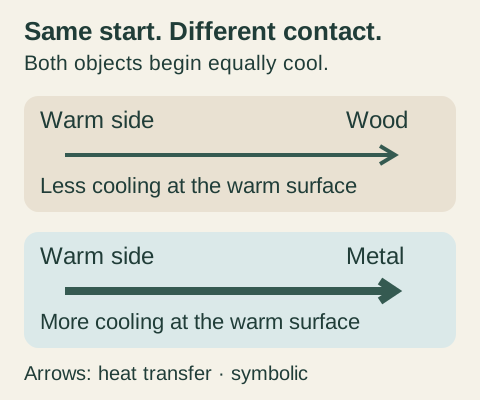
Imagine a spoon beside a wooden chopping board in a quiet kitchen. Neither has been near the cooker or the fridge. The room has stayed at the same temperature for hours. Yet when a hand meets them, the spoon delivers a little shock of cold while the board feels almost welcoming.
Suppose careful temperature measurements, taken before either object is touched, agree: both are 20°C. Nothing has gone wrong with the instruments. The hand is responding to something the two temperature readings leave out: what happens when warm skin meets each surface.
Metal usually feels colder because it draws heat from warmer skin more readily during contact. The object's starting temperature matters, but so does its response to receiving that heat.
The hand changes the scene
Objects that have settled into the same thermal surroundings can reach the same temperature. Physicists call this thermal equilibrium. There is then no net heat transfer driven by a temperature difference between them. OpenStax uses the different feel of wood and metal to explain why sensation alone cannot establish temperature.
Touching introduces a new participant. Your skin is usually warmer than ordinary room-temperature objects, so energy flows from skin into the object. The transfer of thermal energy because of a temperature difference is heat. There is no substance called cold travelling from the spoon into your fingers.
The exchange changes both sides. Skin near the contact cools; material near it warms. The important action begins in these surface regions, rather than throughout the entire spoon or chopping board at once.
Follow the warmth away from the surface
Picture a small patch of the spoon beneath a fingertip. Energy arrives there from the skin. Metal conducts that energy into the surrounding material effectively, allowing more of the spoon to participate in the exchange.
Wood carries energy away less effectively. Its contact region can become relatively warm while the deeper wood remains close to its original temperature. That warmer contact region produces less cooling of the skin than the metal does.
This is why saying only “metal conducts heat well” gets the answer started but leaves part of it missing. The receiving material must also absorb energy while its temperature changes. The amount needed to warm one kilogram by one degree is called its specific heat capacity. The University of Tennessee explains both heat spreading away from a contact layer and the energy needed to warm that layer.
Density matters too: the same volume can contain different amounts of material. A surface's response therefore combines how well energy spreads with how much energy the participating material takes to warm up.
One property brings those effects together
The combined quantity is thermal effusivity. In an ideal early-contact model, it describes how strongly a material exchanges heat with another material at a different temperature.
Effusivity combines thermal conductivity, density and specific heat capacity. A high value gives the material more influence over the temperature where the two surfaces meet. Purdue University's heat-transfer explanation explicitly distinguishes this contact response from conductivity alone.
For ordinary metal and wood below skin temperature, the metal's higher effusivity keeps the contact temperature closer to the metal's cool starting temperature. Low-effusivity wood lets that temperature sit closer to the skin's warm starting temperature. The skin therefore undergoes different cooling even though the objects began together at 20°C.
Same starting temperatures, different contact
In both examples, the warm side starts at 32°C and the object at 20°C. These are illustrative inputs, not measured skin or material properties.
Lower-response object
Object / warm-side effusivity: 0.5
Warm side → object
Arrow: heat transfer, not cold flow.
Ideal contact: 28.0°C
The contact stays closer to the warm side’s starting temperature. Its surface cools less.
Higher-response object
Object / warm-side effusivity: 10
Warm side → object
Arrow: heat transfer, not cold flow.
Ideal contact: 21.1°C
The contact stays closer to the object’s cool starting temperature. The warm-side surface cools more.
Schematic, not to scale. Only the local interface shares this temperature; neither whole body instantly reaches it. Perfect contact and effectively thick, uniform bodies are assumed.
Source: Jain (2023), early-contact equations. Original diagram by The Daily Wonder.
The “meeting temperature” is local. It is not a claim that every part of your hand and the entire object instantly reaches one temperature.
A small calculation makes the difference visible
Consider an illustrative model, not measurements of a particular person or spoon. Let the skin start at 32°C and both objects at 20°C. Give skin an effusivity of 1,200, wood 600 and metal 12,000, all in the same standard units: joules per square metre per kelvin per square root of a second.
The contact temperature is a weighted average. The skin and wood receive weights of 1,200 and 600, so skin has twice the influence. The result is (1,200 × 32 + 600 × 20) ÷ 1,800 = 28°C.
For metal, the object's weight is ten times the skin's. The result is (1,200 × 32 + 12,000 × 20) ÷ 13,200 = about 21.1°C. Identical starting object temperatures have produced very different ideal contact temperatures.
Ankur Jain's heat-transfer paper gives this relationship and examines where it stops working. The calculation assumes perfect contact and bodies thick enough that their distant boundaries have not yet affected the exchange. A thin spoon and a living fingertip only approximate that picture.
The equation behind the example
Real surfaces and real senses add detail
Even apparently smooth surfaces do not meet perfectly. Tiny gaps reduce the actual area through which heat passes. Research on the finger–object interface shows why roughness and contact force matter. The resistance at that boundary can even leave the two immediate surfaces at different temperatures, unlike the single meeting temperature in our ideal calculation.
Wood also varies. Its moisture content, density and grain direction affect heat conduction, as the US Forest Service's Wood Handbook documents. “Wood” is a family of materials, not one exact thermal number.
Nor is a fingertip a passive block. It contains layers of living tissue. Research modelling skin thickness and contact resistance shows that these affect the temperature changes reaching its temperature-sensitive nerve endings. The calculated interface temperature is therefore not a direct prediction of what someone will report feeling.
Those nerves respond to conditions in the skin. Recordings from human sensory nerve fibres show responses to cooling. The nervous system does not inspect a spoon's undisturbed temperature from a distance; contact has already changed the thermal situation it is sensing.
Back in the kitchen, the spoon and board can still have begun at exactly the same temperature. The difference appeared when the hand joined them. The spoon's coolness is the experience of an exchange: warmth leaving the skin, with the material helping determine how that exchange unfolds.
EXPLORE THE IDEA
Change the contact, not just the temperature
Keep the object at 20°C and increase its thermal response. The contact temperature moves toward the object’s starting temperature. Set the object to 32°C to remove the temperature difference, or above 32°C to reverse heat transfer.
Ideal contact temperature: 28.0°C
Warm-side surface change: -4.0°C
Heat transfer: warm side → object
15°C35°C
The warm side always starts at an illustrative 32°C. A ratio of 0.5 represents the article’s low-response example; 10 represents its high-response example. These are teaching inputs, not exact wood or metal properties.
How the calculation works
Contact temperature = (32 + ratio × object temperature) ÷ (1 + ratio). The ratio compares effusivities: a combined response involving conductivity, density and heat capacity. Temperatures are in °C. This ideal contact temperature does not drift with time; a real finite object needs a more detailed model.
Source: Jain, International Journal of Heat and Mass Transfer (2023), equations 1–2.
Illustrative early-contact model, not measurements or a safe-touch calculator. Two uniform, thick bodies; constant properties; perfect contact; no tissue layers, blood flow, coatings or surface gaps. The result is local contact temperature, not whole-body equilibrium or a sensation rating.
YOUR PERSPECTIVE
Join the discussion
What surprised you? Have a question or a correction? Share your thinking.
No comments yet. Start the conversation.
Sign in with ChatGPT to commentAnyone can read the discussion. Sign-in helps limit spam.