
A bowl of bread dough can seem almost still. Then its surface rounds upward, small blisters appear under the skin, and the mass becomes larger and lighter in texture without anyone pumping air into it. The change is real enough to measure, yet no single ingredient can explain it.
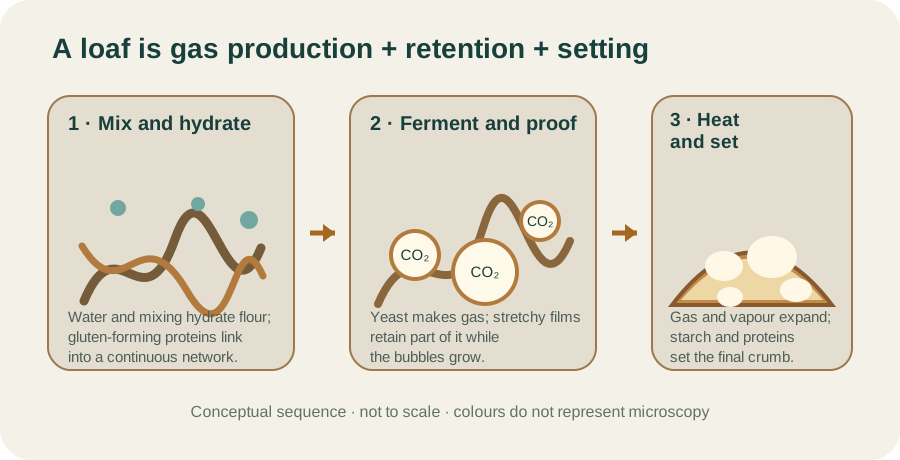
The familiar answer, “yeast makes bread rise”, is only the beginning. Yeast supplies carbon dioxide. The dough must also create bubbles, hold them while they enlarge, and become rigid before they escape. Bread rises because living microbes make gas, the dough’s protein network holds it, and heat sets the expanded structure.
Bread before anyone knew about microbes
People were processing grains long before they could see a yeast cell. Charred fragments from Shubayqa 1 in northeastern Jordan provide direct evidence of bread-like food made by hunter-gatherers about 14,400 years ago, at least four millennia before agriculture became established in the region. Microscopy showed carefully processed wild cereals and tubers, but the fragments were probably unleavened flatbreads. The peer-reviewed PNAS study describes the evidence and its limits.
Leavened bread, bread raised by gas bubbles, could be made without understanding fermentation, the process in which microbes break down sugars and release products such as gas. Flour and water naturally encounter microbes, and a portion of active dough can seed the next batch. The explanation came much later. Between 1857 and 1862, Louis Pasteur’s experiments helped establish that alcoholic fermentation was the work of a living organism, overturning the idea that it was merely chemical decay. Institut Pasteur traces that research.
Today’s baker’s yeast is commonly Saccharomyces cerevisiae, a single-celled fungus. It is not a chemical powder that simply releases gas on contact with water. It is a living system using sugars for energy. UC Davis’s Phaff Yeast Culture Collection explains what yeasts are.
Where the gas comes from
Flour contains a great deal of starch, but yeast cannot consume an intact starch granule as if it were a spoonful of sugar. Enzymes, proteins that help chemical reactions proceed, include amylases, which cut starch molecules into smaller sugars. Flour supplies some fermentable sugars already, and its enzymes continue making more as the hydrated dough rests. The balance matters: too little enzyme activity can limit the sugar supply; too much can weaken dough quality. University of Maine Extension explains this grain-to-dough connection.
In dough, yeast uses those sugars for energy and produces carbon dioxide and ethanol, a form of alcohol. The overall alcoholic-fermentation reaction is often written as glucose becoming two molecules of carbon dioxide and two of ethanol, plus released energy. Real dough is less tidy: oxygen availability changes, sugars differ, cells grow, and many minor products contribute aroma. The equation is a carbon ledger, not a full description of a bakery.
Some carbon dioxide dissolves in the dough’s water; some enters existing pockets of air and makes them grow. That detail corrects another misconception. Yeast does not usually manufacture a brand-new, perfectly spaced set of holes. Mixing incorporates tiny gas cells, and fermentation feeds carbon dioxide into that evolving bubble population.
Gas production is not gas retention
If carbon dioxide were produced in a thin liquid, much of it would simply reach the surface and escape. Wheat dough behaves differently because water and mixing allow two families of flour proteins, gliadins and glutenins, to form a continuous gluten network. It is viscoelastic: it can slowly flow and stretch under force, while also pulling back like an elastic material.
That network forms films around gas cells. As carbon dioxide enters, pressure stretches the films and the dough expands. The material needs a compromise. If it is too stiff, the bubbles cannot enlarge easily. If it is too weak, they merge or rupture and the gas leaks away. The same protein web helps dough retain its shape; University of Maine’s account links gluten-forming proteins directly to carbon-dioxide retention.
Kneading is one way to organise and strengthen the network, but time, hydration and folding can also change it. Different flours and recipes therefore produce different crumbs. Gluten-free bread can rise, but it must use other structure-building ingredients or processes to hold a foam; it is not evidence that gas retention is optional.
The model separates two jobs
Proofing builds a temporary foam
During proofing, the resting period when dough rises before baking, fermentation continues while the bubble walls rearrange. Warmer dough generally makes yeast work faster within a suitable range, but “faster” is not automatically “better.” The gluten network also needs time and must not be stretched beyond what it can retain. Salt, hydration, flour quality, acidity and handling all affect the coupled system.
Sourdough adds another community. Its yeasts supply gas for the rise. Lactic-acid bacteria, bacteria that turn sugars into acids, add acidity and many flavour compounds. A starter is therefore not simply packet yeast with a dramatic personality; it is a changing microbial ecosystem. Purdue University’s food scientists describe the partnership.
The visible rise is useful evidence, but it is not a direct yeast counter. A dough that doubles in volume has not necessarily produced exactly twice as much carbon dioxide. Some gas dissolves, some escapes, bubbles redistribute, and the material’s shape changes.
The oven makes the rise permanent
When dough enters a hot oven, the bubbles expand. Dissolved carbon dioxide becomes less soluble, existing gases warm, water and ethanol contribute vapour, and yeast briefly remains active before heat stops it. This early expansion is called oven spring. Washington State University’s Breadlab explainer follows the sequence.
Expansion cannot continue indefinitely. Starch granules take in water and swell as they heat, a change called gelatinisation. Proteins also change, and the soft inside of the bread, or crumb, sets into a firmer structure. The flexible foam becomes a porous solid. Later, evaporation, crust formation and browning transform the surface. The Exploratorium’s bread-science guide follows the roles of yeast, gluten and starch from mixing to baking.
This also explains why a loaf can collapse. Producing abundant gas is useless if the network cannot retain it, and a beautifully inflated dough remains fragile until heat fixes the structure. Bread is less like a balloon than a construction project whose scaffolding must stretch, survive and then harden at the right moment.
One practical caution belongs beside the science: do not taste raw flour, dough or batter. Flour is a raw agricultural product and may contain harmful bacteria; ordinary processing does not reliably kill them. The US Food and Drug Administration advises cooking or baking before eating.
The rising loaf is a collaboration across scales. Enzymes release sugars, microscopic fungi rearrange carbon, protein films stretch under gas pressure, and heat locks thousands of bubbles into place. Yeast starts the expansion, but bread rises only because the rest of the dough knows how to keep the gas long enough to become a structure.
EXPLORE THE IDEA
Why is making gas only half the job?
600 mLIllustratively retained
200 mLIllustratively released
75%Selected retention
Raise gas production while retention is low: most of the extra gas still escapes. Hold production fixed and improve retention: more of the same gas remains available to expand bubbles.
Scroll the diagram sideways to see every label.
Illustrative gas-volume balance at one reference condition. Retained gas = generated gas × retention fraction. Millilitres are teaching inputs, not measured dough data. The model omits dissolved gas, pressure, temperature, fermentation rate, bubble merging, dough stiffness and oven spring, so it cannot predict loaf volume or proofing time. No animation.
YOUR PERSPECTIVE
Join the discussion
What surprised you? Have a question or a correction? Share your thinking.
No comments yet. Start the conversation.
Sign in with ChatGPT to commentAnyone can read the discussion. Sign-in helps limit spam.