
The first sound from a pan of popcorn is easy to misunderstand. It seems to announce destruction: a hard seed has burst. Yet the white object that lands beside it is not debris scattered at random. It is a new structure, inflated, cooled and made rigid during the same event.
The useful question is therefore not simply “Why does popcorn pop?” It is: how can a kernel break apart and build an organised foam almost at once?
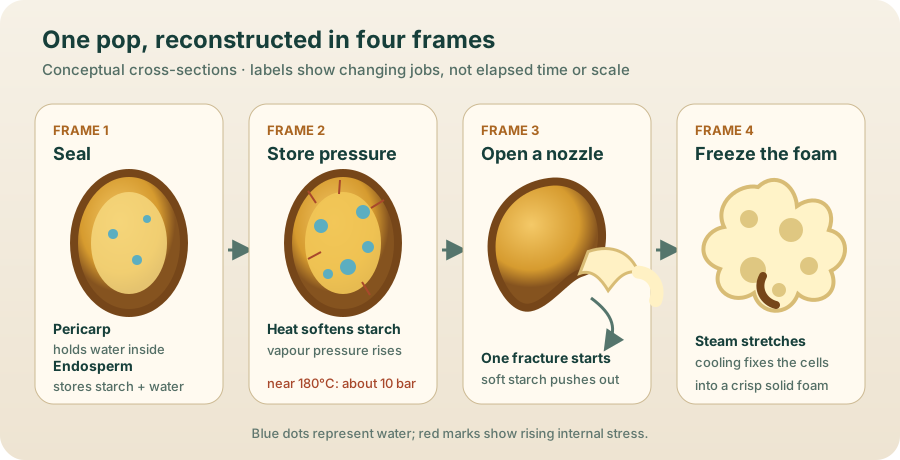
We can reconstruct the event in four frames. Each frame gives one part of the kernel a different job.
Frame one: the shell becomes a pressure vessel
A popcorn kernel is a seed. Its thin outer coat is the pericarp, a tough layer made from the wall of the corn fruit. Inside it lies the endosperm, the seed's main store of starch and protein, plus a small amount of water.
Most maize can be heated, but popcorn varieties combine an unusually strong, well-sealed pericarp with a large region of hard endosperm. The shell slows the escape of water vapour. That turns the kernel into a small pressure vessel rather than an open pot.
Studies of popping traits treat the pericarp's strength and the structure of the endosperm as central to expansion. Lignin is a material that strengthens plant cell walls. One biochemical study found that lignin content and composition in the pericarp were related to popping capacity. Another genetic study describes how moisture, density, shape and hard endosperm all contribute.
The seal must be neither simply “strong” nor simply “weak”. A leaky or damaged coat releases vapour before enough pressure accumulates. A sound coat postpones failure while heat continues to enter.
Frame two: water writes an invisible pressure curve
Liquid water can remain above 100°C inside the sealed kernel because higher pressure raises its boiling temperature. A pressure cooker works on the same principle. Inside the kernel, liquid water and vapour coexist. At each temperature, there is a pressure at which water evaporates and vapour condenses back into liquid at equal rates. This is the equilibrium vapour pressure. It rises steeply as the water gets hotter.
At the same time, hot water softens the starch-rich endosperm. Starch granules take up water and lose their former ordered structure, a change called gelatinisation. The inside is no longer merely dry powder waiting to scatter. It becomes a hot, deformable mass that can stretch when pressure is released.
French physicists Emmanuel Virot and Alexandre Ponomarenko filmed individual kernels with a high-speed camera and microphone. In their experiments, the critical popping temperature was close to 180°C, corresponding to a vapour pressure of about 10 bar, roughly ten times normal atmospheric pressure. Their published reconstruction separates the rupture, jump and sound in time.
What the model can and cannot show
EXPLORE THE IDEA
When does the kernel's seal lose the contest?
10.21 barAbsolute vapour pressure
9.19 barAbove room air
0.21 bar aboveSelected threshold
Keep the threshold at 10 bar and move from 160°C to 180°C. The calculated pressure nearly doubles, which is why the final degrees matter so much.
Scroll the diagram sideways to see every label.
Equilibrium vapour pressure of pure water, calculated with an Antoine relation valid over this temperature range. Temperature and hull-failure pressure are illustrative inputs, not measurements of one kernel. The model assumes enough liquid water remains, uniform temperature, a perfect seal before rupture and one fixed failure threshold. It omits moisture movement, shell defects, starch mechanics and heating rate. It cannot predict pop time, flake size or safe cooking conditions. No animation.
Frame three: the weakest point opens first
The pericarp does not vanish everywhere. A fracture starts at a weak point. The pressurised interior pushes material through that opening. As the pressure drops from roughly ten bar toward room pressure, some of the hot liquid water rapidly turns into vapour. The vapour expands and stretches the softened starch.
That direction matters. Popcorn does not swell gently and evenly like a balloon. The soft endosperm is forced through a local break. Virot and Ponomarenko's high-speed recordings show a protruding “leg” of starch forming before the kernel lifts from the plate. The leg presses against the hot surface and acts like a springboard, lifting the kernel.
The recordings also helped separate the sound from the jump. In one synchronized recording, the sound began about 100 milliseconds, a tenth of a second, after the first opening and before the kernel jumped. The researchers therefore ruled out landing as its source. They proposed that escaping water vapour made spaces inside the kernel vibrate and produce the “pop”. This is an explanation consistent with that recording, not a fixed timetable for every kernel.
Frame four: a liquid-like interior becomes a solid foam
As the endosperm emerges, expanding vapour stretches it into thin walls around gas spaces. The material turns partly inside out. Its original compact starch becomes the pale branching flake, while much of the dark pericarp remains attached as small fragments.
Expansion alone is not enough. The walls must also stop flowing. Rapid evaporation removes water and cools the stretched starch, so it changes from a deformable material into a rigid foam. This final stiffening preserves the air spaces that make popcorn large and crisp.
Moisture is therefore both engine and construction material. Too little water gives weak pressure and poor softening. Too much can also reduce expansion because more energy is spent heating and evaporating water while the softened structure may not set as effectively. Engineering studies commonly report a useful kernel moisture range near 12–14%, but the best value depends on variety and method. A peer-reviewed popping-machine study summarises that range and the pressure-vessel mechanism. A broader meta-analysis of popcorn traits shows why expansion is a breeding target rather than a single universal number.
An ancient machine refined by selection
This mechanism existed long before cinemas or microwave ovens. Excavations at Paredones and Huaca Prieta on Peru's north coast recovered hard-endosperm maize remains, including popcorn types, from contexts dated as early as roughly 6,700 to 6,500 years before present. The researchers were careful about inconsistent dates from some uncharred samples, but their directly dated finds document an early history of popcorn-like maize.
People did not need a pressure gauge to select kernels that expanded well. Repeated planting could preserve shells, moisture behaviour and endosperm structures that made popping more reliable. Modern breeding measures expansion volume, unpopped kernels and flake form, but the underlying machine is still biological.
The pop lasts less than a blink. Its preparation takes much longer: a plant builds a sealed seed, drying leaves the right amount of water, and heating raises the pressure inside. Then one fracture changes the rules: expanding vapour pushes the softened starch through the opening, and the starch sets into a foam. The failed shell becomes the doorway through which a new structure builds itself.
YOUR PERSPECTIVE
Join the discussion
What surprised you? Have a question or a correction? Share your thinking.
No comments yet. Start the conversation.
Sign in with ChatGPT to commentAnyone can read the discussion. Sign-in helps limit spam.