
When the crew of the research submersible Alvin reached the Galápagos Rift in 1977, the surprise was not merely warm water escaping from the seabed. Around it stood a crowded community of large clams, pale crabs and unfamiliar red-plumed tubeworms. It was more abundance than darkness at that depth seemed able to support.
No sunlight reached the seafloor. No plants fed the community. The discovery raised a question beyond “How can life survive here?” Where did its usable energy enter?
The answer was not heat itself. It was chemistry at a boundary.
A vent is a circulation system
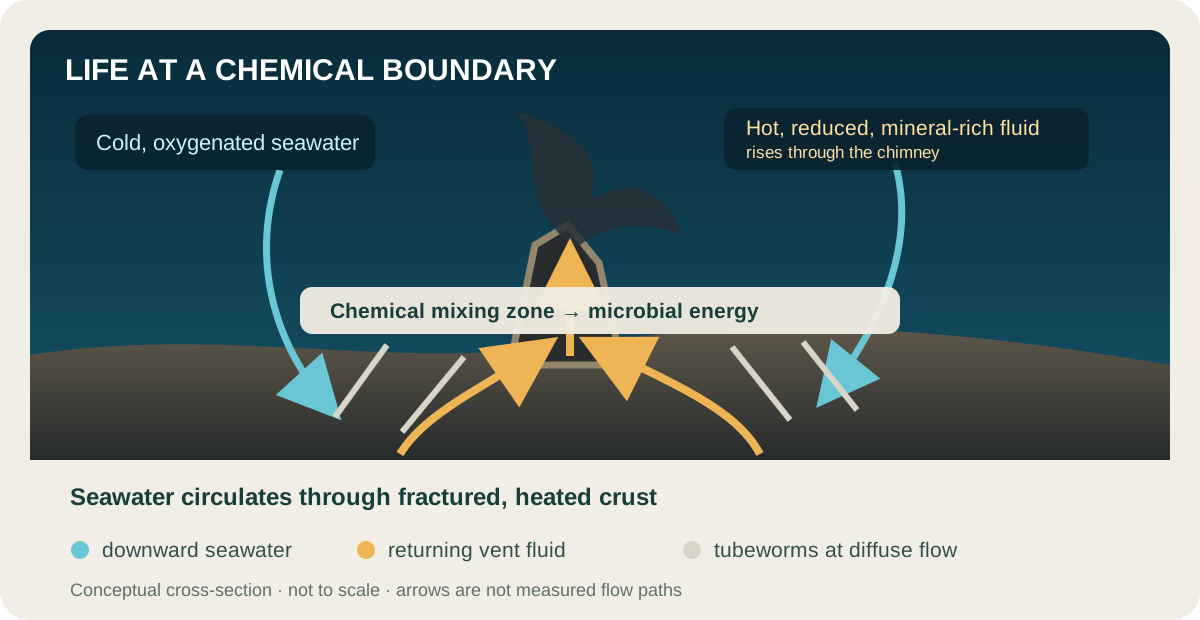
Hydrothermal vents are openings where heated, chemically changed water comes out of the seabed. They commonly occur where moving plates and volcanoes heat the ocean crust, including underwater mountain ridges and chains of volcanoes. Cold seawater enters cracks, moves through hot rock, reacts with it and returns to the seabed changed. The fluid can be hotter and more acidic or alkaline. It loses some seawater substances and gains others, including dissolved metals and hydrogen sulfide. Some chemicals can give up electrons in energy-releasing reactions; these are called reduced chemicals.
NOAA's vent overview follows seawater down through fissures and back toward the ocean. Some high-temperature vent fluids exceed 340 °C. They do not simply boil away because the surrounding deep-ocean pressure raises the conditions under which liquid and vapour phases form. The details depend on depth, pressure, salinity and chemistry; not every vent behaves like an ordinary kettle held down by a lid.
When hot, mineral-rich fluid meets near-freezing seawater, the rapid change in temperature and chemistry makes dissolved material form solid particles, a process called precipitation. Iron sulfides can create the dark plume and chimney of a black smoker. The “smoke” is therefore mostly mineral particles in water, not soot from combustion.
The richest habitat is not the hottest jet
A fluid hot enough to emerge above 300 °C is not a comfortable bath for giant animals. Vent communities live around the outlet, where temperature and chemistry change over short distances. They occupy cooler flows, chimney surfaces and places where vent chemicals meet seawater containing oxygen.
This mixing is essential. Hydrogen sulfide is often described as the ecosystem's fuel, but fuel alone cannot release useful energy. Microbes obtain energy through oxidation–reduction reactions. In these reactions, electrons move from one chemical to another. Compounds such as sulfide, hydrogen or methane supply electrons; chemicals such as oxygen or nitrate receive them. The reaction can release energy that a microbe uses. Different microbes use different pathways.
The useful mixing zone may be only centimetres wide. Too close to a hot source, temperature and chemistry may be intolerable. Too far away, the reduced chemicals become diluted or exhausted. At the mixing boundary, both sides of a reaction can arrive together.
A little deeper: heat source versus energy source
Chemosynthesis fixes carbon in the dark
Plants use light energy to turn carbon dioxide into carbon-containing food molecules. This process is called carbon fixation. Many vent microbes perform chemosynthesis: they use energy from chemical reactions to drive carbon fixation without sunlight. Bacteria and archaea, another major group of single-celled microbes, can grow as films on surfaces, form suspended particles or live inside animals.
There is no single universal equation for chemosynthesis. One simplified sulfur-based pathway combines carbon dioxide, hydrogen sulfide and oxygen to represent the production of carbohydrate, sulfur and water. Real cells use sequences of enzyme-controlled reactions, and vent communities use many chemical pairs. NOAA's chemosynthesis fact sheet explicitly separates this diversity from the simplified classroom equation.
The organic matter made by these microbes becomes local food. Some microbes are grazed by animals. Others live in partnerships, or symbioses, in which host and microbe exchange resources.
A tubeworm is an ecosystem inside an animal
The giant tubeworm Riftia pachyptila has no conventional feeding life as an adult. Its plume absorbs oxygen, carbon dioxide and sulfide from the surrounding water. Its blood transports these ingredients to an internal organ called the trophosome. It is packed with bacteria that gain energy by reacting sulfur compounds with oxygen. The bacteria use that energy to make food from carbon dioxide; the worm supplies a protected home and a continuous delivery system.
MBARI records giant tubeworms up to about two metres long and identifies their nutrition as the work of symbiotic sulfur-oxidizing bacteria. This partnership is a major route from chemical energy to animal growth.
Mussels, clams and shrimp at different vent fields have their own microbial partnerships. Other animals graze microbial mats, filter particles or prey on the grazers. Together they form a food web of producers, consumers and decomposers, powered by chemistry rather than sunlit plants.
The discovery changed a larger assumption
Before the Galápagos observations, researchers expected geothermal activity along the spreading ridge. What they did not expect was a dense biological community whose local production did not begin with photosynthesis. NASA's history describes the temperature clues, camera survey and Alvin observations that revealed the ecosystem in 1977.
The discovery did not prove that sunlight is irrelevant to all vent life. Oxygen in deep seawater ultimately reflects processes connected to Earth's surface biosphere, and sinking organic material can supplement vent food webs. It did show that primary production, the creation of new organic matter from inorganic carbon, can be driven locally without light.
This changed the search for habitable worlds. If an icy moon contains liquid water, rock, a source of chemical disequilibrium and sustained energy flow, sunlight at its ocean floor may not be essential. Whether any such world actually contains life remains unknown. Likewise, proposals that alkaline vents contributed to life's origin on Earth are active hypotheses, not a conclusion supplied by the 1977 animals.
Islands that can switch off
Hydrothermal vents are geologically restless habitats. A chimney can clog or collapse; an eruption can bury a community; subsurface flow can shift and open an outlet elsewhere. When the chemical supply stops, organisms that depend on it can disappear.
Yet new vents are colonized. Microbial cells travel with water, and animal larvae disperse through the deep ocean before settling. How larvae locate rare, temporary habitats, sometimes separated by great distances, remains an important research problem. The habitat’s boundary follows its chemical supply.
Explore the mixing boundary
NOAA footage from the Mariana back-arc, linked below, shows why the word “oasis” persists: dense life around chimneys in almost complete darkness. The source of that abundance is invisible. Two chemically different fluids meet. Microbes capture some energy from their reactions and use it to make food. The hot rock keeps delivering the ingredients.
EXPLORE THE IDEA
Where can vent chemistry support production?
50 relative unitsAvailable reaction capacity
15.0 relative unitsCaptured-production index
Oxidant limits. Increasing only the non-limiting supply does not raise capacity; both sides of the chemical boundary matter.
Scroll the diagram sideways to see every label.
Illustrative limiting-input model: reaction capacity is the smaller of two relative supplies; captured-production index = capacity × capture percentage. Inputs are not observations. This is not chemical stoichiometry, thermodynamics, biomass, reaction rate or toxicity. It omits temperature, pH, mass transfer, multiple chemical pathways, maintenance energy and community composition; no animation.
YOUR PERSPECTIVE
Join the discussion
What surprised you? Have a question or a correction? Share your thinking.
No comments yet. Start the conversation.
Sign in with ChatGPT to commentAnyone can read the discussion. Sign-in helps limit spam.