
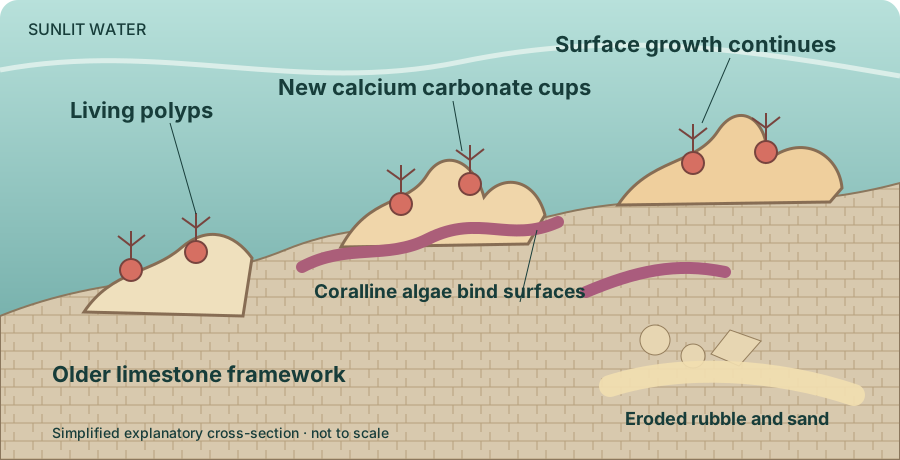
At first glance, a coral reef looks like brightly coloured rock. Look closely and the surface becomes crowded with tiny mouths and tentacles. The rock is partly the work of those animals, and much of it is the accumulated architecture of animals that died long ago.
This is the central surprise of a reef: its grand scale is produced by creatures that may be only millimetres across. A reef is not one enormous coral, and coral itself is not a plant. It is a changing structure made by colonies, reinforced by other organisms and continually worn down by waves, chemistry and hungry animals.
The builder inside the cup
A coral polyp is a soft-bodied animal related to sea anemones and jellyfish. Its basic plan is simple: a mouth surrounded by tentacles leads into a body cavity. Stinging cells in the tentacles can capture plankton, small organisms drifting in the water. Many reef-building species live as colonies whose genetically identical polyps remain connected by living tissue.
Under each polyp, a stony coral deposits a cup of calcium carbonate, a hard mineral also found in limestone. In coral skeletons, it is mainly arranged in a crystal form called aragonite. The animal draws calcium and carbonate components from seawater and controls mineral formation in a small space beneath its tissues. As the polyp grows upward, earlier skeleton remains below. Neighbouring cups join into branches, domes, plates or other colony forms.
One layer is slight; repetition is powerful. NOAA describes reef structures as millions of polyps growing over the limestone remains of earlier colonies. Massive corals often expand only about 0.5 to 2 centimetres a year, although some corals can grow faster under favourable conditions. NOAA explains how the living mat and carbonate skeleton accumulate.
An animal powered partly by sunlight
Most shallow tropical reef-building corals host microscopic algae in their tissues. The algae use light to make food, a process called photosynthesis. They are often called zooxanthellae. Their scientific classification is more precise: they belong to several groups of single-celled algae called dinoflagellates, within the family Symbiodiniaceae. The partnership is the key.
The algae use sunlight to make energy-rich compounds and transfer a share to the coral. The coral supplies a protected, illuminated home and nutrients released as the coral processes food. This partnership helps corals build their mineral skeletons (calcify) and grow fast enough to build large tropical reefs. It does not make the coral a plant: polyps still feed with their tentacles, and some corals live without photosynthetic partners. The Smithsonian describes the animal, mineral and algal parts of the partnership.
Sunlight also explains why the most familiar reefs occupy clear, shallow water. Light must reach the algae. Sediment or excessive nutrients can cloud that light and alter competition on the reef. Cold-water corals prove that “coral” and “sunlit tropical reef” are not synonyms: some live in deep, dark water, capture food directly and build complex habitats without photosynthetic symbionts.
A little deeper: making stone from seawater
A reef needs more than coral
Coral colonies create much of the three-dimensional framework, but they do not finish the job alone. Crustose coralline algae, algae that form mineral-rich crusts, grow as hard pink or purple sheets and help bind exposed surfaces. Other organisms occupy gaps, trap sediment or add their own carbonate remains. A loose collection of skeletons becomes a more coherent structure through biological growth and natural cementation.
Construction has an opposite process: bioerosion. Parrotfish scrape algae from reef surfaces and may remove carbonate as they feed. Sponges bore into skeleton. Urchins graze; worms and microbes weaken material; waves break branches and move fragments. The resulting rubble and sand can fill spaces, form beaches or be carried away.
The Smithsonian's step-by-step reef video shows this succession as an ecosystem, not a solo building project. Stony corals provide foundation and complex habitat; algae, sponges, invertebrates and fish then change both the community and the structure.
This suggests a better mental model than “coral grows, so reef rises.” A reef has a carbonate budget, a comparison of how much mineral material is added and lost. New skeletons and natural binding add material. Feeding animals, boring organisms, chemical dissolving, storm damage and fragments carried away remove it. If production stays above loss, framework can accumulate. If loss catches or exceeds production, living corals may remain while the physical reef stops gaining structure or begins to erode.
Explore a simplified reef budget
Darwin's moving foundation
During the voyage of HMS Beagle, Charles Darwin considered why fringing reefs, barrier reefs and ring-shaped atolls occur in different arrangements. In his 1842 book on coral reefs, he proposed that corals could keep building upward while a volcanic island slowly sank, a process called subsidence. A fringing reef could become separated from the sinking island by a lagoon, then persist as an atoll after the island disappeared below sea level.
Later drilling found volcanic rock beneath thick reef limestone on oceanic atolls, supporting the essential insight that an apparently fixed ring can record movement of its foundation. But not every reef follows one neat sequence. Sea-level changes, erosion, tectonic movement and local ecological history also shape the final form. The Smithsonian's introduction to atoll geography places Darwin's model within that broader history.
When the living skin is stressed
The reef's great mass can make it seem permanent, yet active construction is concentrated near a vulnerable living surface. Heat stress can disrupt the partnership between coral and algae. When corals lose much of their symbiotic algae, the pale skeleton becomes visible through translucent tissue: bleaching. A bleached coral is not necessarily dead, but prolonged stress removes a major energy source and raises the risk of disease and death. NOAA explains what bleaching does and does not mean.
Extra carbon dioxide in seawater also changes carbonate chemistry. This ocean acidification makes seawater less alkaline. It can slow skeleton-building and weaken reef structures; warming, disease, pollution and physical damage add pressures of their own. NOAA summarises these connected climate effects. The outcome is not merely fewer colourful animals. It can change whether the entire construction budget remains positive.
A reef is therefore both archive and activity. Its limestone remembers countless earlier polyps, changes in sea level and episodes of breakage and repair. Across that old foundation, a living film continues the work, one mineral cup, one new bud and one contested patch of surface at a time.
EXPLORE THE IDEA
What happens when reef construction and loss change?
+3 mm/yearNet illustrative balance
+30 cmLinear 100-year equivalent
This selection gives framework gain. Equal production and loss means zero net change in this simplified budget, not an unchanging real reef.
Scroll the diagram sideways to see every label.
Illustrative linear carbonate budget, not a forecast or a measurement. Inputs are carbonate-equivalent thickness in millimetres per year; the 100-year result simply extends the selected annual difference. Reef geometry, porosity, cementation, compaction, sea level, storms, transport and ecological feedbacks are excluded. No animation.
YOUR PERSPECTIVE
Join the discussion
What surprised you? Have a question or a correction? Share your thinking.
No comments yet. Start the conversation.
Sign in with ChatGPT to commentAnyone can read the discussion. Sign-in helps limit spam.