
In a dark experimental room in the early 1940s, Donald Griffin and Robert Galambos hung thin wires from the ceiling and watched bats fly through them. The animals usually avoided the wires. When the researchers temporarily blocked hearing or prevented normal calling, collisions increased. The impairments were reversible, and the pattern helped show that the animals were guiding flight with sounds and returning echoes.
The National Academies’ biographical account of Griffin preserves the history and its limits: Griffin and Galambos established a sensory system, not a supernatural “sixth sense.” They called it echolocation.
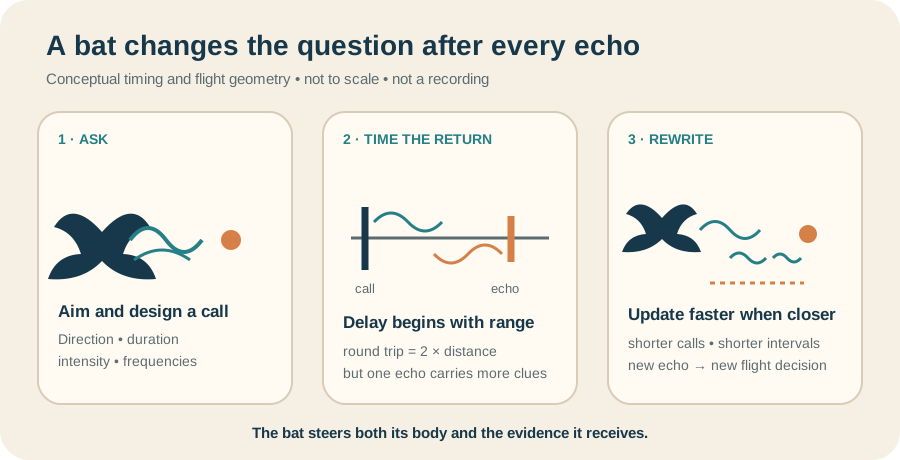
The usual summary says that a bat makes a sound and hears an echo. Correct, but incomplete. The more revealing idea is that every call is a question whose design changes what can be learned. A flying bat then rewrites the next question while the answer to the previous one is still shaping its movement.
A clock hidden inside every echo
For a simple target, distance begins with elapsed time. A call travels from bat to object and the echo travels back, so the sound covers twice the one-way distance. At about 20°C, sound moves through air near 343 metres per second; NASA explains why the speed depends on gas and temperature.
If an echo returns 6 milliseconds after a call, the reflecting surface is roughly one metre away, not two. The division by two matters because the clock measured a round trip. A modern review of bat auditory processing reports the same useful scale: about 1 millisecond of delay for every 17 centimetres of one-way range. It also explains that neurons can be selective for particular call–echo delays. The review distinguishes measured mechanisms from open questions.
Range is therefore not painted onto an acoustic picture. It is inferred from a relationship between two events: emission and return.
What the timing model can and cannot show
One return carries more than one answer
Delay is only the beginning. Two ears receive an echo with differences in level, timing and spectrum. The outer ear reshapes sound differently depending on elevation. Edges, surfaces and textures alter which frequencies return. For some bats, Doppler shifts are especially useful for detecting motion such as beating insect wings.
These are not interchangeable clues, and species do not all solve the problem in the same way. A broad scientific review describes how echo delay supports range, binaural and spectral cues support direction, and spectral structure can contribute information about shape and texture. It also marks some claims about reconstructing shape as plausible but not yet demonstrated in natural behaviour. That distinction matters: a mechanism can be well motivated without every proposed use being settled.
The call itself has geometry. Mouth or nose shape, frequency and aperture help set the width and direction of the sound beam. Calling louder can extend useful range, but high-frequency sound weakens rapidly in air. A louder question is not automatically a better one if it floods the ears with clutter from leaves and walls.
The question changes during the chase
When an insect-eating bat searches open space, widely separated calls can sample a large volume ahead. Once prey is selected, the problem changes. Distance is shrinking, direction is changing and the next manoeuvre has less time to wait.
Many frequency-modulated bats shorten calls as they approach objects, helping to reduce overlap between the outgoing pulse and nearby echoes. They also reduce intervals between calls. Near capture, some produce the rapid sequence called a terminal buzz. This is not simply excitement made audible. More frequent calls provide more frequent updates while the geometry changes fastest.
Field and laboratory work shows something subtler than a steadily accelerating metronome. Bats can group calls, shift the aim of an “acoustic gaze,” and adjust duration to inspect an obstacle before attending to prey behind it. Cynthia Moss and Annemarie Surlykke’s review of active sonar behaviour describes bats steering the information they receive, not passively accepting an echo stream.
That feedback loop is the heart of the system:
1. Send a call with a chosen direction, duration, intensity and frequency range. 2. Sort returning echoes by delay and acoustic structure. 3. Change flight and design the next call around the new problem.
The environment answers, but the animal decides how to interrogate it.
Clutter is an assignment problem
A forest does not return one neat echo. It returns a cascade from branches, leaves, ground and prey. The bat must decide which return belongs to which call and which object deserves attention. Shorter calls can sharpen timing; directional beams restrict the sampled region; call groups can help track a selected target across successive snapshots.
This is why describing echolocation as “seeing with sound” is useful only up to a point. Vision often begins with light already present in the environment. Echolocation is active sensing: the animal spends energy to create the signal, and the signal’s design changes the evidence available. The nearest technological cousin is not a camera but a radar or sonar system whose transmitter and receiver adapt together.
Bats are not blind microphones
The phrase “blind as a bat” is false. Bats have eyes, and many use vision alongside hearing. Nor do all bats use the same sonar design; some fruit bats rely heavily on vision and smell, while most bat species echolocate in diverse ways. The Smithsonian’s bat guide separates eyesight from acoustic orientation and describes calls emitted through the mouth or nose.
Even the famous wire-room experiments should not be turned into a complete theory. They established that hearing the echoes of self-produced calls was necessary for obstacle avoidance under those conditions. Decades of microphones, high-speed cameras, behavioural tests and neural recordings were needed to reveal beam steering, delay tuning and adaptive call sequences.
The deepest lesson is not that bats possess a perfect map of darkness. It is that perception can be an experiment performed at flight speed. A call asks, “What reflects from this direction, at this scale, right now?” The echo changes the bat. The changed bat asks a different question.
EXPLORE THE IDEA
Can the echo return before the next call?
A timing ledger, not an acoustic picture
- Ink marker: outgoing call at 0 ms.
- Orange marker: echo returns at 35.0 ms.
- Teal marker: illustrative next call at 50 ms.
- Axis: one fixed 0–130 ms scale for every control setting.
343.2 m/sSound speed
35.0 msRound-trip delay
15.0 msTiming margin
At this temperature, each millisecond of round-trip delay represents about 17.2 cm of one-way range.
Illustrative single-target timing in still, dry air. Distance is one way; delay is a round trip. Sound speed uses a dry-air ideal-gas approximation. The next-call interval is a chosen teaching input, not a species rule or performance threshold. Real bats receive many, weakening and overlapping echoes, move during the exchange, and adapt call duration, beam direction and timing. No animation.
YOUR PERSPECTIVE
Join the discussion
What surprised you? Have a question or a correction? Share your thinking.
No comments yet. Start the conversation.
Sign in with ChatGPT to commentAnyone can read the discussion. Sign-in helps limit spam.