From inside a substantial building, a flash can turn the window white and leave a short, peculiar silence behind it. Then comes the sound: sometimes a sharp crack, sometimes a rolling growl that seems to move across the sky.
It is tempting to imagine two events, one causing the other after a pause. But the pause is mostly a journey. The light and the pressure disturbance begin at almost the same time, while their messages travel through the world at very different speeds.
The delay explains when thunder reaches us. Its changing voice reveals something more interesting: lightning is an extended, irregular source, and the atmosphere is an active part of what we hear.
Electricity gives the air a sudden push
Thunder begins with rapid heating along a lightning channel. The air can reach temperatures of around 30,000°C, although that is an approximate extreme rather than the temperature of an entire storm cloud. Heating happens so quickly that the surrounding air cannot simply accommodate it through gentle expansion.
Pressure rises, the channel expands violently, and a shock wave moves outward. Farther from the channel, the disturbance weakens into the sound we recognise as thunder. Both cloud-to-ground lightning and lightning within clouds can produce it. The sound does not require a bolt to hit a tree, a building or the ground. The National Weather Service explains how thunder begins.
The flash's electrical preparation is a separate question, explored in how a storm builds lightning. Here, the crucial conversion is from electrical energy to rapid heating, then to mechanical motion in the air. Thunder is the audible consequence of that conversion.
What actually travels to your ear?
Sound is a pressure disturbance moving through matter. Air is compressed and rarefied—made slightly less dense—as the disturbance passes. The local air moves back and forth; it does not have to travel all the way from the lightning channel into your room.
That distinction between moving material and moving disturbance helps explain why sound needs a medium. Light is an electromagnetic wave and can cross a vacuum; ordinary sound cannot. In air, the speed of sound depends on the gas's physical properties and temperature. It is not a universal constant like the speed of light in vacuum. OpenStax explains sound waves and their speed.
This is also why the atmosphere matters after the thunder has been created. A sound has to survive spreading, absorption and a journey through layers of air before it reaches a listener. Hearing is a measurement of what arrived, not a perfect recording of everything the source produced.
The pause becomes a rough ruler
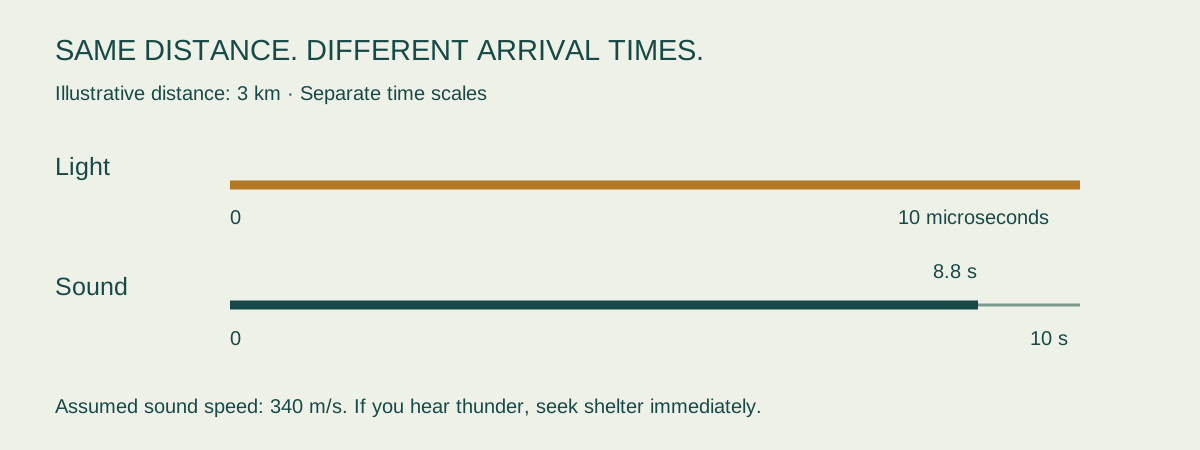
For a simple estimate, sound travels through ordinary air at about 340 metres per second. Light travels about 300,000 kilometres per second. Across a few kilometres, light's travel time is negligible to our senses, while sound's journey lasts seconds. NASA illustrates the different arrival times.
Consider an illustrative source three kilometres away. Dividing 3,000 metres by 340 metres per second gives about 8.8 seconds. Light covers the same distance in about ten millionths of a second. The diagram uses separate scales because putting both on one ordinary timeline would make the light's travel time practically invisible.
A little deeper: what the stopwatch estimates
Why a clap can turn into a roll
A lightning channel is not a single point. Sound comes from many places along its twisting length. The nearer portions can be heard before farther portions, spreading the arrival over time even when the light looked like one brief event. The channel's orientation relative to the listener therefore matters.
The atmosphere changes the mixture further. Higher-frequency sound is absorbed more strongly over distance, helping a distant flash sound like a low rumble rather than a sharp crack. Terrain and other reflecting surfaces can add echoes. A rumble is not simply clouds colliding, nor does its entire duration measure how long electricity was flowing. The National Weather Service's account of thunder's different sounds.
Low notes do not reach you late simply because they are low. Under the same conditions, ordinary audible frequencies travel at nearly the same speed in air. Different travel distances and changes in what survives the journey explain much more. Explore frequency, wavelength and propagation with OpenStax.
A question older than electronic clocks
The effort to understand sound's speed long predates microphones and digital timers. In seventeenth-century France, Marin Mersenne investigated acoustics alongside music and mathematics. His interests joined things that can feel separate today: the behaviour of a vibrating string, musical pitch and the propagation of sound.
Mersenne also maintained an extensive correspondence linking researchers. His place in this story is not that he supplied today's complete explanation of thunder, but that sound became something to measure and compare rather than merely describe. The University of St Andrews traces Mersenne's work.
A thunderstorm makes that change of attitude unusually accessible. A pause that initially feels dramatic can also contain quantitative information. No special musical ear is required to notice that the world does not deliver every signal instantly.
The silence has limits
Sometimes a distant storm illuminates the horizon without audible thunder. This is often called “heat lightning,” but it is not a special silent discharge created by a warm evening. It is ordinary distant lightning whose sound is not reaching the observer audibly. The National Weather Service explains the name.
If you do hear thunder, seek shelter immediately in a substantial building with electricity or plumbing, or an enclosed metal-topped vehicle with its windows closed. Remain sheltered for at least 30 minutes after the last thunder. Indoors, avoid plumbing, corded electrical equipment and windows. Do not wait for a shorter flash-to-thunder interval. Official lightning safety guidance.
From shelter, the sequence becomes a compact lesson in physics: a flash announces the event, a pause records the journey, and a rumble carries traces of the path. The storm is not waiting to speak. Its slower message is still on the way.
EXPLORE THE IDEA
How long does the sound take?
Illustrative source distance and sound speed of 340 m/s. Real temperatures and channel geometry change the delay. If you hear thunder, take shelter immediately; do not use this model to decide whether it is safe outdoors.