
To investigate a light show larger than a country, Kristian Birkeland built a small magnetic Earth. Inside a glass vacuum chamber, the Norwegian physicist directed electrons toward a magnetised sphere. Luminous patterns appeared around its magnetic regions: a laboratory clue to the northern lights.
His experiments were not a miniature copy of the whole atmosphere. They isolated a relationship between charged particles, magnetism and glowing gas. Birkeland combined such work with Arctic observations, publishing the results in his multivolume account of the Norwegian Aurora Polaris Expedition. The Linda Hall Library preserves that account and photographs of his apparatus.
The experiment captures something important about discovery. A model can reveal a mechanism without reproducing every detail. Explaining the real aurora would require looking far beyond the laboratory, into a region of space that no early twentieth-century instrument could visit.
The Sun supplies energy, not a projected picture
An aurora is not sunlight reflected from high clouds. Nor is the atmosphere burning. The visible light is produced locally, by gases high above the ground after energetic particles transfer energy to them.
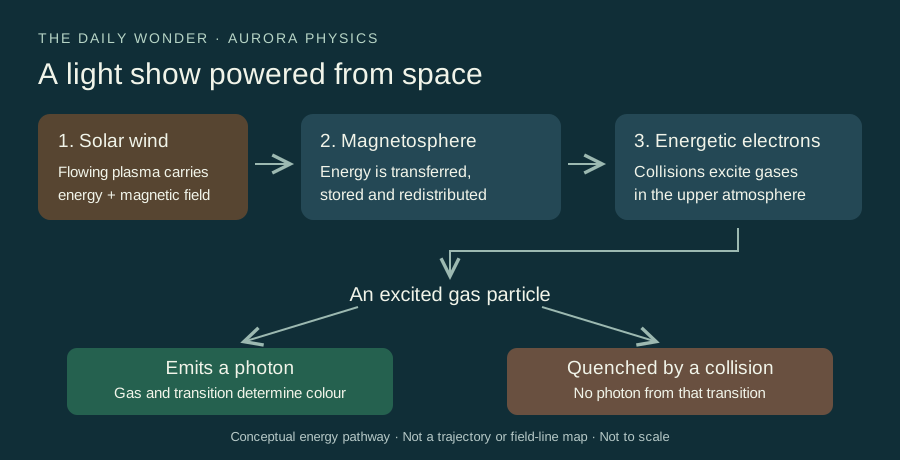
The Sun continually releases the solar wind, a flowing plasma, a gas containing electrically charged particles. Earth’s magnetic environment interacts with this flow. Some particles gain energy within that environment and travel along magnetic field lines toward the upper atmosphere. NASA’s illustrated introduction follows this connection from the Sun to the sky.
The journey is not a straight solar beam. Earth’s magnetosphere, the region strongly influenced by its magnetic field, stores and redistributes energy. Many auroral electrons come from populations already within it. Processes in its long night-side tail can send energetic electrons toward the atmosphere. It is an active participant, not merely a protective wall. NOAA explains the magnetotail’s role.
Why the lights gather around the poles
The magnetic field helps organise where the particles arrive. Auroras commonly occupy oval-shaped regions around the magnetic poles, rather than illuminating every latitude equally. More intense activity can extend the visible displays toward lower latitudes; the pattern is not a permanent circle painted onto the planet.
The familiar name aurora borealis describes the northern lights; aurora australis describes their southern counterpart. Both occur high in the atmosphere, in a region called the thermosphere, one of the upper layers of Earth’s atmosphere. The same broad mechanism can produce delicate arcs, diffuse glows and rapidly changing forms. UCAR’s aurora guide explains the two hemispheres and the atmospheric setting.
These are not the same phenomenon as sprites and blue jets above thunderstorms. Both involve atmospheric light, but the energy sources and electrical processes differ. A storm-powered flash above a cloud is not a small aurora.
The colour belongs to the gas
When an energetic electron collides with an atmospheric atom or molecule, it can leave that particle excited: carrying more internal energy than before. If the excited particle returns to a lower-energy state by emitting light, the energy it loses determines the wavelength of the emitted light, and therefore its colour. A photon is a tiny packet of that light; wavelength is the distance between neighbouring wave peaks.
Oxygen produces the familiar green and also red emissions. Nitrogen contributes blue and pink or purplish light. Altitude matters because the atmosphere’s composition and density change with height, but there are no sharply painted colour layers. Green oxygen light commonly comes from heights of roughly a hundred to a few hundred kilometres; red oxygen light is favoured higher up. Different emissions can overlap along a viewer’s line of sight. NASA explains the gases, colours and approximate altitude ranges.
Knowing which gas is present is only half the explanation. The excited state also needs time to release its light.
A race between emission and collision
Some excited states emit quickly; others can remain excited much longer. While a particle waits, a collision may remove its excitation energy without producing the photon we were expecting. This process is called collisional quenching.
In denser air, collisions are more frequent. An atom that takes longer to emit light is more likely to collide first and lose the energy without emitting that light. In thinner air higher up, its chance of surviving to radiate improves. This helps explain why oxygen’s red emission is associated with greater heights than much of its green emission. It is not simply that one oxygen atom is red and another is green. NOAA describes the competing lifetimes and collisions.
Explore a simplified competition
Watching a moving system
Birkeland could make a glow in a chamber. Modern scientists can compare changes across an enormous stretch of sky. NASA’s THEMIS all-sky-camera visualization assembles ground observations over Canada onto a view of Earth, showing the development of an auroral substorm. It is an observational composite, not a single movie filmed from orbit; the mapped images were coloured green for the visualization.
That distinction matters. A beautiful image can also be a carefully constructed measurement product. Combining observations lets researchers ask how activity develops across locations rather than mistaking one observer’s changing view for the behaviour of the entire system.
The glow is a sign, not the cause
During a strong geomagnetic storm, unusually large amounts of energy move from the solar wind into Earth’s magnetic environment. Such storms can disturb radio communication and satellite navigation, increase atmospheric drag on low-orbiting spacecraft, and induce currents in long conducting systems such as power networks. The visible aurora is not itself what disrupts those systems: light and technological effects are different consequences of the larger disturbance. NOAA’s geomagnetic-storm overview separates those effects.
Above a quiet landscape, the colours can seem detached from everything around them. Yet they connect a star, a magnetic planet and individual collisions in rarefied gas. Birkeland’s little world revealed part of that connection. The real sky keeps showing how much larger the experiment is.
EXPLORE THE IDEA
Will an excited particle emit light?
50.0%Emit a photon
50.0%Quenched
Increase the collision rate, then increase the waiting time. Both reduce the chance of emission. With no quenching, every particle eventually emits in this idealised model.
Scroll the diagram sideways to see every label.
Independent constant-rate competition for an already-excited population. Illustrative waiting times and quenching rates, not measured oxygen values. Excludes excitation, changing gas density and other pathways; cannot predict altitude, colour or auroral brightness. No animation.
YOUR PERSPECTIVE
Join the discussion
What surprised you? Have a question or a correction? Share your thinking.
No comments yet. Start the conversation.
Sign in with ChatGPT to commentAnyone can read the discussion. Sign-in helps limit spam.