
Evidence: Confirmed astronomical observation, reported by the mission agency.
Source dates: ESA announcement: 19 October 2026. Observations: 16–24 September 2026. Confirmation: 8 October 2026. These are separate from the Daily Wonder publication date.
Imagine taking a photograph of a distant mountain and discovering that something interesting crossed the foreground. Astronomy can work that way too. A picture taken for one question can contain the beginning of a completely different investigation.
What is new?
ESA announced that Euclid had discovered its first previously unknown comet, now called C/2026 S1 (Euclid). The telescope recorded it in September; the Minor Planet Center confirmed it on 8 October. Those are different dates from the public announcement.
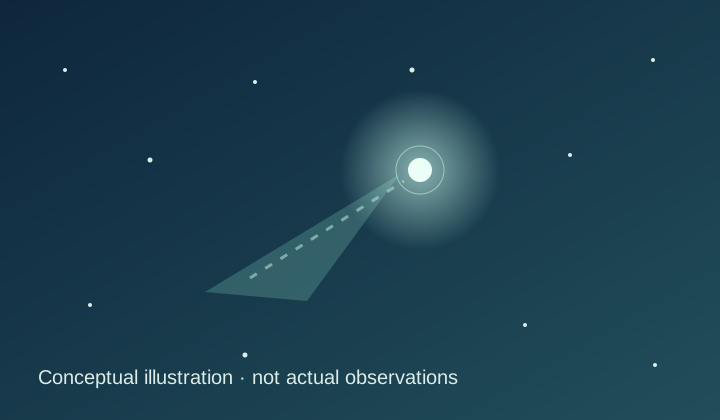
Researcher Mikko Pöntinen’s software picked out a moving streak. Matching its predicted positions across images helped connect the observations. A fuzzy surrounding cloud suggested comet activity, and checks found no matching known object. Follow-up observations contributed to confirmation. ESA discovery announcement
From a moving mark to a confirmed object
- Compare images
A mark moves relative to the background stars across observations.
- Check the candidate
A consistent path, fuzzy surrounding cloud and catalogue checks support a new comet candidate.
- Confirm with more evidence
Follow-up observations help establish the object; the Minor Planet Center confirms it.
Schematic explanation. This is an evidence chain, not the measured orbit or a reconstruction of Euclid’s images. Further observations refine the orbit.
Why was this unexpected?
Euclid’s main job is much larger in scale. It observes distant galaxies to investigate how the Universe has expanded and how its structures have formed. Its survey is designed to cover more than a third of the sky. The mission uses galaxy measurements to investigate dark matter, dark energy and gravity, not simply to produce beautiful space pictures. A foreground visitor is therefore a different kind of discovery from its central scientific goal. ESA mission overview
What makes a comet look fuzzy?
A comet contains frozen material mixed with dust and rock. Heating near the Sun releases gas and dust, creating a surrounding cloud and sometimes long tails. The bright-looking part can be much bigger than the solid body itself. A photograph of that glow is not a photograph of an equally enormous solid object. NASA comet explainer
What should we not conclude?
This was Euclid’s first discovery of a new comet, not its first sighting of any comet. Its orbital estimate will improve with further observations. ESA also says this particular object is not suitable for its future Comet Interceptor mission, although the discovery-and-alert process provides useful experience. ESA discovery announcement
Think like a scientist
One unusual mark might be an imaging fault. Several marks that follow a consistent path make a stronger case. The useful question is not only “What does it look like?” but also “Does it behave consistently across observations?”
Try sketching five dots on separate sheets, moving one dot slightly each time. Flip the sheets quickly. A moving object becomes easier to spot against an unchanged background. That simple activity captures the logic of comparing observations, without pretending to reproduce the real analysis.
The larger lesson is that discoveries need both noticing and checking. An interesting picture begins a question; repeated evidence helps answer it.
YOUR PERSPECTIVE
Join the discussion
What surprised you? Have a question or a correction? Share your thinking.
No comments yet. Start the conversation.
Sign in with ChatGPT to commentAnyone can read the discussion. Sign-in helps limit spam.