
On 25 December 1969, Seiko released the Quartz Astron 35 SQ. Inside a wristwatch, a quartz crystal and an electronic circuit supplied a rhythm that could drive the hands. The challenge had been to make the crystal, electronics and motor small enough, and economical enough with electricity, to work together on a wrist. Seiko's museum documents the release and the engineering behind it.
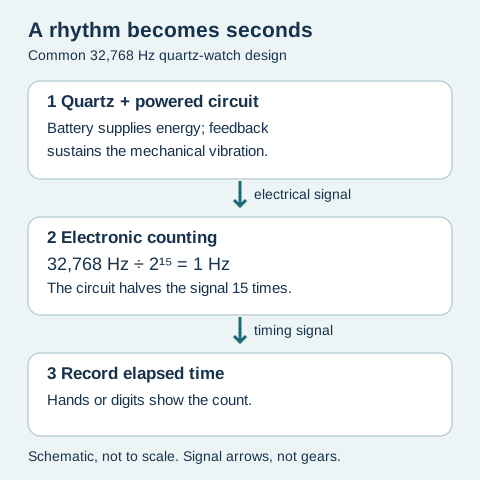
Look at an ordinary quartz watch today and a question remains: how does a piece of crystal become a sequence of seconds? The battery supplies energy, but it does not contain a clock. The answer comes from keeping a vibration going, turning that rhythm into an electrical signal and counting its cycles.
A crystal that connects motion and electricity
Squeeze quartz in the right direction and electrical charge appears on its surfaces. Apply an electric field and the crystal changes shape slightly. This two-way connection between mechanical strain and electricity is called the piezoelectric effect.
Pierre and Jacques Curie demonstrated the pressure-to-charge effect in 1880 and its reverse in 1881. Decades later, Bell Telephone Laboratories developed quartz clocks; a quartz-clock design was described in 1927. The wristwatch inherited a principle that had already served much larger instruments. NIST's history traces these steps.
The useful crystal is carefully shaped, often into a tiny tuning fork. Like a musical tuning fork, it has a preferred rate of vibration, called its resonant frequency. Its dimensions and the way it is cut help determine that rate. The resemblance concerns repeated mechanical motion; the watch is not listening for a musical note.
A crystal left alone cannot keep vibrating forever. Motion loses energy. A battery-powered circuit sustains it by feeding an electrical signal back to the crystal with timing that reinforces the vibration. The crystal's motion also produces an electrical response, so motion and voltage participate in the same repeating loop. The crystal and sustaining circuit together form an oscillator. Epson explains why the crystal needs a matched circuit.
Think of maintaining a playground swing with small, well-timed pushes. The pushes replace lost energy; the swing's physical properties help set the rhythm. In the watch, electrical feedback supplies the pushes. The analogy stops at the circuit: nobody measures the fork by eye, and the crystal is not swinging under gravity.
Why count to 32,768?
Many modern quartz watches use a frequency of 32,768 hertz, meaning 32,768 complete cycles each second. The electronics produce a repeating signal from the oscillator and count those cycles. NIST describes this common timekeeping arrangement.
That number looks awkward in decimal, but it is wonderfully convenient for circuits that divide by two. Halve 32,768 and you get 16,384; halve again and you get 8,192. After fifteen halvings, the output repeats once per second. The device that performs this operation is a frequency divider.
Electronic counting halves the signal, not the crystal’s motion
One divider stage: four input cycles become two output cycles over the same illustrative interval.
Input: 4 cycles
After one ÷2 stage: 2 cycles
- Before division32,768 cycles/sStage 0: oscillator signal
- After one halving16,384 cycles/sStage 1: electronic output
- After fifteen halvings1 cycle/sStage 15: one-second timing
The upper signals show only one divide-by-two stage, with a made-up four-cycle interval so the counting rule is visible. Below, three labelled stages show the nominal rates in a common watch: 32,768 cycles per second before division, 16,384 after the first stage, and one after the fifteenth. Stages 2 through 14 are omitted from this summary; each also halves the rate.
Symbolic waveforms, not voltage measurements or a circuit wiring diagram. The four-cycle example is not a plot of 32,768 Hz in real time. Electronic division preserves fractional frequency error; it does not correct a fast or slow crystal.
Sources: NIST: quartz clocks; Nexperia: fifteen-stage divide-by-two principle (a generic divider example, not a claim about a particular watch chip). Original diagram by The Daily Wonder.
One basic dividing stage changes between two electrical states on successive input cycles. It needs two input cycles to complete one output cycle, so its output frequency is half its input frequency. Connecting fifteen such stages produces the full division. Nexperia's divider datasheet shows this chain of fifteen stages.
Nothing here makes the crystal physically vibrate more slowly. It continues at its fast rhythm while successive electronic stages produce slower signals. Nor does the number create accuracy by itself: 32,768 cycles amount to one second only when the oscillator runs at the intended rate.
The 1969 Astron initially used 8,192 hertz. Seiko later adopted higher frequencies as electronics needed less power. Today's common 32,768-hertz choice combines a practical crystal rhythm with convenient electronic counting; it is not a frequency used by every quartz timepiece.
Make the count visible
In a typical analogue quartz watch, the divided timing signal controls brief electrical pulses to a small motor. Each pulse creates a magnetic field that moves the motor through a step. Gears carry that motion to the hands. The familiar once-a-second movement is therefore a mechanical display of an electronically counted rhythm. Seiko describes the Astron's motor and its one-pulse-per-second drive.
A digital quartz watch can use the counted time to update numbers on a liquid crystal display, or LCD. It does not need hands to make the rhythm readable. Seiko's 1973 06LC, for example, displayed six digits on an LCD. “Quartz” names the timing technology; “digital” describes how the result is shown. The Seiko Museum explains the development of LCD watches.
A small error, counted faithfully
Suppose an oscillator runs slightly fast. The divider still counts correctly, but finishes each group of cycles too soon. The watch gains time. A slower oscillator makes it lose time. Counting faithfully preserves a systematic rate error rather than cancelling it.
Engineers often express that error in parts per million, or ppm. An illustrative error of +20 ppm means a rate 20 millionths faster than intended. Over a day of 86,400 seconds, that adds 1.728 seconds, about 1.7 seconds. If the error stays constant, twice as much elapsed time produces twice as much gain.
What the model can and cannot show
EXPLORE THE IDEA
Let a tiny rate error accumulate
Change the clock’s frequency error and the time since it was set. Positive error means the clock counts too quickly and runs ahead; negative error means it falls behind. The plot shows calculated drift, not measurements.
For every million cycles expected, this illustrative clock produces 20 extra cycles.
Clock error (seconds): above zero = ahead; below zero = behind
The line extends to 30 days; the dot marks your selected duration. At zero frequency error the line stays on zero.
How the calculation works
Clock error in seconds = frequency error in parts per million × days × 86,400 ÷ 1,000,000. One day contains 86,400 seconds. A rate error of +20 parts per million therefore adds 1.728 seconds each day, about 1.73 seconds in the display. Rounding is for readability, not a claim about measurement precision.
Illustrative constant-error calculation, not a watch specification or a calibration tool. The clock starts correctly set. This is accumulated timing error; a real display may advance in discrete steps. Temperature changes, ageing, adjustment, synchronisation and battery failure are omitted. No animation.
Keeping the rhythm close
Manufacturing differences can shift the frequency. Temperature also changes the crystal's behaviour, and gradual changes with age can alter its rate. Many ordinary tuning-fork crystals run slower when taken sufficiently above or below their temperature of highest frequency. Microchip's application note explains manufacturing tolerance, temperature drift and ageing.
Calibration means comparing the oscillator with a reference and adjusting its timing. Some circuits can trim the frequency by changing an electrical property called capacitance. That lets the circuit correct a small offset, but does not guarantee perfect timing under every condition. Epson explains frequency trimming and its limits.
The little jump of a second hand hides all of this work: energy replenished, quartz flexing, electrical cycles counted and a motor moving. A watch turns that fast physical rhythm into a useful answer to an everyday question: how much time has passed?
YOUR PERSPECTIVE
Join the discussion
What surprised you? Have a question or a correction? Share your thinking.
No comments yet. Start the conversation.
Sign in with ChatGPT to commentAnyone can read the discussion. Sign-in helps limit spam.