
Evidence: Peer-reviewed prototype research, not a retail product.
Source dates: Nature paper published: 21 October 2026. NUS announcement: 22 October 2026. These are separate from the Daily Wonder publication date.
Most screens ask clothing to make room for them: attach a watch, carry a phone or fasten a device to a strap. A new research project asks a different question. Could the threads of a garment become part of its screen and controls?
What is new?
Researchers at the National University of Singapore built fibres that combine small picture elements, called pixels, with touch sensing. Their sleeve display has 96 × 54 pixels and updates the image 30 times per second. The system brings display, sensing and circuitry into a fibre-based design rather than relying on a conventional rigid panel. The paper appeared in Nature on 21 October. Research paper and abstract
How can a thread respond to a finger?
According to NUS, the team connected tiny electronic components along wires, then formed a multilayer fibre. Pressing its touch-sensitive layer completes a circuit, allowing the system to locate the contact. In the demonstrated sleeve, 54 fibres each carried 96 tiny light-emitting components, called LEDs. Other fibres supported functions including sound and sensing. NUS research announcement
A touch becomes an input
- Press
A finger presses the touch-sensitive layer in a fibre.
- Detect
Contact completes a circuit, allowing the system to locate the press.
- Respond
The located touch can control an output on the display. LEDs provide the visible picture.
Schematic explanation. Conceptual input–output sequence, not a wiring diagram or the researchers’ pixel layout. A prototype does not establish everyday durability or a retail launch.
The important idea is the relationship between an input and an output. Your touch is an input: it tells the system where you pressed. A changed picture is an output: it shows the result. Putting these together is what makes an interface interactive rather than simply decorative.
Why does this matter?
The paper describes a research platform for interactive textiles. Its abstract reports graphics, audio-video playback and wireless exchange, alongside flexibility, washability and breathability. That combination matters because a wearable display must function as more than a screen: it must also tolerate being worn. Research paper and abstract
NUS reports tests involving 50 detergent washes and 1,000 bends, with little change in light output and touch response. The university also describes demonstrations such as a calculator, compass and image display. These are reported laboratory results, not a promise about every future garment or washing routine. NUS research announcement
What remains uncertain?
A working prototype does not establish an affordable price, a launch date or years of everyday reliability. Before calling such clothing practical, we would want clear answers about power needs, repairs, comfort, long-term wear and what happens when one part fails. Any medical use would require its own validation; a temperature display alone does not prove a diagnostic device.
The research abstract and the university announcement were available for this explanation. Direct access to the Nature article redirected to an inaccessible identity endpoint during research. This article does not claim a complete review of the paper’s full methods or an independent replication of the results.
Try the idea
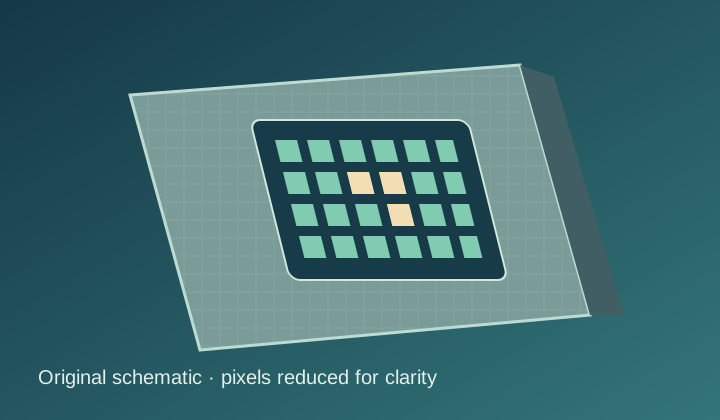
Draw a small grid and colour a few squares to make an arrow. Now double the grid’s width and height. You need four times as many squares, not twice as many. That illustrates why making a sharper display also creates a larger control problem. This is a simple paper activity, not a simulation of the researchers’ device.
YOUR PERSPECTIVE
Join the discussion
What surprised you? Have a question or a correction? Share your thinking.
No comments yet. Start the conversation.
Sign in with ChatGPT to commentAnyone can read the discussion. Sign-in helps limit spam.