
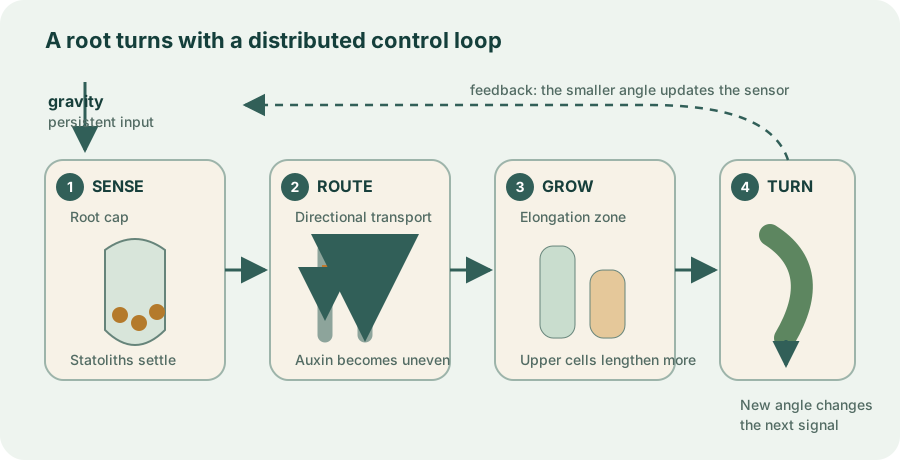
In 1880, Charles Darwin and his son Francis described an unsettling result. A young root laid sideways normally curved downward. Damage only its extreme tip, however, and the part behind it could keep growing without making the usual turn.
Their book credited the botanist Theodor Ciesielski with earlier experiments in which severed tips abolished the response and regenerated tips restored it. The Darwins repeated and extended such work using cut tips and tips damaged by heat, alongside comparison roots left intact. Their evidence did not reveal a molecule or a gene. It did reveal an architecture: the place that senses gravity is not the place that does most of the bending. The original account can be read in Darwin Online.
That separation makes a root less like a falling object and more like a small control system. It must detect its orientation, transmit information, compare growth across its two sides and use growth itself as the motor.
The experiment that separated sensing from movement
A root cannot pull itself around with muscles. Its turn is built from unequal extension. Cells in a region a little behind the tip take up water and lengthen. If cells on one side lengthen more than cells on the other, the root curves.
Yet the root cap at the very tip contains the most important gravity-sensing cells. Modern experiments locate much of gravity perception and early signal processing in specialised columella cells there. A signal travels back to the elongation zone, where cells lengthen. If one side lengthens more than the other, the root bends. This unequal extension is called differential growth. A review in the Annals of Botany follows this sequence from perception to bending.
This division of labour solves a practical problem. The growing zone can remain machinery for extension while the cap, already protecting the root as it pushes through soil, carries orientation sensors. The tip does not steer by swinging like a rudder. It changes the instructions used by tissue behind it.
A level hidden inside a cell
Inside columella cells are dense, starch-filled bodies called amyloplasts. In this role they are often called statoliths. Turn the root, and gravity makes them settle toward a new lower side of the cell. Their displacement is one of the earliest physical events in the response.
The appealing picture is a builder's level: particles fall, and their final position declares which way is down. It is useful, but incomplete. In Arabidopsis, a small flowering plant often used in experiments, plants with defective starch-filled statoliths can retain a weaker gravity response. NASA has used mutants, microscopes and a centrifuge, a spinning device that supplies a gravity-like force, aboard the International Space Station to separate gravity level from other influences. Its Plant Gravity Perception experiment explicitly tests what statolith behaviour can and cannot explain.
Researchers also debate what aspect of the particles matters most. Recent models suggest their position may give a more reliable signal of the root’s tilt than their small weight gives of gravity’s strength. The chain between particle movement and the first biochemical signal remains an active research problem, as an integrative model in Frontiers in Plant Science explains.
The message is routed, not poured
The next step uses auxin, a plant hormone that influences growth. Auxin does not simply leak to whichever side is lower. Transport proteins, proteins that move substances across cell membranes, guide which way auxin moves.
After a root is turned sideways, proteins including PIN3 can relocate toward the newly lower membranes of gravity-sensing cells. In Arabidopsis, this rearrangement has been observed within minutes. It helps route more auxin toward the lower side and then back toward the elongation zone. Other carriers, tissues and feedbacks participate, so PIN3 is not a solitary switch. A 2021 review of auxin and root gravitropism describes the network and its remaining uncertainties.
This is the most surprising part of the controller. A physical event inside a few tip cells becomes a sideways chemical difference, and directional transport carries that difference to another region.
The actuator sits behind the sensor
In a root's elongation zone, more auxin on the lower side generally slows cell lengthening there compared with the upper side. The upper side lengthens more, so the root bends toward gravity. Shoots often respond to auxin differently, which is one reason the same hormone can help roots turn down while shoots turn up.
The cap senses; unequal cell lengthening makes the turn
In this tilted section, the lower flank is on the left and the upper flank is on the right. The cap senses; the region behind it does most of the lengthening
Upper-side cells lengthen more
Less auxin than the lower side during this response. More extension over the same illustrative interval
Lower-side cells lengthen less
More auxin during this response. Lengthening is slowed relative to the upper side
The two cell rows use the same drawing scale and begin at the same dashed reference. Three joined cells are shown on each side; the lengths stand for “more” and “less,” without specifying a growth rate
Unequal extension turns the root toward down
Solid outline: a bent root section. Dashed line: its initial direction. Downward arrow: gravity, not auxin transport or movement of cells
Qualitative teaching sections, not to scale or microscope images. Cell lengths are symbolic comparisons, not measured growth. The sensing-to-transport chain remains under study, and auxin responses depend on tissue and conditions. The curve is not a recorded root path, and the steering model below does not predict real growth.
Sources: Baster and colleagues: auxin routing and lower-side growth inhibition; Annals of Botany: root-cap sensing and differential growth; 2021 review: transport, feedback and unresolved steps
No cell needs a map of the whole root. Each cell responds to local chemistry and mechanics. Yet their unequal growth changes the organ's angle, which changes statolith position, which changes transport again. The response feeds back on itself. As the root turns down, its tilt becomes smaller and the growth signal changes. This is a closed feedback loop:
root tilted → starch-filled particles shift → more auxin moves to one side → cells lengthen unequally → root turns closer to down.
What the model can and cannot show
EXPLORE THE IDEA
How can repeated local corrections find down?
31.5°Remaining angle from down
58.5°Illustrative correction
Correcting toward downController state
Set response strength or elapsed time to zero: the angle stays unchanged. Increase either input: the remaining error shrinks. This shows feedback logic only, not how fast a particular seedling grows.
Scroll the diagram sideways to see every label.
Illustrative orientation-error envelope: remaining angle = initial angle × exp(−0.25 × response strength × hours). Angle is measured from gravitational down. Response strength is a dimensionless teaching input, not an auxin measurement. The model omits growth rate, root length, species, soil, water, light, temperature, mechanics and microgravity. Rays show orientation, not a real root path. No animation.
Remove gravity and other instructions appear
On Earth, gravity is so persistent that it can hide competing cues. In orbit, seedlings do not receive a stable gravitational down. Experiments can then expose how light, moisture and internal developmental patterns guide growth. NASA and ESA's Seedling Growth experiment grew Arabidopsis beside a centrifuge that supplied controlled gravity levels, while cameras recorded the response.
This does not mean space roots become completely random. Plants carry several orientation systems, and their relative influence changes with the environment. Nor does a downward response guarantee the best route. A root encountering a stone must redirect growth; one near uneven water may bend toward moisture. Gravity is an important reference, not an exclusive command.
A root negotiates rather than obeys
Calling the tip a “brain” would turn a nineteenth-century metaphor into anatomy. Roots have no neurons and no central decision-maker. Their behaviour emerges from distributed sensing, transport, growth and feedback.
That is precisely what makes the system remarkable. The sensor is buried in the cap, the message crosses tissues, and the actuator, the part that produces movement, consists of cells changing their length. The correction then alters the next signal. A seed can therefore begin in almost any orientation and send its root into darkness without seeing the destination.
The root does not know where the centre of Earth is. It repeatedly turns a local physical error into a local growth difference, and down emerges from the loop.
YOUR PERSPECTIVE
Join the discussion
What surprised you? Have a question or a correction? Share your thinking.
No comments yet. Start the conversation.
Sign in with ChatGPT to commentAnyone can read the discussion. Sign-in helps limit spam.