
In the 1820s, Joseph Fourier faced an accounting problem. Earth receives energy from the Sun and returns energy to space. If those flows were the whole story, simple estimates suggested a colder planet than the one people inhabited. Something in the system was changing the balance.
That puzzle is often compressed into a tidy sentence: “Fourier discovered the greenhouse effect.” It makes poor history and hides the most interesting part. The modern explanation did not arrive as one idea in one mind. Over more than a century, different investigators asked different questions, built different instruments and learned different pieces of the mechanism.
The discovery is better understood as a relay. Each person inherited a question that the previous method could not settle.
Question one: why is Earth not colder?
Fourier treated planetary temperature as a physics problem. In 1824 he argued that the atmosphere could raise Earth’s temperature because incoming solar energy and outgoing, non-luminous heat did not pass through it equally. The IPCC’s historical account places Fourier’s reasoning at the start of the greenhouse-effect concept.
This changed the question. The atmosphere affected how much energy Earth received and lost. Scientists call this accounting of incoming and outgoing energy an energy budget. But Fourier did not have modern spectroscopy, which measures how matter interacts with different wavelengths. He could not identify the particular ranges of wavelength that different gas molecules absorb. These absorption bands are central to today’s explanation. Wavelength is the distance between neighbouring peaks of a light wave.
Even the name can mislead. A garden greenhouse stays warm largely because its enclosure restricts moving air. Earth’s atmosphere absorbs and emits infrared radiation, invisible light that warm objects give off. Heat also moves as air rises and sinks (convection), water evaporates and air circulates around the planet. “Greenhouse effect” is a historical analogy, not a literal description of glass around the planet.
Question two: can the gases behave differently?
In 1856, Eunice Newton Foote put thermometers inside glass cylinders, changed the air in them and exposed them to sunlight. Her short paper, preserved by the Biodiversity Heritage Library, reported that a cylinder containing carbon dioxide, then called carbonic acid gas, heated more and cooled more slowly than one containing ordinary air. She proposed that an atmosphere rich in the gas would give Earth a high temperature.
That was an extraordinarily perceptive connection between gas composition and climate. It was not, however, a clean measurement of the modern greenhouse mechanism. Sunlight entered glass cylinders, and several processes could affect their temperatures. Foote did not separate incoming solar wavelengths from the long-wave infrared emitted by a warm Earth.
The distinction is not a way to diminish her. It tells us exactly what her apparatus contributed: evidence that different gases heated and cooled differently, and a reason to ask whether changing the mixture of gases could change climate. The Royal Institution’s attribution review calls Foote the earliest known person to suggest that changing carbon dioxide and water vapour could change climate, while being explicit about what her experiment did not isolate.
Question three: which gases absorb Earth-like heat?
John Tyndall changed the experiment. Beginning in 1859, he sent radiant heat through a tube containing controlled gases and compared what reached a detector. The surviving Royal Institution apparatus is a reminder that a conceptual advance can be a plumbing problem: prepare gases, keep the path controlled and detect small differences in invisible radiation.
The major atmospheric gases, nitrogen and oxygen, transmitted the radiation readily. Water vapour, carbon dioxide and several trace gases absorbed it. Tyndall had isolated the physical process Foote’s sunlit cylinders could not: selective interaction with long-wave heat radiation.
This also corrected a tempting misconception. Importance is not decided by abundance alone. A comparatively scarce gas can matter if its molecules interact strongly at wavelengths relevant to Earth’s outgoing radiation. Modern measurements show which wavelength bands each gas absorbs. The atmosphere therefore lets some radiation pass more easily than other radiation. It does not block every wavelength equally.
Question four: could a changing gas change climate?
Svante Arrhenius turned laboratory absorption into a planetary calculation. His 1896 paper, On the Influence of Carbonic Acid in the Air upon the Temperature of the Ground, estimated how different carbon-dioxide amounts might alter temperature across latitudes and seasons. He was trying to understand ice ages, not producing a modern forecast.
His calculation was ambitious and limited. It simplified clouds, convection and the exchange of heat through the atmosphere; the available absorption data were sparse. Yet it crossed an important threshold. Carbon dioxide was no longer only a gas that absorbed radiation in a tube. Its concentration had become a variable in a numerical climate question.
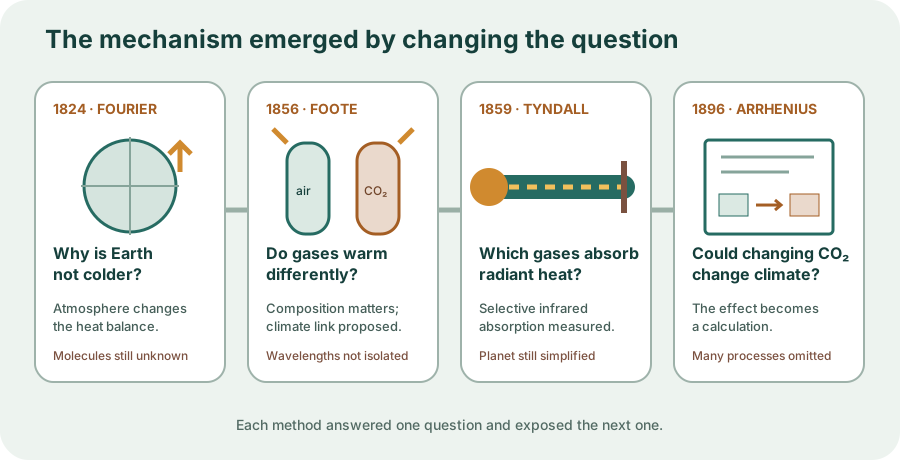
A new method made a different question answerable
1. Fourier, 1824: a planetary budget
Question: why is Earth not colder?
Incoming and outgoing energy must be considered together. The atmosphere can change how they balance
Limit: the particular molecular absorption bands were still unknown
2. Foote, 1856: cylinders in sunlight
Question: can different gas mixtures warm differently?
Thermometers compare ordinary air with carbon dioxide in sunlit cylinders. Foote proposed a climate connection
Limit: this did not isolate Earth’s long-wave infrared absorption
3. Tyndall, 1859: an infrared path
Question: which gases absorb radiant heat?
A heat source, controlled gas tube and detector test what radiation gets through. Some gases absorb it much more strongly
Limit: a controlled tube is not the whole atmosphere
4. Arrhenius, 1896: a calculation
Question: could changing carbon dioxide change climate?
Laboratory absorption becomes an input to a planetary temperature calculation
Limit: sparse measurements and simplified clouds, convection and heat exchange constrained the result
Planet arrows: incoming and outgoing energy. Cylinder symbols: gas comparison with thermometers. Dashed tube line: the radiation path from source to detector. Paper boxes: a calculation’s input and output. None is a measured temperature or flux plot
Schematic apparatus symbols, not to scale or reconstructions of historical laboratories. Thermometer symbols carry no measured readings. The boxes in the calculation stand for input and output, not data points. The order is chronological, not a claim of direct collaboration. Foote did not isolate outgoing infrared wavelengths, and Arrhenius did not produce a modern climate forecast.
Sources: IPCC: early energy-budget reasoning; Foote: original gas-cylinder paper; Royal Institution: experiments and attribution; Royal Institution: Tyndall’s apparatus
In 1938, Guy Callendar assembled temperature records and carbon-dioxide estimates to argue that human emissions were already warming the climate. Later work repaired large gaps in both his and Arrhenius’s treatment. The American Institute of Physics history follows that uneven progress, including decades when researchers doubted that carbon dioxide could have a large effect.
What the mechanism means now
Most incoming sunlight is visible light or near-infrared light, just beyond the red end of the visible range. After the surface warms, it gives off infrared radiation with longer wavelengths. Greenhouse gases absorb particular parts of that outgoing spectrum and emit infrared in all directions. The upward emission still allows energy to escape to space; the downward emission adds energy to the surface and lower atmosphere. The climate warms until outgoing energy again balances absorbed sunlight.
That last sentence matters. Greenhouse gases do not “trap heat forever.” They change the altitude, wavelengths and temperature from which energy escapes. Rising and sinking air, evaporation and condensation also move energy inside the atmosphere, so a complete climate model is much richer than a single radiating layer.
NASA’s measured energy-budget explanation connects the mechanism to satellite observations. Roughly 1,360 watts per square metre arrives on a surface directly facing the Sun. Earth is a sphere, so the same incoming sunlight is spread over a total surface area four times as large. The planetary average is therefore about one-quarter of that value. Reflection, absorption and outgoing infrared then close the budget.
What the model can and cannot show
EXPLORE THE IDEA
How does one radiating layer change equilibrium?
Upper rounded band: one effective infrared layer. Lower rectangle: the radiating surface. Energy pathways are labelled below instead of crossing the arrows.
Orange downward arrow: absorbed sunlight reaches the surface, 238.0 W/m². The surface emits 387.0 W/m² of infrared in this equilibrium.
Navy surface-to-space arrow: 89.0 W/m² passes through the layer without absorption. Red surface-to-layer arrow: 298.0 W/m² is absorbed by the layer.
Green arrows starting at the layer: 149.0 W/m² emitted upward and the same amount downward. Total escaping infrared is direct surface emission plus upward layer emission, 238.0 W/m², matching absorbed sunlight.
Arrows identify energy pathways; widths are not scaled to wattage. Zero-flux paths disappear. At zero absorptivity, all surface infrared escapes directly and the layer absorbs and emits none.
238.0 W/m²Absorbed sunlight
-18.6 °CNo-layer effective temperature
14.3 °COne-layer surface
+32.9 KModel layer difference
Increase albedo: more sunlight is reflected and both temperatures fall. Increase infrared absorptivity: the selected layer sends more energy downward, so the surface must become warmer before the same absorbed solar power escapes to space.
Ideal global-mean, one-layer radiative equilibrium. Solar input is fixed at 1,360 W/m² and divided by four for spherical geometry. The atmosphere is transparent to sunlight, has one effective infrared absorptivity and obeys Kirchhoff’s law; the surface is an ideal infrared emitter. Inputs are illustrative, not observations. The model omits wavelength bands, clouds, convection, evaporation, height and feedbacks, so it is not a climate forecast and its absorptivity is not CO₂ concentration. No animation.
No single experiment discovered today’s greenhouse effect. Fourier identified a planetary imbalance. Foote showed that gas composition could change heating and imagined a climatic consequence. Tyndall measured selective absorption of infrared. Arrhenius made composition calculable. Later scientists confronted those ideas with better spectra, weather records, balloons, aircraft and satellites.
The result is not a chain of names decorating a settled fact. It is a chain of questions, each made answerable by a new way of seeing the invisible.
YOUR PERSPECTIVE
Join the discussion
What surprised you? Have a question or a correction? Share your thinking.
No comments yet. Start the conversation.
Sign in with ChatGPT to commentAnyone can read the discussion. Sign-in helps limit spam.