
A breaking wave briefly acquires a blue edge. Then the edge disappears. Another wave arrives, and the light returns in a different pattern. The sea seems to have an electrical fault, but the flashes are being made by living organisms responding to their surroundings.
The distinction matters. Water can reflect moonlight, and foam can scatter illumination from the shore. Bioluminescence is different: organisms supply light through chemical reactions. It occurs from surface waters to the deep seafloor, and its purposes include feeding, defence and communication. NOAA's introduction places a familiar beach spectacle within this much wider biological world.
A wave switches on a living response
Many sparkling surface displays involve dinoflagellates, single-celled plankton that drift in the water. The passage of a boat or a swimming animal can trigger a flash by bending or disturbing the cells. A glowing wake therefore traces both moving water and the presence of responsive cells. The light does not mean that seawater itself has become a luminous substance. The Bioluminescence Web resource hosted at UC Santa Barbara describes these organisms as the usual source of a ship's brilliant surface wake.
For a cell, disturbance can begin a sequence of internal signals. When a cell’s surface is bent, electrical changes occur across its outer membrane. These lead to changes in acidity inside the cell, which help switch on the light-producing reaction. This is biological control of a reaction, rather than friction heating the water until it glows. The details vary among organisms, so one cellular mechanism should not be treated as a universal marine lighting circuit.
Flashes also have a time structure. The UCSB resource describes some dinoflagellate flashes as lasting roughly a tenth of a second, while other organisms emit for much longer. A continuous-looking display can contain many separate events. Previous daylight and biological rhythms can influence the response too: a photograph of bright water does not tell us that every cell is shining steadily. The physiology overview explains these distinctions.
Where the light's energy comes from
The names luciferin and luciferase describe roles, not one identical pair of chemicals used by every luminous creature. A luciferin participates in the light-producing reaction; a luciferase is a protein that helps the reaction proceed, called a catalyst. A chemical reaction involving oxidation produces a molecule with extra energy. As that molecule returns to a lower-energy state, it can release a photon, a packet of light.
Some systems hold the reacting chemicals within a protein complex called a photoprotein. A charged particle, or ion, such as calcium can trigger it to release light. Organisms may obtain light-producing ingredients through food or manufacture them themselves. The essential engineering distinction is between the energy supply and its control: a trigger starts the process, but does not create energy from nothing. UCSB's chemistry guide introduces these alternatives.
Fluorescence has a different energy source. It absorbs incoming light and re-emits some of that energy, generally at a longer wavelength, meaning a greater distance between wave peaks. A fluorescent organism needs illumination of a suitable kind; a bioluminescent reaction can produce its own light in darkness. Both phenomena can occur in marine life, which is why the words should not be used interchangeably.
Sometimes shining helps you disappear
A luminous signal can serve opposite purposes. It may draw prey towards a mouth, startle an attacker, or distract it with released glowing material. In NOAA's Bioluminescent Ocean video, researcher Edie Widder explains another possibility: an easily noticed display can attract a larger predator that attacks the original attacker. This is often called a burglar alarm. Its usefulness depends on who sees the signal and what they do next.
But consider an animal viewed from below against dim light filtering down from the surface. Its body can interrupt that background, producing a silhouette. Light organs on its underside can reduce the difference by emitting light towards the observer. This is counterillumination: camouflage achieved by adding light. The Smithsonian's explanation illustrates how matching the background can make a body harder to distinguish.
An underside can add light to reduce its silhouette
Both panels show an observer’s upward view against the same dim surface-light background
No underside light
Background: dim light filtering down from above
Observer below, looking up: the underside makes a dark patch against the light
Background-matched underside light
Background: the same dim light from above
Observer below, looking up: light from the underside makes its brightness closer to the background
The eye and upward dashed arrow indicate the observer and viewing direction. The pale field represents the light background. The second body is outlined only to show where it is
Schematic upward views of a generic underside, not to scale or observations of a species. The dashed outline and small circles locate the body and light organs; they do not show measured visibility. Brightness matching alone does not guarantee invisibility: colour, viewing angle, shape and changing illumination also matter. Proposed functions require evidence for each organism.
Sources: Smithsonian Ocean: underside light and camouflage; UCSB: proposed functions and experimental evidence
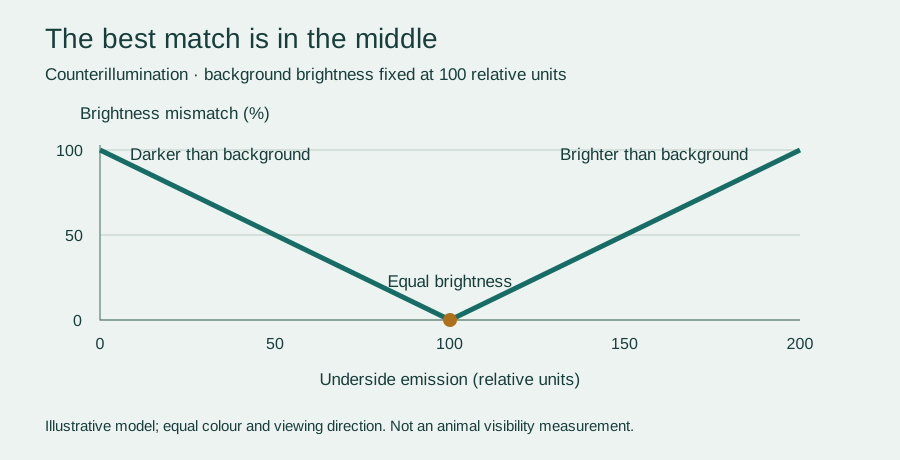
More light is not automatically better. Too little leaves a dark patch; too much creates a bright patch. The interactive model below isolates this matching problem. It compares two brightness values, without claiming to reproduce an animal's shape, vision or complete behaviour. Real camouflage must also contend with colour, viewing angle and changing illumination.
Nor does every plausible explanation count as a demonstrated function. Researchers must observe or test how other organisms respond. The UCSB functions overview explicitly distinguishes proposed roles from those supported by experiments. One species may use light in several contexts; another may remain poorly understood.
From sailors' accounts to satellite evidence
There is another kind of glowing sea, with a surprisingly different appearance. Mariners have described broad, steady whitish illumination rather than brief blue sparks. These rare milky seas are associated with luminous bacteria, although their formation on enormous scales remains incompletely understood.
In January 1995, the merchant vessel S.S. Lima crossed one such region. Researchers later identified corresponding satellite imagery. A 2021 study led by Steven Miller and colleagues extended the investigation using sensitive night-time satellite observations. Searching imagery from 2012–2021, they identified twelve candidate events meeting their detection criteria. Their open-access research paper connects historical reports with measurements and explains the limitations.
This is more than a new way to take a striking picture. Knowing where a persistent glow is occurring could help scientists direct a ship towards it and sample the organisms. A satellite detects light over a large area; it does not, by itself, identify every cell responsible. Combining observations from a distance with samples of the water is what can turn a luminous mystery into a biological explanation.
Go deeper: the brightness-matching model
The next blue wave is worth seeing as a sequence of events: water moves, cells respond, chemistry releases light, and another living thing may detect it. What looks like decoration to a person on the shore belongs to the practical business of surviving in the ocean.
EXPLORE THE IDEA
Can more light make an animal harder to see?
Increase underside emission until it matches the light behind it, then continue past the match.
Scroll the diagram sideways to see every label.
Illustrative brightness comparison, not a real animal or visibility threshold. Background = 100 relative units. Mismatch = absolute difference divided by background, expressed as percent. Equal colour and viewing direction assumed; shape, scattering, reflections and visual sensitivity are excluded. No animation.
YOUR PERSPECTIVE
Join the discussion
What surprised you? Have a question or a correction? Share your thinking.
No comments yet. Start the conversation.
Sign in with ChatGPT to commentAnyone can read the discussion. Sign-in helps limit spam.