
In July 1969, Apollo 11 astronauts placed a square panel of glass corner-cube reflectors on the Moon. These send incoming light back towards its source. The device needed no battery. An observatory on Earth could fire a laser pulse toward it, wait for a few returning photons (tiny packets of light) and measure their round-trip time. Decades later, those echoes still reveal a motion far too small to notice in the sky: the Moon’s mean orbital distance is increasing by about 3.8 centimetres per year.
That value comes from a long series of measurements, not from comparing two photographs. NASA describes a typical round trip for the laser light as about 2.5 seconds; modern analyses can determine range to millimetre scales after modelling the orbit, Earth’s rotation, the atmosphere and the observing station. NASA explains the experiment and its five lunar reflector arrays. The International Laser Ranging Service describes the scientific network that turns those difficult photon returns into a record of the Earth–Moon system.
Why should the distance change at all? The answer begins not on the Moon, but in Earth’s oceans.
A tide is more than water rising at a beach
The Moon’s gravity is slightly stronger on the side of Earth nearer the Moon and slightly weaker on the far side. That difference stretches the oceans and the solid Earth into a tidal pattern. If Earth did not rotate and its response were perfectly immediate, the bulges would line up neatly with the Moon.
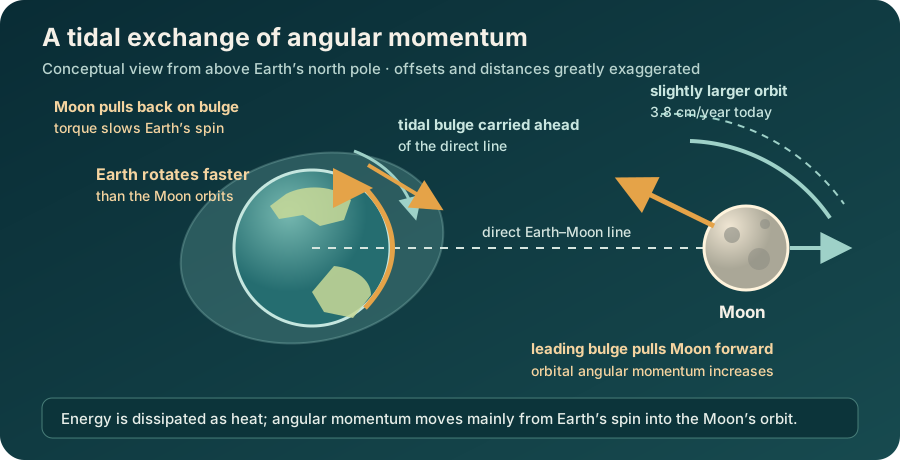
Real Earth is messier. Our planet turns once in roughly 24 hours, much faster than the Moon completes an orbit in about 27.3 days. Continents interrupt the oceans. Water takes time to change its motion, a property called inertia. Friction also turns some of the moving water’s energy into heat. Earth’s rotation carries the tidal response slightly ahead of the direct Earth–Moon line. NASA’s tidal-locking explainer shows this deliberately exaggerated geometry.
The offset matters because the bulge itself has mass. Its gravity pulls on the Moon a little forward along the Moon’s path. The Moon, in return, pulls backward on the bulge and therefore on rotating Earth. This paired interaction is a torque, a turning influence. Earth’s spin slows, while the Moon’s orbit gains angular momentum. This measures rotational motion and depends on mass, speed and distance from the centre of rotation.
Slower in orbit can mean farther away
It sounds contradictory: a forward gravitational pull gives the Moon angular momentum, yet a higher orbit has a lower average orbital speed. The missing step is that an orbit is a continuous fall.
Adding orbital energy and angular momentum does not make the Moon fly straight outward. It moves into a slightly larger orbit. At the greater distance, gravity is weaker and the Moon takes longer to complete each circuit. Satellites raised to higher circular orbits behave in the same counter-intuitive way: after the manoeuvre is complete, they travel more slowly around the planet even though energy was added.
The accounting separates two quantities. Some mechanical energy becomes heat through tidal friction in oceans and within Earth. But, to a very good approximation for this explanation, angular momentum is transferred within the Earth–Moon system: Earth’s spin loses some and the lunar orbit gains some. A peer-reviewed review of laser-ranging results describes the same leading bulge, the deceleration of Earth’s spin and the increase in lunar distance. Read the open-access analysis.
The interactive model below keeps that bookkeeping deliberately simple. Move a small fraction of Earth’s present spin angular momentum into an ideal circular lunar orbit. Earth’s illustrative day lengthens and the orbit expands. It is not a timeline or a forecast: the real torque changes with ocean geometry, distance and many other factors.
Why does the Moon not fall back when it slows?
Measuring a trend inside a changing distance
The Moon is not always 384,400 kilometres away. That number is an average; its elliptical orbit makes the instantaneous distance vary by tens of thousands of kilometres. The annual 3.8-centimetre recession is therefore not read from a single range value. Scientists fit years of observations to a detailed dynamical model and look for the accumulated change in the orbit.
The experiment also depends on knowing where the observatory is and how Earth is oriented. The University of Texas notes that McDonald Observatory began routine lunar ranging after Apollo 11 and that timing a laser’s outward and return journey supplies the distance. Its laser-ranging history explains the measurement chain. NASA’s Moon facts page gives the current mean distance as about 384,400 kilometres. See the scale of the Earth–Moon system.
At the present rate, the mean distance changes by only about one kilometre in 26,000 years. That comparison is useful for scale, but it must not be treated as a prediction.
The rate has never been a fixed clock
It is tempting to multiply 3.8 centimetres by billions of years and run the film backward. That produces the wrong history. Tidal dissipation depends on the shapes and depths of oceans, the positions of continents, Earth’s rotation rate and the Earth–Moon distance itself. All have changed.
Layers deposited by ancient tides and astronomical cycles preserved in rocks provide clues to past day lengths and lunar distance, but the records are sparse and their interpretation can be difficult. The oceans respond more strongly to tidal forcing at some rhythms than others, much as a swing responds to well-timed pushes. These resonances change as ocean basins change. Modern models allow for this instead of assuming that tides always lose energy at today’s rate. A 2022 study from researchers at the Paris Observatory and partner institutions matched the present rate, lunar age and much of the geological evidence while finding strongly non-uniform evolution. The institute explains the evidence and the remaining uncertainty.
So the Moon is not “escaping Earth” in the ordinary sense, and 3.8 centimetres per year is not an eternal speed. It is today’s measured chapter in a coupled evolution. Earth raises tides because of the Moon; those tides reach back gravitationally, lengthening Earth’s day and enlarging the Moon’s orbit.
The laser panel left in 1969 makes the exchange tangible. A pulse crosses nearly 400,000 kilometres of space, touches a silent piece of glass and returns. Repeated over decades, that journey shows that even the apparently permanent distance to the Moon is being rewritten, one few-photon echo at a time.
EXPLORE THE IDEA
Where does Earth’s spin angular momentum go?
24.060 hIllustrative rotation period
+3.6 minChange from 24 hours
384792 kmIllustrative orbital radius
Move the slider upward. Conserving angular momentum makes Earth rotate more slowly while the ideal lunar orbit expands. The slider is intentionally not labelled in years: real tidal transfer has never proceeded at one fixed rate.
Scroll the diagram sideways to see every label.
Illustrative angular-momentum ledger, not a past or future timeline. Starts with a 24-hour Earth, a circular 384,400 km lunar orbit and fixed present-day masses and Earth radius. The slider transfers a selected fraction of Earth’s present spin angular momentum into the lunar orbit. It omits tidal-rate history, eccentricity, the Sun, changing oceans, internal deformation and energy dissipation details. No animation.
YOUR PERSPECTIVE
Join the discussion
What surprised you? Have a question or a correction? Share your thinking.
No comments yet. Start the conversation.
Sign in with ChatGPT to commentAnyone can read the discussion. Sign-in helps limit spam.