
A model in the Smithsonian’s collection carries a surprisingly modern label: Jacob Perkins Ice Machine, 1834. Its pipes and vessels look remote from the quiet cabinet in a kitchen, yet the central idea survived. A volatile fluid, one that can readily turn into vapour, could circulate in a closed system, repeatedly evaporating and condensing instead of being consumed.
The Smithsonian object record preserves a model of Perkins’s machine. It marks an important change in the meaning of cold. Ice no longer had to be collected somewhere cold and transported. A machine could maintain a cold space by moving energy.
That last phrase is the key. A refrigerator does not manufacture “cold” as a substance. It pumps heat out of one place and releases still more heat somewhere else.
Heat would rather travel the other way
Leave a cold drink in a warm room and heat flows from the room into the drink. The temperatures drift toward one another. The reverse does not happen by itself: a cold drink does not become colder while making the room warmer.
A refrigerator uses electrical energy to drive that reverse transfer. The study of heat and energy is called thermodynamics. In its language, a refrigerator is a heat pump used to keep the cold side cold. MIT’s thermodynamics notes describe the energy balance: the machine extracts heat at low temperature, receives work, and rejects heat at a higher temperature.
This is why running a refrigerator with its door open cannot cool a kitchen. While running with its door open, it returns the heat it removes to the same room plus the electrical energy used by its compressor. The room warms overall.
One fluid, four jobs
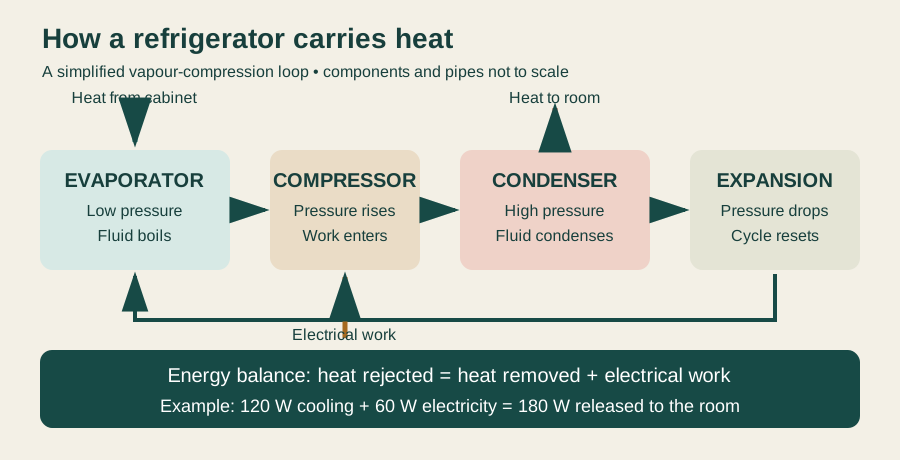
Most household refrigerators use a vapour-compression loop. The refrigerant, the fluid carrying heat around the loop, repeatedly performs four jobs:
The evaporator absorbs heat. A heat exchanger lets heat pass between the refrigerant and its surroundings. Inside the evaporator, the low-pressure refrigerant is colder than the cabinet air. Energy enters it from the air, shelves and food. Much of the fluid boils, changing from liquid to vapour. Boiling is useful because a phase change can absorb substantial energy without requiring a similarly large temperature rise.
The compressor adds work. An electric motor drives a pump that draws in the low-pressure vapour and compresses it. Its pressure and temperature rise. The hot, high-pressure vapour can now release heat to a room that is warmer than the refrigerator interior.
The condenser rejects heat. In the room-side heat exchanger, energy flows from the hot refrigerant to the surrounding air. The refrigerant releases energy as it changes from vapour towards liquid. This change is called condensation. On some appliances these coils are visible at the back; on others they are concealed in the cabinet structure.
The expansion device restores the low-pressure side. A narrow capillary tube or another passage that restricts flow drops the refrigerant’s pressure before it re-enters the evaporator. At the lower pressure, its boiling temperature is low enough for it to absorb heat from the cabinet again.
Pressure does not magically destroy heat. The compressor and restriction establish two pressure regions, while the heat exchangers let the same fluid absorb energy inside and reject it outside. The loop works because the fluid’s temperature is made lower than the cabinet on one side and higher than the room on the other. MIT’s hardware explanation follows these energy transfers around the loop.
Why the back feels warmer than the food was
Suppose the evaporator removes an average of 120 watts of heat from the cabinet while the compressor consumes 60 watts of electrical power. Conservation of energy requires the condenser to release 180 watts into the room: 120 watts carried from inside plus 60 watts supplied by the motor.
The ratio of useful cooling to work input is the refrigerator’s coefficient of performance, or COP. In that illustration, COP = 120/60 = 2. A COP above one is not a claim of free energy. Cooling is heat being transported, not electrical energy being created. The room receives the complete energy total.
Explore the heat balance
Real machines cycle on and off, change efficiency with operating conditions, and use fans, controls and sometimes heaters for defrosting. COP is not a fixed badge for every moment. A larger difference between the cold interior and warm room generally makes moving the heat harder and reduces efficiency. This difference is called the temperature lift.
The cabinet is part of the machine
Insulation and door seals do no active cooling, but they reduce the heat that the loop must transport. Every door opening exchanges some cold cabinet air for warmer, often moister room air. Warm food adds another temporary load. Moisture can freeze on cold surfaces, which is why frost management matters to heat transfer and airflow.
This explains several practical recommendations without turning them into rituals. ENERGY STAR advises keeping door seals airtight, minimising open-door time, allowing air circulation behind the appliance and placing it away from heat sources. Its refrigerator guidance also notes the roles of efficient compressors and improved insulation.
Temperature is not merely an energy question. The US Food and Drug Administration recommends keeping a refrigerator at or below 4°C and a freezer at −18°C; chilling slows the growth of many bacteria but does not make poor handling safe. Its food-storage guidance distinguishes refrigeration from sterilisation and gives current safety advice.
The fluid matters beyond the appliance
A refrigerant needs suitable pressure–temperature behaviour, but performance is not the only design concern. Toxicity, flammability, ozone depletion and climate impact also matter. The US Environmental Protection Agency evaluates alternatives across these risks; its current refrigeration overview shows why there is no single fluid choice detached from the application.
Refrigerant history also contains an environmental correction. The 1987 Montreal Protocol organised the phase-out of ozone-depleting substances. Some hydrofluorocarbons adopted as replacements do not deplete ozone but are powerful greenhouse gases, so the 2016 Kigali Amendment called for their phasedown. The UN Ozone Secretariat explains that sequence.
The ordinary refrigerator is therefore a compact meeting of physics, engineering and policy. Perkins’s nineteenth-century apparatus demonstrated that a working fluid could be sent around again. Modern machines make that loop quiet, controlled and repeatable, but never effortless. Each time the cabinet loses heat, the room must receive that heat, the compressor’s work, and the reminder that “cold” is really a carefully maintained imbalance.
EXPLORE THE IDEA
Where does the refrigerator’s energy go?
120 WTotal cooling load
60 WCompressor input
180 WHeat released to room
1.44 kWh/dayCompressor electricity only
Increase the door/food load: both electrical input and room heat rise. Raise COP: input falls, but the selected cooling load stays the same.
Scroll the diagram sideways to see every label.
Steady average-load teaching balance, not an appliance test or energy-label prediction. Heat leak and door/food load are illustrative watts; COP is dimensionless and held constant. Daily energy counts compressor electricity only; it excludes fans, controls and defrost heaters. It assumes the selected average loads persist for 24 hours. Real compressors cycle and COP varies with temperatures and operating state. No animation.
YOUR PERSPECTIVE
Join the discussion
What surprised you? Have a question or a correction? Share your thinking.
No comments yet. Start the conversation.
Sign in with ChatGPT to commentAnyone can read the discussion. Sign-in helps limit spam.