
In February 1941, a gravely ill policeman named Albert Alexander received an experimental treatment in Oxford. His condition improved. Then the available penicillin ran out. The infection returned, and he died. The episode, described in the Science Museum’s history of penicillin, exposes what the familiar discovery story leaves unfinished.
A substance can work and still fail to become an available medicine. Someone must obtain it reliably, separate it from everything else, test it and make enough. Alexander’s story turns the question from “Who discovered penicillin?” into something harder: how did anyone make the discovery usable?
The clear space on a crowded dish
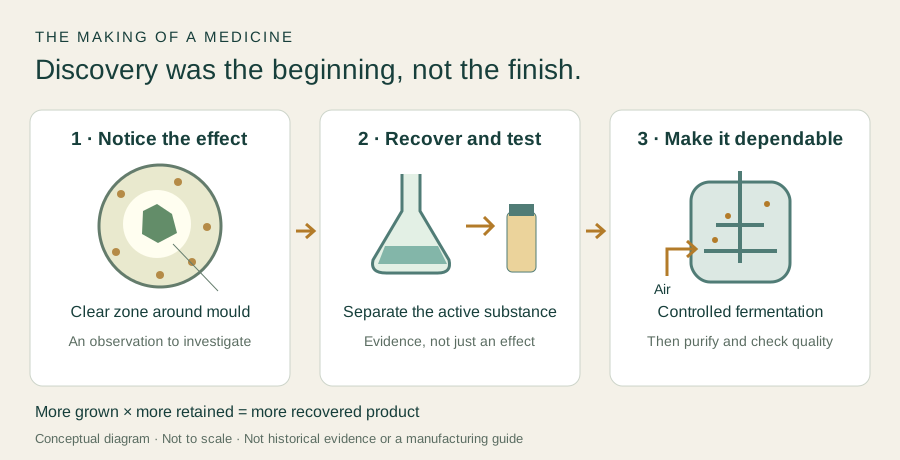
In 1928, at St Mary’s Hospital in London, Alexander Fleming noticed that bacteria were absent around a patch of contaminating mould on a culture plate, a dish used to grow microbes. The mould produced a substance that slowed or stopped the growth of bacteria that were sensitive to it. Fleming named it penicillin and published his findings in 1929. Isolating a stable preparation proved difficult. The American Chemical Society traces the discovery.
The observation mattered because it was more than an untidy dish: there was a biological effect to investigate. But a clear patch is not a medicine bottle. It does not establish how much active material is present, whether it can survive extraction, or what will happen inside a patient. Those are separate questions, and a striking first result cannot answer them by itself.
A wall that bacteria need to build
Penicillin interferes with construction of the bacterial cell wall. Many bacteria have a reinforcing mesh called peptidoglycan outside their cell membrane. Enzymes, proteins that help chemical reactions proceed, join parts of that mesh together as the cell grows and remodels its surroundings. Penicillin binds to particular wall-building enzymes, preventing the links that join the mesh into a strong wall. In susceptible, growing bacteria, the weakened wall can fail.
Block the builder, weaken the growing wall
In susceptible, growing bacteria
Normal growth
Dark horizontal lines: wall strands
Penicillin present
Dark horizontal lines: wall strands
Schematic, not to scale. The enzyme and drug shapes are symbols, not molecular structures. Susceptibility and drug access matter. This is not treatment advice.
Source: OpenStax Microbiology: inhibition of new peptidoglycan cross-linking
That is a targeted disruption of a cellular process, not a chemical that simply burns through everything nearby. It also explains why “kills bacteria” needs qualification: the organism must be susceptible, and the drug must reach its target. Bacteria can resist penicillins through mechanisms including enzymes that break an essential ring-shaped part of the drug molecule, called its beta-lactam ring. This medical review explains the mechanism and its limitations.
Knowing the molecular explanation today should not make the original work seem inevitable. Researchers could demonstrate useful effects before they possessed our detailed account of the machinery involved.
Oxford turns a clue into evidence
Howard Florey, Ernst Chain and their Oxford colleagues took up the problem. Norman Heatley made important contributions to extraction and testing. In 1940, experiments showed protection against otherwise lethal bacterial infection in mice; clinical work followed in 1941. ACS documents the Oxford programme.
The laboratory became an improvised production centre. Mould cultures occupied an assortment of containers, followed by specially designed vessels. Six women employed to maintain the cultures performed the repetitive work behind the precious output. The Science Museum preserves the vessels and the team’s story.
There is a useful distinction here between a convincing experiment and a dependable supply. An experiment asks whether an effect exists under specified conditions. Production asks whether the result can be obtained again, in sufficient quantity and to an acceptable standard. Penicillin needed both kinds of success. The less celebrated work of tending cultures was not an epilogue to discovery; it was part of making discovery matter.
The agricultural laboratory in the middle
In 1941, Florey and Heatley travelled to the United States. An agricultural laboratory in Peoria, Illinois, had expertise in fermentation: growing microbes under controlled conditions to make useful products. Its researchers helped improve yields using corn-steep liquor, a by-product of corn processing, and growing the mould within liquid, with air supplied to support its growth.
They also searched for more productive mould strains. A mouldy cantaloupe from a Peoria market supplied a strain whose improved descendants performed well in submerged conditions. Methods and cultures were shared with research groups and industry. USDA recounts the Peoria contribution.
The important point is not that a second lucky mould solved everything. A candidate organism still had to be evaluated, improved and matched to a workable process. Biology supplied possibilities; systematic comparisons determined which could be useful.
A bigger vessel is a different problem
Industrial fermentation means cultivating organisms to obtain useful products; it does not necessarily mean making alcohol. For penicillin, manufacturers had to make a living production system behave consistently.
Pfizer brought experience from producing other chemicals by fermentation, including gluconic acid in aerated deep tanks. Its engineers had to keep unwanted microbes out, supply enough oxygen and grow mould throughout large tanks of liquid rather than only at the surface. The company opened a large-scale penicillin plant in Brooklyn in 1944. Other manufacturers also contributed to the wider production effort. ACS describes the deep-tank engineering.
Production was only half the accounting. Penicillin in the broth, the liquid in which the mould grew, still had to be separated and cleaned. Some penicillin was lost during this extraction and purification, so increasing the amount grown and retaining more of it were different opportunities for improvement.
Explore the production arithmetic
A breakthrough, not a universal remedy
Fleming, Florey and Chain shared the 1945 Nobel Prize for their penicillin work. The ACS historical account also makes clear how many collaborators and institutions lay behind the medicine.
The achievement does not make antibiotics appropriate for every illness. They do not treat viral infections such as colds and flu, and unnecessary use contributes to resistance. Decisions about treatment belong with a qualified clinician; prescribed antibiotics should be taken as directed. The NHS explains appropriate antibiotic use. This story is medical history and science education, not advice to make or select a treatment.
Penicillin’s journey changes what a discovery looks like. The memorable image is a dish with a clear patch. The fuller image includes culture vessels, careful measurements, extraction equipment and factories. Noticing nature’s possibility was essential. Making that possibility dependable was another achievement altogether.
EXPLORE THE IDEA
What happens if more of the product survives recovery?
10.0 gInitially in broth
5.0 gRecovered product mass
5.0 gNot recovered
Raise recovery from 50% to 75%: output rises by half without adding any broth. Doubling volume helps only if the other assumptions hold.
Scroll the diagram sideways to see every label.
Illustrative mass balance, not historical production data or a manufacturing protocol. Recovered mass (g) = volume (L) × concentration (mg/L) × recovery fraction ÷ 1,000. Inputs are assumed independent; real fermentation, purity, potency, contamination, costs and quality requirements are not modelled. Not a dose calculator. No animation.
YOUR PERSPECTIVE
Join the discussion
What surprised you? Have a question or a correction? Share your thinking.
No comments yet. Start the conversation.
Sign in with ChatGPT to commentAnyone can read the discussion. Sign-in helps limit spam.