You are sitting in Delhi. Someone in London sends you a photograph. A moment later, it appears on your phone.
No parcel arrives. Nothing around you seems to move. Your phone is not connected to a visible cable. Yet the information behind that photograph may have travelled through glass fibres resting on the seabed.
The internet feels almost weightless because its machinery is so well hidden. But its international connections belong to a very physical world of coastlines, ships, cables and repair crews. To understand them, it helps to begin with a time when an ocean could hold up a conversation for weeks.
When a reply needed a ship
In the nineteenth century, a message between Europe and North America travelled by sea. Telegraphs were already changing communication on land. Extending that idea across the Atlantic demanded something much harder: manufacturing, transporting and laying an immense continuous cable without losing it to the deep.
Cyrus West Field helped drive the project forward. In 1858, after failed attempts, two ships joined their cable lengths in the Atlantic and sailed towards opposite shores. A connection was achieved, but it worked for only a few weeks. The effort had demonstrated a possibility without yet delivering a dependable service.
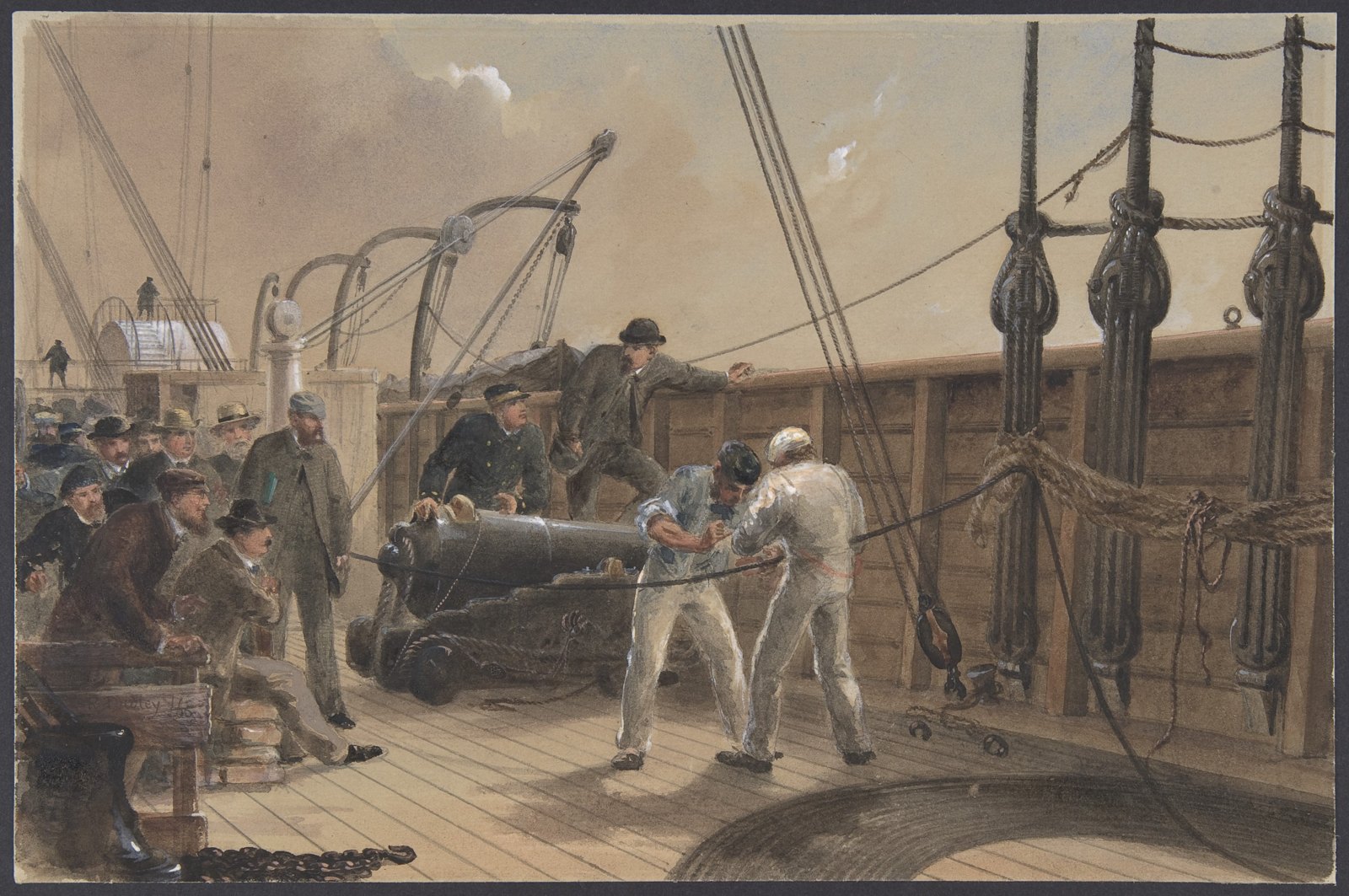
Further attempts followed. The enormous Great Eastern carried cable for the 1865 expedition, which also suffered a break. In 1866 a successful cable finally established a lasting connection. The achievement depended on improved equipment, practical experience and persistence as much as ambition. The Science Museum tells the history.
Look at the painting above: the people bending over the cable are doing work that an abstract drawing of a network leaves out. Someone has to build the connection. Someone has to recover it when it fails. Even a seemingly invisible service has a working life of tools, weather and difficult decisions.
What actually crosses the water?
Today, the photograph is represented as digital data. Across the internet, data travels in smaller units called packets. Addressing information allows networking equipment to forward those packets, and the receiving system reconstructs the data needed to display the image.
Imagine sending a book in numbered envelopes. The delivery network handles the envelopes; the recipient assembles their contents. This is a simplified analogy, but it captures a useful idea: moving information and understanding what it means are different jobs. How the internet works — Cloudflare.
A typical journey can involve several physical media. A radio signal might connect your phone to a nearby router or mobile network. Fibre then carries traffic across land. If the selected route crosses an ocean, a submarine cable can connect the networks on either side. Not every international connection needs a submarine cable; neighbouring countries can connect over land too. The physical infrastructure beneath internet routing — CAIDA.
Notice what that means for the word “wireless.” It describes the connection you can see—or, more precisely, the cable you do not need at your end. It does not describe every metre of the journey.
Glass, light and a very long journey
Inside a modern optical cable, information is encoded onto light. The fibre is engineered to guide that light along its length. Its central core and surrounding cladding have different optical properties; total internal reflection provides a useful first explanation of how the light remains guided. Optical fibre basics — The Fiber Optic Association.
There is no need to follow the equations to appreciate the design. A thin strand of carefully made glass becomes a controlled path for a signal. The protective cable around it must survive handling and the environment while the optical system preserves readable information over distance.
How does the light stay inside?
Light weakens as it travels, so long submarine systems use optical amplifiers in repeaters along the route. Capacity depends on more than the number of glass strands: the optical equipment, signal design and power available for amplification all matter.
Google’s Dunant Atlantic cable offers a concrete example. Its design uses twelve fibre pairs, with pump lasers shared among multiple pairs to support amplification. That is the sort of engineering decision hidden behind an ordinary download. Inside the Dunant design — Google.
The connection that can take another route
A cable can be damaged. The useful question is what remains available afterwards. Alternative routes can allow traffic to be redirected, but they need enough capacity to carry the additional load. Route diversity is therefore part of the design of a reliable network. Cable network resilience — ICPC.
Think of a bridge closure. A second road is helpful, but it is not equivalent to an unlimited replacement bridge. If many journeys move onto it at once, the detour itself becomes part of the problem. A backup route should be judged by the conditions under which it must work.
Meanwhile, the physical damage still requires attention. Specialised ships can recover the cable and carry out repairs. Redirecting information and restoring the original connection are separate operations, on very different timescales. See cable recovery and repair — ICPC.
The ocean crossing you might never make
Here is the unexpected part: a video from an overseas website may be delivered from a server near you.
Content delivery networks, or CDNs, keep copies of suitable content in different locations. A nearby server can supply a copy without fetching it from the distant original every time. The company’s address and the location serving your screen do not have to be the same. How CDNs work — Cloudflare.
It is like a publisher supplying local bookshops. Every reader does not need a separate delivery from the printing press. Sometimes the best way to improve a journey is to arrange things so that the long journey is unnecessary.
The next time a photograph appears almost instantly, picture the hidden choices behind it: the path through connected networks, the physical medium carrying the signal, and perhaps the nearby copy that saved an ocean crossing altogether.
And keep one question in mind: if your broadband became ten times faster, would a live conversation across the world become ten times more immediate? Follow that question into bandwidth and latency.
EXPLORE THE IDEA
What makes a connection feel faster?
100 msPropagation round trip
0.80 sIdeal file transfer
0.90 sCombined simple estimate
Try increasing the data rate, then shortening the path. Only one of those changes reduces propagation delay.
Idealised fibre speed: 200,000 km/s. Transfer assumes the selected rate is fully available. The combined estimate includes one round trip plus transfer, excluding protocol overhead, queues and server work. The animation shows order only; it is not timed to real network speed.