
In May 1796, Edward Jenner gave eight-year-old James Phipps material from a cowpox sore on the hand of milkmaid Sarah Nelmes. Phipps became unwell and recovered. In July, Jenner deliberately exposed him to smallpox material; the boy did not develop smallpox. The episode is famous, but its central puzzle remains striking: how could one encounter change the outcome of another, weeks later?
Jenner worked within an older history of attempts to prevent smallpox. Variolation, practised in parts of Asia and Africa before its introduction to Europe, used material from smallpox itself and carried serious risks. Cowpox offered a less dangerous source. WHO’s historical account traces these different approaches. Deliberately exposing a child to smallpox is a troubling part of this history, not a model for modern research.
The protection did not depend on remembering the event consciously. Something had changed in the immune system. Vaccination exploits that biological capacity while using tested preparations designed to reduce the dangers of encountering the disease itself.
A recognisable target, presented in advance
An antigen is a molecule or part of a molecule that the immune system can recognise as a target. Different vaccines deliver that target differently: some contain weakened or inactivated organisms, others selected components, and others genetic instructions that let cells temporarily produce an antigen. Their common purpose is to prepare a response to a particular threat. WHO explains the approaches and why some vaccines need several doses.
This is a selective preparation. Immunity against one target does not automatically protect against every other microbe. Related pathogens, organisms or agents that cause disease, can share recognisable features, which helps explain the cowpox–smallpox connection, but similarity is not a universal guarantee. The precise target matters as much as the existence of a response.
The first encounter takes organisation
The immune system already has fast-acting defences. Its adaptive branch develops a response to particular targets, using immune cells called B cells and T cells. Each carries receptors, molecular structures that recognise particular targets. Dendritic cells show antigen fragments to T cells to help start the response. This can happen in lymph nodes, small organs where immune cells gather.
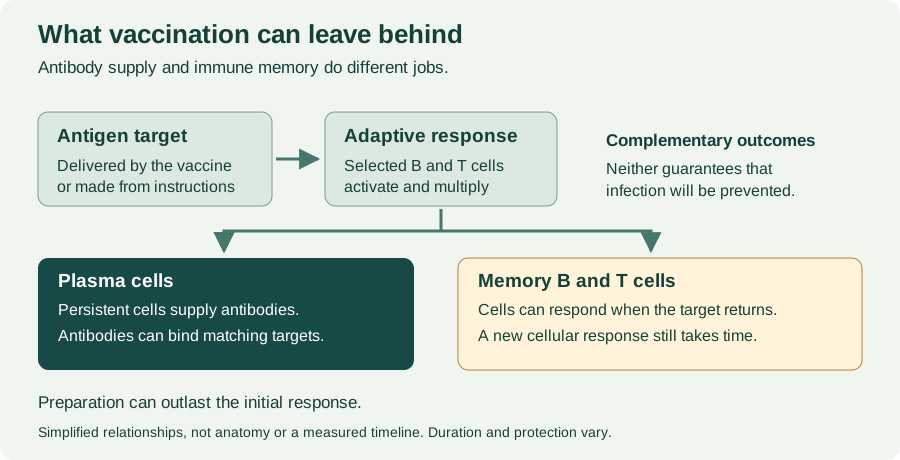
Once activated, helper T cells coordinate other immune cells; some help B cells respond. Cytotoxic T cells can kill infected body cells. B cells can become plasma cells, which release antibodies, proteins that bind matching targets. Building enough of these specialised responders takes time: relevant cells must be activated and multiply. The British Society for Immunology describes this coordination.
A vaccine therefore does more than put a protective substance into circulation. It sets biological work in motion. The eventual response depends on the vaccine, the recipient and the pathogen; there is no single timetable that describes every case.
Where a response becomes more precise
Inside structures called germinal centres, often within lymph nodes, activated B cells multiply. Small changes, or mutations, appear in genes related to their antibodies. The cells then undergo selection based partly on how well their antibodies bind the target. This process is called affinity maturation. It can produce antibodies that attach more strongly to the target, improving the response. Some resulting cells become memory B cells; others become antibody-secreting plasma cells. The BSI’s B-cell guide explains the process.
These changes are experimentally accessible. In a 2022 study, Wooseob Kim and colleagues detected spike-specific memory B cells in 42 people six months after two doses of the Pfizer–BioNTech COVID-19 vaccine. By tracing related cells and testing their antibodies, the researchers linked continuing germinal-centre activity with improved antibody binding and neutralisation, the ability to block the virus’s activity. The university’s record includes the peer-reviewed study’s findings.
That was evidence about a particular vaccine and study population. It was not proof that every vaccine produces identical memory, or that finding memory cells establishes lifelong protection. The value is more specific: researchers could follow the cellular changes behind a response that kept developing.
Antibodies on hand, cells in reserve
Long-lived plasma cells and memory B cells solve different problems. Plasma cells can continue supplying antibodies, including from the bone marrow, the soft tissue inside bones. Antibodies already present may bind a matching invader as it arrives. Memory B cells preserve the capacity to respond again and generate further antibody-producing cells after reactivation. Memory T cells add another part of preparedness.
This distinction matters when someone hears that antibody levels have fallen. It does not automatically mean every relevant memory cell has disappeared. Equally, having memory cells does not mean the body can instantly stop every infection: recalling and expanding a response takes time. A Nature Reviews Immunology review explains the complementary roles of plasma cells and memory B cells.
Explore what changes on a return visit
Why remembering is not an absolute shield
An encounter with a familiar target can produce a quicker response than the first meeting. But protection is not one simple on/off property: preventing infection and limiting its consequences are different outcomes. Children’s Hospital of Philadelphia explains primary and memory responses. A drawing of a faster response should never be mistaken for a prediction about an individual.
Nor does biological understanding remove the need for evidence about each product. Vaccines undergo safety testing and continued monitoring. Most side effects are mild and short-lived, but serious allergic reactions can occur rarely, and certain vaccines are unsuitable for some people. The NHS explains these qualifications. This article explains a mechanism; personal vaccine choices and schedules need current local guidance and an appropriately qualified clinician.
The achievement that began with observations about smallpox eventually required much more than immune memory. Vaccine supply, surveillance and the work of health teams turned protection into a global programme. The World Health Assembly endorsed smallpox eradication on 8 May 1980. The CDC records that history.
The lasting lesson is that a body can retain the consequences of an encounter after the encounter ends. Vaccination makes that capacity useful: a future response can begin with experience already built into living cells.
EXPLORE THE IDEA
What changes when the target returns?
Scroll the diagram sideways to see every stage.
Matching cells must be activated
Antigen recognition starts a specific response. Dendritic cells help activate T cells; B cells also recognise antigen. This simplified first encounter assumes no pre-existing memory to this target.
A qualitative teaching model of adaptive immune memory, not measured data. The later encounter assumes the target is recognised and memory has formed. Responses overlap; the stages are not a clinical timetable. No formula, cell-count estimate or animation is used. This cannot determine vaccine effectiveness, personal protection or dose timing.
YOUR PERSPECTIVE
Join the discussion
What surprised you? Have a question or a correction? Share your thinking.
No comments yet. Start the conversation.
Sign in with ChatGPT to commentAnyone can read the discussion. Sign-in helps limit spam.