
On 16 October 1846, Edward Gilbert Abbott entered the surgical amphitheatre at Massachusetts General Hospital with a tumour-like swelling beneath his jaw. Dentist William Morton gave him ether, a volatile liquid whose vapour was used as an anaesthetic; surgeon John Collins Warren operated. The surviving surgical record is less theatrical than later retellings, but the result was public and repeatable enough to travel. Harvard’s Countway Library examines the operation and its records.
This was not the first human use of an inhaled substance to reduce surgical pain, and it was not the work of one uncontested inventor. Its importance lay elsewhere. A medical audience saw that an operation and the patient’s experience of it could be separated. Once that possibility became credible, surgeons could begin asking not only what could be cut quickly, but what could be repaired deliberately.
A breakthrough with several claimants
Years before the Boston demonstration, physician Crawford Long had used ether during operations in Georgia, beginning in 1842, but did not publish until later. Dentist Horace Wells used nitrous oxide for dental extraction and attempted a public demonstration in Boston in 1845; the patient cried out and the event was judged a failure. Morton’s ether demonstration the following year succeeded before influential witnesses and was rapidly reported. The Wood Library-Museum’s history describes the 1846 event as the first successful public demonstration of modern surgical anaesthesia.
That wording matters. “First discovery” makes history into a finish line. “Successful public demonstration” identifies the mechanism by which practice changed: evidence was shown to people who could scrutinise it, repeat it and tell others. A peer-reviewed historical review likewise distinguishes Morton’s influence from the earlier work of Wells and Long.
The episode also exposes the importance of delivery. Knowing that ether can alter consciousness is not the same as administering enough to prevent pain without pushing breathing and circulation into danger. Early anaesthesia was not merely a substance; it was an uncertain control problem.
Pain had imposed an engineering constraint
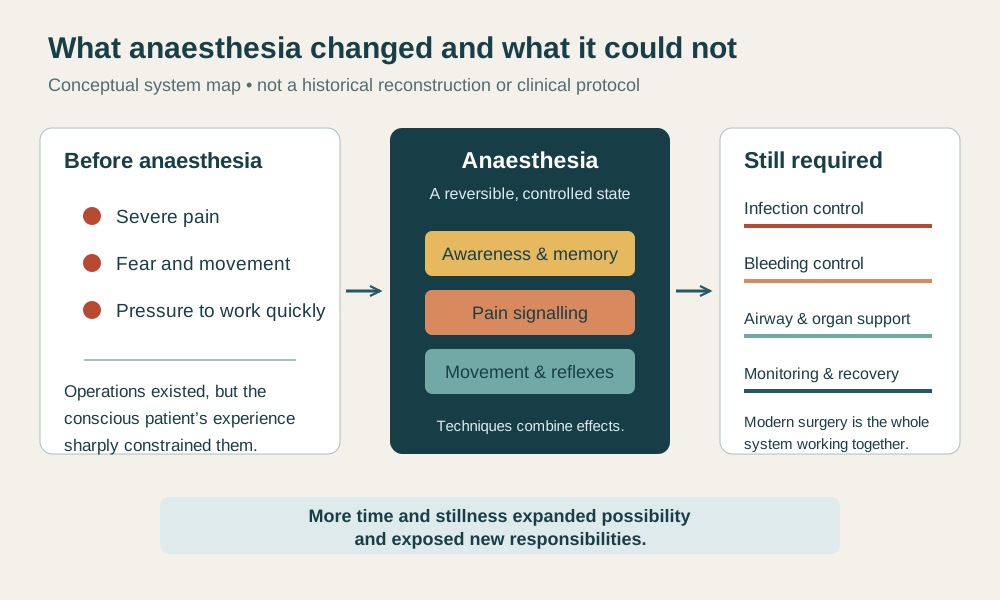
Before effective anaesthesia, operations were not literally unknown. Surgeons amputated limbs, removed bladder stones and treated accessible injuries. But the conscious patient’s pain, fear and movement imposed severe constraints. Speed was valued because every additional moment extended suffering and struggle. Complex internal work was correspondingly difficult to contemplate.
The US National Institute of General Medical Sciences notes that surgery before safe, effective anaesthetics was rare, dangerous and generally a last resort. Anaesthesia did not make the surgeon more knowledgeable by itself. It changed the conditions under which the surgeon worked: the patient could remain still, the operation could be planned in stages, and the surgeon could work with greater deliberation.
That extra time was not automatically beneficial. A longer operation could also mean more blood loss, greater physiological disturbance and more opportunity for contamination. Anaesthesia removed one bottleneck and made the others impossible to ignore.
Four problems that should not be confused
General anaesthesia is not ordinary sleep
Modern general anaesthesia is a drug-induced, reversible state. A widely cited medical review by Emery Brown and colleagues describes several components: unconsciousness; amnesia, preventing memory formation; analgesia, reducing or preventing pain; and immobility, preventing movement. Clinicians also manage bodily responses such as changes in breathing and blood pressure. These components are related but not identical. A person can be unable to form memories without every pain pathway being blocked; a drug that relaxes muscles does not by itself produce unconsciousness.
That is why contemporary practice often uses balanced anaesthesia: different medicines and techniques contribute different effects rather than asking one agent to do everything. Local and regional anaesthesia can interrupt signals from a particular area while the patient remains conscious; general anaesthesia acts across the body and brain. NIGMS explains that anaesthetics influence nerve signalling in several ways. These involve neurotransmitters, chemicals that carry messages between nerve cells, and ion channels, tiny pathways that let charged particles cross cell membranes. Scientists are still investigating important details of altered consciousness and awakening.
Calling the state “sleep” is convenient but incomplete. Natural sleep is generated and cycled by the brain. General anaesthesia is deliberately induced, maintained and reversed while surgery sends powerful signals through the body.
Removing pain created a new profession
The early triumphs were followed by deaths and disputes over agents such as ether and chloroform. The lesson was not that anaesthesia had failed, but that someone had to treat it as continuous clinical work. The team must manage the dose, keep the airway clear, supply oxygen, support breathing, and watch blood pressure and temperature. Care continues as the patient recovers. An anaesthetist does not simply start unconsciousness and leave the room.
Oxford University Hospitals describes the modern role clearly: the anaesthetist plans an individual approach, remains throughout the operation, monitors heart, blood pressure and oxygen levels, treats the effects of surgery and anaesthesia, and continues responsibility into recovery. Its clinical overview follows that work from assessment to recovery.
This history also corrects a comforting misconception. Modern anaesthesia is generally very safe, but “safe” does not mean risk-free. Breathing problems, allergic reactions, temporary confusion and other complications can occur; individual risk also depends on the operation and the patient’s health. MedlinePlus gives a current, patient-facing summary of benefits and risks. This article is history and science education, not personal medical advice.
Anaesthesia’s deepest contribution was therefore not a single bottle of ether. It was the idea that pain, consciousness and physiology could be managed as an active system while another team repaired the body. The public demonstration in 1846 opened that door. Antisepsis, blood control, monitoring, specialist training and recovery care made it possible to keep walking through it.
YOUR PERSPECTIVE
Join the discussion
What surprised you? Have a question or a correction? Share your thinking.
No comments yet. Start the conversation.
Sign in with ChatGPT to commentAnyone can read the discussion. Sign-in helps limit spam.