
A piece of wood from an ancient Egyptian coffin arrived with something most archaeological samples lack: an age that historians could estimate from records without using the new dating method. In the late 1940s, Willard Libby's group used such known-age objects to test a new clock. If the physics disagreed badly with the established chronology, the idea would fail before it could rewrite anyone else's past.
The measurements agreed closely enough to make the method credible. Libby had not found a date hidden in the grain. He had connected five different kinds of evidence: particles from space, the carbon cycle, radioactive decay, sensitive measurement and historical cross-checks. The University of Chicago describes the coffin wood and other early tests.
That chain is the real invention. Radiocarbon dating is not one clock. It is several imperfect clocks made to correct one another.
The clock is manufactured in the sky
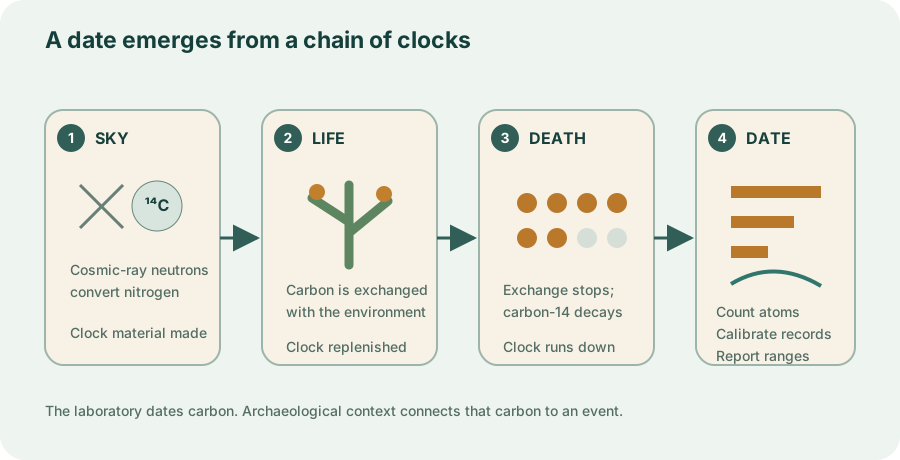
Cosmic rays, high-energy particles from space, strike Earth's atmosphere and produce neutrons, particles found inside atomic nuclei. Some neutrons collide with the centres, or nuclei, of nitrogen-14 atoms and convert them into radioactive carbon-14. That carbon joins atmospheric carbon dioxide. Plants take it in during photosynthesis; animals acquire it through food.
Carbon-14 is rare, while carbon-12 and carbon-13 are stable. These are isotopes: forms of carbon with different numbers of neutrons. Carbon-14 is radioactive, meaning its nucleus can change into another kind of nucleus and release particles or energy. During life, exchange with the environment keeps replenishing the mixture. The exact atmospheric ratio has never been perfectly constant, but living tissue broadly tracks the carbon reservoir from which it feeds. The US Geological Survey explains the atmospheric production and biological exchange.
Death changes the bookkeeping. A leaf cut from a tree, a seed burned in a hearth or collagen, a structural protein, preserved in bone stops acquiring fresh carbon. Its carbon-14 atoms continue to decay into nitrogen-14. After about 5,730 years, half of the original carbon-14 remains. This interval is its half-life. After another half-life, half of that remainder survives, leaving one quarter of the original amount.
The clock therefore starts not when an object is excavated or used, but when its carbon stops exchanging with its source. That distinction will matter later.
Libby's wager needed objects with two ages
Libby began the research at the University of Chicago in 1945. His proposal depended on natural carbon-14 existing at detectable levels and on its behaviour being predictable enough to distinguish old organic material from new. The American Chemical Society's historical account follows the work from cosmic-ray research to the first archaeological tests.
Known-age tree rings and Egyptian material provided an unusually strong challenge. One age came from historical or ring-counting evidence; another came from the remaining radioactivity. Agreement did not prove every later sample would be simple. It showed that an invisible nuclear process could recover a human timescale without reading an inscription.
The achievement earned Libby the 1960 Nobel Prize in Chemistry. Yet the modern method is no longer exactly his instrument. It has become more sensitive, more statistical and much more alert to the ways a sample can mislead.
Count atoms instead of waiting for clicks
Early laboratories detected beta particles, electrons emitted when carbon-14 decays. Because carbon-14 is scarce and decays slowly, that demanded relatively large samples and long counting times.
Accelerator mass spectrometry, or AMS, takes another route. The sample is converted into a form suitable for the instrument, and carbon isotopes are separated so carbon-14 atoms can be counted relative to stable carbon. Oxford's radiocarbon laboratory explains the distinction between measuring decay and directly counting atoms.
Atom counting allows much smaller samples. It does not remove the hardest question: which carbon was actually measured? Soil, conservation materials, rootlets or laboratory handling can add carbon of another age. Pretreatment tries to isolate the material that belongs to the sample. For very old objects, a small amount of modern carbon can create a large error because so little original carbon-14 remains.
What the model can and cannot show
EXPLORE THE IDEA
How can a trace of modern carbon move an old clock?
8.898%Ideal original carbon-14 remaining
8.898%After illustrative mixing
20,000 yearsApparent uncalibrated age
0 yearsYounger than the selected true age
Make the sample older, then add 1% modern carbon. The contaminant becomes large compared with the small surviving original fraction, so the simple calculation reports a younger age.
Scroll the diagram sideways to see every label.
Ideal carbon-14 decay with a 5,730-year half-life, followed by simple mixing with a selected fraction of modern carbon. The apparent age reverses only that ideal mixture. Inputs are illustrative scenarios, not measurements. The model omits uncertainty, isotope fractionation, laboratory background, pretreatment, atmospheric variation, reservoirs and calendar calibration. It cannot date an object. No animation.
A radiocarbon age is not yet a calendar date
If atmospheric carbon-14 had always been constant, a decay calculation could map one ratio to one calendar age. It has varied with solar activity, Earth's magnetic field, the carbon cycle, fossil-fuel emissions and nuclear testing. A raw radiocarbon result must therefore be calibrated.
Tree rings provide the essential bridge for much of the recent record. Dendrochronology matches overlapping patterns of tree rings to build a dated sequence. Each ring therefore has a calendar date and a carbon-14 concentration that can be measured. Older archives extend the comparison. The international IntCal20 curve combines tree rings and other independently dated records, reaching to about 55,000 calibrated years before present. The peer-reviewed IntCal20 paper describes its data and intended use.
Calibration is not always a neat correction from one number to another. Wiggles and plateaus in the curve can turn one measurement into several possible calendar ranges. A date is properly reported as a spread of possible dates, called a probability distribution, often with ranges containing 68% or 95% probability, not as a guaranteed birth year for an artefact. Oxford's OxCal page visualises how measurement and calibration curves combine.
The date belongs to the carbon
Suppose charcoal lies beneath a wall. The laboratory can estimate when that wood stopped exchanging carbon. It cannot decide by itself whether the tree was cut for the wall, reused from an old beam, or burned centuries earlier and moved by later disturbance.
This is the old-wood problem in its simplest form. Marine organisms add another complication because ocean carbon may already appear older than contemporary atmospheric carbon. Historic England's detailed guidance explains reservoir effects and the need for appropriate corrections and insists that a sample must be securely associated with the event being studied.
Archaeology therefore supplies the last clock: context. Stratigraphy, the study of layers of soil or sediment, can show that one deposit came before another. Species identification can favour short-lived seeds over long-lived timber. Several dates can be combined with those ordered relationships in a chronological model. The instrument measures atoms; the excavation determines what those atoms can honestly date.
That is why radiocarbon dating transformed history without turning it into a spreadsheet of exact years. It created a disciplined conversation between physics and context. Cosmic rays make the isotope, life carries it, death starts the decay, a laboratory counts what survives, tree rings repair the calendar, and archaeology asks whether the counted carbon belongs to the question.
The result is powerful precisely because it is not a magic date. It is a chain of claims, each visible enough to test.
YOUR PERSPECTIVE
Join the discussion
What surprised you? Have a question or a correction? Share your thinking.
No comments yet. Start the conversation.
Sign in with ChatGPT to commentAnyone can read the discussion. Sign-in helps limit spam.