
Among the materials documenting the decipherment of Linear B are cigarette cartons filled with handwritten slips of paper. They belonged to Alice Kober, a classics scholar whose filing system made patterns in an unreadable script easier to compare. In a university exhibition, these modest containers stood beside the correspondence of the people who eventually made the writing intelligible. Archaeologist Susan Lupack describes the surviving objects.
The cartons are a useful starting point because this discovery is often compressed into a moment of inspiration. A brilliant person sees the answer; an ancient civilisation speaks again. The actual problem was more demanding. Before assigning sounds to signs, researchers had to decide what counted as a distinct written symbol, which sequences belonged together, and what would distinguish a successful reading from an ingenious mistake.
An unknown script is more than a substitution puzzle
In the early twentieth century, Arthur Evans uncovered tablets bearing the script he called Linear B. He associated their language with Minoan civilisation; other researchers proposed different answers. The competing guesses are introduced in Lupack’s TED-Ed animation, which offers a visual account of the decipherment and its main contributors.
A familiar word puzzle gives you considerable help without announcing it. You usually know the language, that letters represent sounds, and where words begin and end. An unfamiliar ancient inscription does not necessarily grant those advantages. A mark might represent a sound or a syllable, a spoken unit such as “ma”. It might instead represent a quantity or a category of goods. Even identifying the units is part of the investigation.
Nor should an unknown script automatically be called a secret code. Its original users may have read it perfectly easily. The barrier can be the loss of knowledge across generations, not an ancient intention to conceal information.
Find relationships before choosing a language
Kober approached the problem through recurring patterns. Her research records include notebooks, statistical charts and an enormous collection of paper slips. The archival finding aid for her papers documents her analysis of where signs occurred and how groups of signs varied. It also records the practical burden: she pursued this work alongside teaching at Brooklyn College.
One important possibility was inflection: changing a word’s form to express a grammatical distinction. English offers a small, familiar example in “walk” and “walked”. Other languages use much richer systems of endings. Repeated beginnings with systematic changes near the ends could therefore be evidence of grammatical relationships rather than unrelated words.
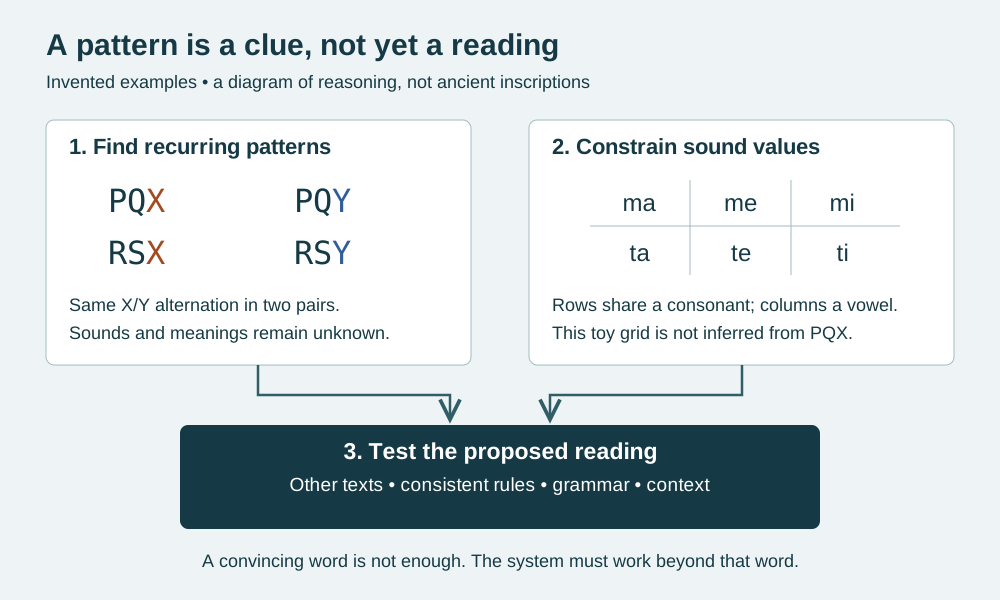
But noticing repetition does not reveal its meaning. Consider two invented pairs: PQX/PQY and RSX/RSY. The shared alternation between X and Y is worth investigating. It does not tell us whether either sequence names a person, describes an object or belongs to a grammatical pair. The diagram uses such invented groups to separate an observation from an interpretation.
Kober went beyond collecting similarities. In a scholarly account of the decipherment, Thomas Palaima explains her use of a sound grid: signs could be related through consonant-and-vowel combinations before researchers knew exactly which sound each sign represented. The grid was not simply an invention that appeared fully formed with Michael Ventris.
Why a grid makes guesses accountable
The unglamorous work that made a breakthrough possible
Reliable comparisons require reliable copies. Kober and Emmett Bennett worked with material from different places: she helped prepare the Knossos tablets for publication with John Myres, while Bennett worked on those from Pylos with Carl Blegen. Their exchanges included corrections, classification and arrangements to compare records. The university’s account of their correspondence follows that collaboration, which continued until Kober’s death in May 1950.
This is not clerical work surrounding the real discovery. It is part of the discovery. If two handwritten versions of the same sign are counted separately, a pattern may disappear. If two different signs are merged, a pattern may be manufactured. Sorting out the records changes which explanations the evidence can support.
The PASP archive guide describes Bennett’s meticulous analyses and preserves access to the researchers’ correspondence. Such records let us examine collaboration instead of assigning all the credit to whoever announced the final result.
A proposal that other people could test
On 18 June 1952, Ventris wrote to Bennett proposing that the tablets from Knossos and Pylos recorded Greek. He supplied proposed readings and sounds so others could check them. Palaima’s study reproduces and examines the letter. John Chadwick subsequently brought his linguistic expertise to the work, collaborating with Ventris on its scholarly explanation.
Linear B represented syllables rather than spelling Greek with the later alphabet. Some distinctions were not written separately: for example, the same signs could serve sounds conventionally rendered with “r” or “l”. Understanding these conventions was essential; expecting a different writing system to behave exactly like our own would misread its evidence.
A persuasive decipherment must do more than produce one recognisable word. It must apply a consistent system across many texts, make grammatical and contextual sense, and survive criticism. Otherwise, freedom to change the rules can turn almost any short inscription into whatever the interpreter hopes to find.
The achievement opened contemporary records of Bronze Age activities to interpretation. Palaima’s account discusses an early reading of a tablet concerning working oxen: hardly a grand heroic speech, but evidence of people organising a living world.
That is what makes the paper slips as important as the breakthrough letter. The ancient words became readable because researchers made their own reasoning inspectable. Their lasting lesson is not to avoid guesses. It is to arrange the evidence so that a beautiful guess can be shown to be wrong.
YOUR PERSPECTIVE
Join the discussion
What surprised you? Have a question or a correction? Share your thinking.
No comments yet. Start the conversation.
Sign in with ChatGPT to commentAnyone can read the discussion. Sign-in helps limit spam.