
On 19 June 1878, a racehorse named Sallie Gardner crossed a track at Palo Alto while Eadweard Muybridge’s cameras divided her run into separate instants. The Library of Congress catalogue preserves the twelve-frame sequence. Legs that had been too quick to untangle by eye became positions that could be inspected one by one.
That result can look like the inevitable purpose of a camera. It was not. Early photography was exceptionally good at recording what stayed still. Making a sharp picture of rapid motion required several inventions to work together. The recording material had to respond to little light. The lens had to gather enough of it, and the shutter had to control exposure time reliably. Later, extremely brief flashes offered another way to freeze movement.
A photograph adds light through time
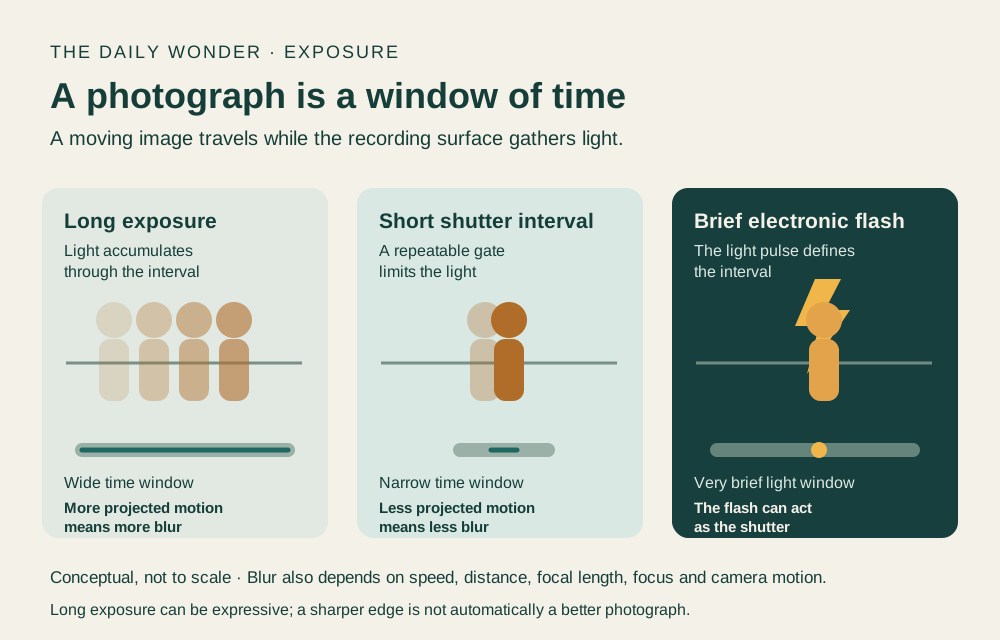
A camera does not seize a mathematical instant. While its recording surface is exposed, light arriving from the scene keeps contributing to the image. A stationary detail continues to fall in roughly the same place. A moving subject projects onto a succession of places, leaving a trail rather than a sharp edge.
This is why exposure time matters. If a subject moves sideways at speed v for a duration t, it travels v × t. For a distant subject and small angles, the corresponding blur on the image is approximately focal length × movement ÷ subject distance. Focal length is a lens measurement, usually given in millimetres; at a fixed distance, a longer focal length makes the subject’s image larger and the same movement creates more blur. The relationship is simple, but “sharp enough” is not: viewing size, pixel or grain size, focus, camera movement and the photographer’s intention all matter.
Long exposure is not a defect by definition. It can turn traffic into luminous lines or water into a smooth field. Freezing motion is one choice about time, not photography’s only correct answer.
The first pictures had to wait
Photography emerged from the union of optics and chemistry. A camera obscura, a dark chamber with a small opening or lens, could already project an outside scene onto a surface inside, but the image vanished unless someone traced it. Nicéphore Niépce and Louis Daguerre worked to make light’s effect permanent; Daguerre’s silver-plated copper process was publicly explained in 1839. The Metropolitan Museum of Art traces that partnership and process.
The earliest practical materials demanded patience. White plaster casts and buildings were cooperative subjects because they reflected light and did not move. Later glass negatives improved the possibilities, but sensitivity remained decisive. The albumen-on-glass process used an egg-white-based layer and could require five to fifteen minutes. Wet collodion, another chemical coating for glass plates, cut that to seconds or minutes, yet the plate had to be coated, exposed and developed before it dried. The National Science and Media Museum compares these processes.
In 1871, Richard Leach Maddox introduced a gelatin dry-plate process. Manufacturers and researchers then improved it dramatically. Ready-coated plates could be stored, and rising sensitivity made fractions of a second practical. Chemistry had shortened the interval that the camera needed to collect a usable signal.
A fast material still needed a clock
When an exposure lasts minutes, removing and replacing a lens cap can be adequate timing. At a fraction of a second, a camera needs a mechanism that opens and closes consistently. The shutter became a clock for light.
Muybridge’s work shows the system character of the problem. His early attempt to settle the phases of a galloping horse was not conclusive. The University of Pennsylvania’s archive notes that improved shutter technology enabled exposures around 1/1,000 second in his later experiments. He then used multiple cameras to turn movement into a sequence. Penn’s archive follows the experiments and the later Animal Locomotion project.
The achievement was not merely “a faster camera.” Sensitive plates, shutters, triggering arrangements and careful geometry had to work together. Each frame sampled a different time. Put in order, the photographs showed how positions changed through time and helped prepare the ground for motion pictures.
One exposure or many?
The snapshot leaves the laboratory
Faster plates also changed who could take photographs. Commercial dry plates and portable cameras removed the need to prepare wet chemistry beside the subject. George Eastman patented a dry-plate coating machine in 1880, and his company pursued easier cameras and flexible film. The George Eastman Museum documents that development.
In 1888, the first Kodak hand camera combined roll film, a built-in shutter and a processing service. Its user armed the shutter, aimed and pressed the release; the camera was returned to the company for processing and reloading. The museum’s Kodak exhibition explains the system. The word snapshot came to describe an informal picture made quickly, but the apparent simplicity rested on industrial coating, manufacturing and photofinishing elsewhere.
A flash can become the real shutter
Mechanical shutters eventually reached very short times, but another route was to control the illumination. In a dark setting, a camera shutter can remain open while an extremely brief flash supplies nearly all the recorded light. The flash duration then becomes the effective exposure for the moving subject.
Harold “Doc” Edgerton, an electrical engineer at MIT, developed stroboscopic techniques using precisely timed, brief electronic flashes to study motion and machinery. His flashes revealed milk splashes, golf swings and bullets crossing cards. The Smithsonian’s Edgerton collection describes how this work laid foundations for modern electronic flash. An MIT Museum record for a hovering hummingbird reports an exposure of 1/100,000 second, short enough to reveal wing positions that had eluded direct observation. See the MIT object record.
The flash did not literally stop a wing. It limited how far the image could move while enough light reached the film. That distinction is the heart of high-speed photography: time keeps going; the measurement window becomes small.
The interactive model below makes that window visible. Shorten the exposure, slow the subject, move farther away or use a shorter focal length, and the projected blur shrinks. These variables do not replace the light budget: a shorter interval admits less ambient light, so the camera may need a wider aperture, the opening that admits light, greater recording sensitivity or extra illumination.
Photography learned to freeze motion by learning to measure time with light. From a patient plate to a triggered camera line and then a microsecond flash, each advance made the window narrower and more dependable. The frozen instant was never truly outside time. It was time, engineered into a thin enough slice for us to see.
EXPLORE THE IDEA
How far does motion travel across the image?
0.068 mmProjected sensor blur
14 pixelsAt illustrative 5 μm pitch
Double the exposure or subject speed and the model doubles the blur. Double the distance and it halves. A longer focal length enlarges both the subject and its projected motion.
Scroll the diagram sideways to see every label.
Illustrative distant-subject, small-angle projection for sideways motion: sensor blur = focal length × subject speed × exposure time ÷ subject distance. Pixel count assumes 5 μm pixels. Camera movement, acceleration, motion toward the camera, focus, aperture, diffraction, rolling shutter, subject shape and viewing size are excluded. This is not a universal sharpness rule. No animation.
YOUR PERSPECTIVE
Join the discussion
What surprised you? Have a question or a correction? Share your thinking.
No comments yet. Start the conversation.
Sign in with ChatGPT to commentAnyone can read the discussion. Sign-in helps limit spam.