
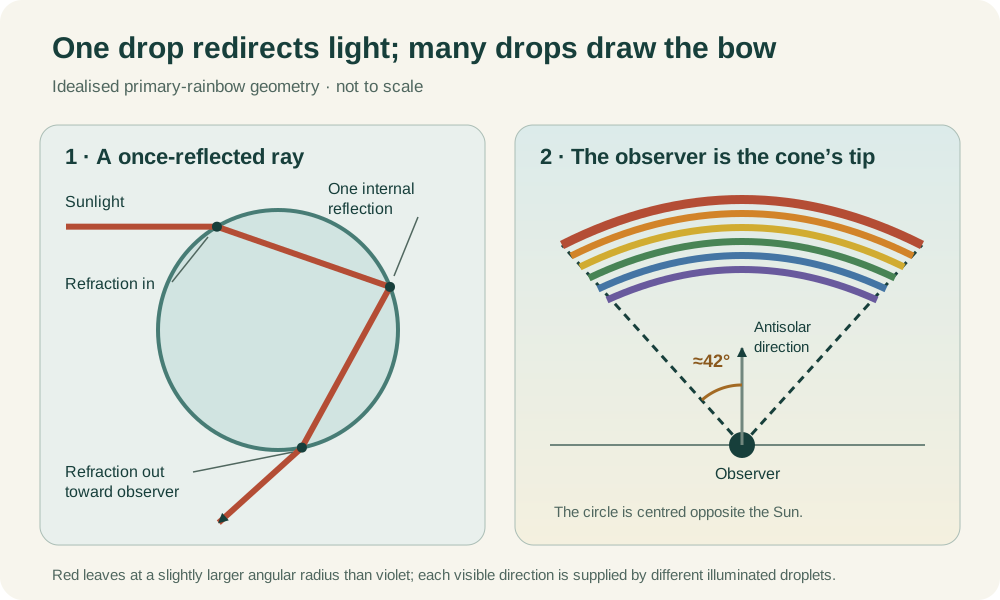
After a shower, two people can stand a few metres apart, look toward the same rain and not receive light from exactly the same droplets. Each still sees a bow centred on the point directly opposite the Sun. Move the observer, and the useful set of droplets moves too.
That makes a rainbow an unusual object. It has a dependable shape, yet it is not hanging at one fixed address. The arc is a map of directions from an observer, created when countless nearly spherical drops sort and redirect sunlight.
The familiar recipe is correct: light bends when it enters and leaves water (refraction), bounces at the back of a drop (reflection), and separates into colours (dispersion). But geometry explains why those processes organise themselves into a bright circle rather than a coloured fog.
One ray makes three turns
Take a narrow ray of sunlight entering a raindrop away from its centre. It first crosses from air into water. Because light travels differently in the two materials, its direction changes: refraction. At the curved rear surface, some light escapes and some reflects. For the primary rainbow, follow the portion that reflects once, crosses the drop, and refracts again as it leaves.
One ray changes direction at three surface points
- Enter: air into water
Refraction turns the ray toward the local normal, the line perpendicular to the surface at entry
- Reflect: at the rear surface
Some light escapes. Follow the portion reflected back inside; its angles to the local normal match. This is partial internal reflection
- Exit: water back into air
Refraction turns the ray away from the local normal. It crosses the boundary and continues through air toward an observer
The orange line and arrows show the light’s travel direction. Numbers mark the three boundary events. Dashed lines show the local surface normals; they are reference lines, not extra light rays
Ideal spherical-drop geometry, not to scale. One illustrative refractive index (1.333) traces one representative ray. The orange is a path key, not a measured colour or a single-ray spectrum. Other transmitted and reflected portions are omitted. A real bow combines a continuous spectrum from many drops; wave interference, diffraction and nonspherical drops are not shown.
Sources: Met Office: refraction, reflection and the observer; OpenStax: Snell’s law and surface normals; Optica: wavelength-dependent refraction
The Met Office’s rainbow guide describes this sequence and the necessary arrangement: the Sun behind the observer, illuminated drops ahead. “Internal reflection” does not mean every photon is totally reflected. A useful fraction follows that route while other light takes other paths.
Water is also dispersive: it bends different colours by slightly different amounts. Its refractive index, a measure of how light travels in a material, varies with wavelength. Wavelength is the distance between neighbouring wave peaks and is linked to colour. Blue and violet light therefore bend more strongly than red light. Optica’s dispersion explanation connects the same principle to prisms, lenses and optical fibres. The rainbow is not seven separate beams inside the drop; sunlight contains a continuous range of wavelengths, which the drop sends out at slightly different directions.
Why one direction becomes bright
Sunlight strikes every part of a drop. Most entry positions send the once-reflected ray away at different angles. Near one special path, however, changing the entry position a little changes the outgoing direction remarkably little. Many neighbouring rays therefore crowd into a narrow angular range.
This concentration is called a caustic. It is related to the bright curves seen at the bottom of a swimming pool, although the rainbow’s optical path is different. For ordinary water, red light in the primary bow emerges near an angular radius of about 42 degrees from the antisolar point, the direction exactly opposite the Sun. Violet lies nearer 40 degrees. Georgia State University’s HyperPhysics treatment shows the primary range and its red-outside ordering.
The angle is measured at your eye, not across the landscape. Imagine an axis running from the Sun, through your head, and onward into the rain. The useful outgoing rays lie on a cone around that axis. Your eye sits at the cone’s tip. Where that cone intersects a curtain of illuminated drops, you see a circle.
This also explains why looking for a rainbow’s physical “end” is misleading. A tree or road can appear aligned with the arc, but the optical construction is tied to your viewpoint. Walk toward the apparent end and the geometry is rebuilt around your new position.
A little deeper: where 42 degrees comes from
The horizon hides most of the circle
The antisolar point is as far below the horizon as the Sun is above it. If the Sun is 10 degrees high, the centre of the rainbow circle is 10 degrees below the opposite horizon. A roughly 42-degree circle can still rise about 32 degrees into the sky. Raise the Sun and the visible arc becomes lower. Once the Sun is higher than the bow’s radius, the primary circle lies below the horizon for an observer at ground level.
The rainbow itself remains a circle of directions. The ground simply blocks the lower part and usually blocks the illuminated drops needed there. From an aircraft or high mountain, with droplets below, a much fuller circle can appear. The Met Office notes full-circle bows from elevated viewpoints, a direct consequence of the observer-centred geometry.
A second reflection reverses the order
Some light reflects twice inside a drop before emerging. Those rays form the fainter secondary bow outside the primary. The extra reflection loses light and reverses the colour ordering: violet is outside and red is inside. The HyperPhysics secondary-bow diagram traces that longer route.
Between the two bows, fewer of these primary and secondary ray families reach the observer, producing Alexander’s dark band. It is not a dark cloud conveniently following the arc. The Met Office identifies the band as an optical consequence of the two scattering patterns.
Drop size changes the appearance without providing a simple size control for the main radius. With very small fog droplets, light’s wave behaviour matters more. Diffraction, the spreading of waves around small objects, helps blur the colours into a broad, pale fogbow. Larger raindrops generally make sharper colours, but real bows also depend on the distribution and shape of drops, the spectrum of the light and the background sky.
Where rays stop being enough
Geometrical rays explain the main circle and colour order, but they cannot explain every fine feature. Narrow pastel bands just inside some primary bows, called supernumerary bows, come from interference between light waves following nearby paths. Their peaks can reinforce each other or cancel, producing the extra bands. A peer-reviewed Bulletin of the American Meteorological Society review places rainbows alongside halos and other atmospheric optics that require careful treatment of scattering and radiative transfer.
That limit makes the rainbow more instructive, not less. A simple model can reveal the cone, the circle and the concentrated angle. Wave optics then explains details that the ray model leaves behind.
The next time a bow appears, turn your back to the Sun and notice what the arc is centred on. Its apparent solidity is assembled at your eye from a vast, shifting population of drops. The rainbow is not merely somewhere in the rain. For a moment, it is the geometry between the rain and you.
EXPLORE THE IDEA
How does the rainbow circle meet the horizon?
42.08°Selected angular radius
27.08°Top relative to horizon
Raise the Sun: the circle’s centre moves down while its angular radius stays fixed. Then raise the refractive index: stronger bending makes the selected radius slightly smaller.
Scroll the diagram sideways to see every label.
Ideal spherical-drop geometrical optics with one internal reflection. Refractive index is an illustrative wavelength proxy, held uniform within each calculation. Sun elevation is measured above a flat astronomical horizon; atmospheric refraction, terrain, drop shape and size, multiple scattering, diffraction and wave interference are omitted. The spectral rings use representative fixed radii. No animation.
YOUR PERSPECTIVE
Join the discussion
What surprised you? Have a question or a correction? Share your thinking.
No comments yet. Start the conversation.
Sign in with ChatGPT to commentAnyone can read the discussion. Sign-in helps limit spam.