
Sunlight warms your hand, but it also pushes on it. The force is far too small to feel. In space, a spacecraft can spread out a broad, extremely light sheet and make that same effect useful. The sheet is a solar sail: a surface designed to receive a push directly from light.
This is not a solar panel supplying electricity to an engine. The sail changes the motion of the light itself. That exchange produces thrust, the force that changes the spacecraft's motion. NASA distinguishes solar sailing from solar-electric power.
Light brings more than warmth
Light arrives in packets of energy called photons. A photon has no rest mass, but it carries momentum, a quantity that has both an amount and a direction. When light is absorbed or reflected, its momentum changes. The receiving surface gains momentum in the exchange.
Think of catching a ball, then compare that with sending it back towards the thrower. Reversing the ball's motion requires a greater momentum change than merely stopping it. Light is not made of tiny rubber balls, but the comparison helps explain why reflection matters. ESA describes the momentum exchange behind a solar sail.
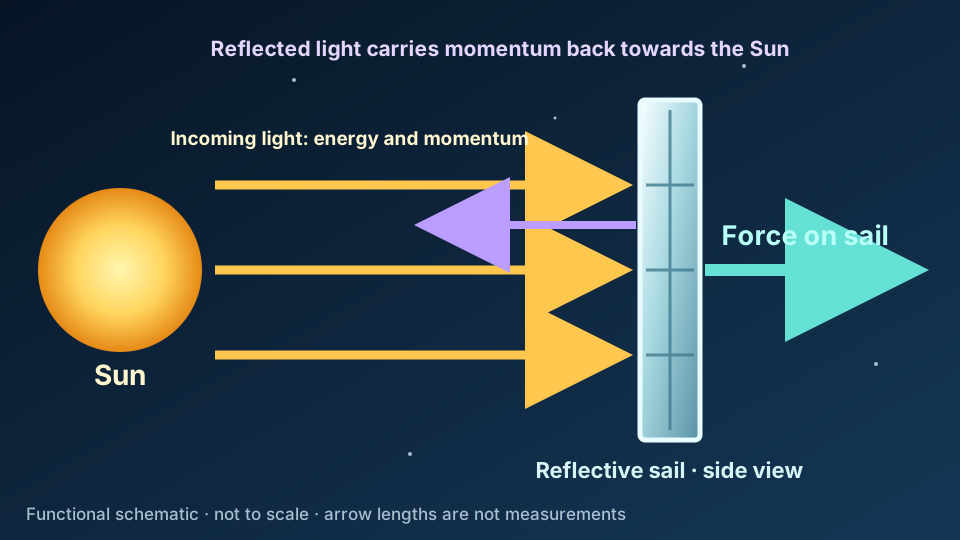
For light arriving straight onto a surface, complete absorption transfers the incoming light's momentum. An ideal mirror sends the light straight back and transfers twice as much, in the slow-moving approximation used here. Both surfaces are pushed away from the incoming light's source; the reflected light travels the other way.
Reflection transfers more momentum than absorption
Head-on comparison with the same incoming light
1 · Light absorbed
2 · Light reflected back
Both panels begin with equal head-on light. In the absorption panel, amber arrows terminate at a dark sail and a teal force arrow points away from the Sun. In the reflection panel, purple arrows carry light back towards the Sun and the teal force arrow is longer. The light arrows show propagation and momentum direction. The teal arrows show force on the sail, not a stream of matter.
Functional schematic, not to scale. Arrow lengths distinguish the ideal one-times and two-times cases; they do not show measured force. Real sails absorb, reflect and scatter light, radiate heat and are usually tilted for steering.
Sources: ESA: photon momentum and reflection; NASA technical report: solar-sail pressure. Original diagram by The Daily Wonder.
Add the contributions from an enormous number of photons and the surface experiences a steady force. Force spread over an area is pressure. In this case it is called radiation pressure, because electromagnetic radiation supplies it. No air is needed between the Sun and the sail.
A small force with time to work
Near Earth's distance from the Sun, a square metre facing the Sun receives about 1,361 watts of sunlight outside the atmosphere. Watts measure energy delivered each second. NASA's radiation researchers give this approximate solar input.
For an ideal mirror facing that light directly, the pressure is about nine millionths of a newton per square metre. A newton is a unit of force. Consider an illustrative sail of 100 square metres attached to a spacecraft whose total mass, including the sail, is 10 kilograms. The sunlight supplies about 0.00091 newtons of thrust.
Dividing force by mass gives the change in velocity each second, or acceleration. Here it is about 0.000091 metres per second per second. If that acceleration stayed constant in one direction for a full day, it would add about 7.8 metres per second of velocity in that direction.
These are teaching inputs, not specifications for a flown spacecraft. The day-long result isolates the sail's contribution; it is not a predicted orbital speed or journey time. Gravity, changing orientation and periods in shadow alter an actual flight. NASA's technical account derives the light-pressure calculation.
What the model can and cannot show
EXPLORE THE IDEA
How much push can sunlight provide?
Change the illuminated area, total spacecraft mass, distance from the Sun and momentum transfer. A larger force does not guarantee a larger acceleration: the same force changes a heavier craft more slowly.
1361.0 W/m²Modelled irradiance
0.908 mNForce on the sail
0.0908 mm/s²Acceleration
How the calculation works
Irradiance is 1,361 divided by distance in AU squared. Pressure equals the momentum-transfer factor × irradiance ÷ the speed of light. Force equals pressure × illuminated area. Acceleration equals force ÷ total mass. The one-day value multiplies acceleration by 86,400 seconds.
Face-on scalar teaching model, not a mission planner. One astronomical unit (AU) is approximately Earth's mean distance from the Sun. Irradiance is 1,361 W/m² at 1 AU and follows an inverse-square distance rule. The momentum-transfer factor runs from 1 for ideal absorption to 2 for ideal head-on reflection. The sail is always normal to the sunlight. It omits sail angle, wrinkles, imperfect optical properties, thermal radiation, degradation, shadows, gravity, orbital motion, steering, deployment and structural mass changes. The one-day velocity increment assumes constant force, mass and direction; no animation.
The useful comparison is area against total mass. A larger sail catches more light. A heavier spacecraft changes motion less under the same force. Doubling area doubles acceleration only if mass and the other conditions remain unchanged. Real extra sail area also requires material and support.
A sail can steer without pulling towards the Sun
A mirror tilted to the incoming light reflects it in a different direction. For an ideal reflecting sail, the resulting force acts perpendicular to its surface. Tilting can therefore give the force a sideways component, as well as a component away from the Sun.
That matters because a spacecraft already has orbital motion. A suitable sail orientation can add to or oppose its motion around the Sun, changing the orbit. Carefully directed thrust can take a craft into a smaller orbit even though sunlight never pulls the sail towards the Sun. ESA's solar-sailing study explains this orbital steering.
The sailboat comparison has a limit here. There is no ocean and no keel resisting sideways motion. Steering follows reflection geometry and orbital mechanics, not a boat's route across water.
From an old idea to a measured push
In the seventeenth century, Johannes Kepler imagined vessels sailing through space after considering comet tails. That was an imaginative starting point, not a modern explanation of photon momentum. NASA recounts the early inspiration. Turning an idea into propulsion required something much harder: deploying a large, very light surface and measuring the resulting change in motion.
Japan's IKAROS supplied that evidence. On 9 July 2010, JAXA announced that precise orbit determination after sail deployment had confirmed acceleration from sunlight. Radio measurements tracked changes in the spacecraft's motion towards or away from Earth. Those observations could be compared with a calculation that omitted the light's push.
The estimated thrust was 1.12 millinewtons, or 0.00112 newtons. This was not a force gauge attached to the sail: researchers inferred the force from tracking and an orbital model. JAXA's original report shows the observations and explains the comparison.
Why the engineering remains difficult
The sheet must unfold reliably, hold a useful shape and remain controllable. Supports add mass, so engineers cannot simply make the sail endlessly larger. NASA's Advanced Composite Solar Sail System tests lightweight supports called booms, which can be rolled for storage and extended to support the sail. NASA explains the deployment challenge.
Sunlight also weakens with distance. At twice the distance from the Sun, the same sail receives one-quarter of the light and, with everything else unchanged, one-quarter of the push. Closer approaches supply more light but create harder thermal and material demands. The sail does not provide unlimited acceleration everywhere.
Nor is this propulsion driven by the solar wind, the stream of charged particles flowing from the Sun. An ordinary reflective solar sail mainly uses photons. Light pressure and particle pressure are different mechanisms, despite the tempting nautical name. NASA's physics account separates them.
Even near Earth, a working sail faces competing effects. LightSail 2 changed its orbit using sunlight, but atmospheric drag eventually brought it down in November 2022. Its mission team describes both the achievement and the limit.
A solar sail avoids expelling propellant for its light-driven thrust. It does not avoid launch, gravity or engineering. Its remarkable resource is simpler: sunlight continually arrives carrying momentum, and a sufficiently light spacecraft can make that delivery count.
YOUR PERSPECTIVE
Join the discussion
What surprised you? Have a question or a correction? Share your thinking.
No comments yet. Start the conversation.
Sign in with ChatGPT to commentAnyone can read the discussion. Sign-in helps limit spam.