
Look up at an old building and you may notice a metal point rising above the roof. It seems an oddly modest response to a thunderstorm. The sky can produce a blinding discharge, yet the object assigned to receive it may scarcely interrupt the skyline.
The apparent mismatch disappears when we stop thinking of the point as the whole invention. A lightning rod is not a shield that pushes storms away. It is the most visible part of a system that carries lightning current from the roof through connected conductors into the ground.
Its history also contains a change in attitude: instead of merely fearing a spectacular natural event, people began asking whether its consequences could be engineered.
Franklin's question was not whether electricity existed
By the middle of the eighteenth century, experimenters already knew about electrical sparks. Benjamin Franklin wanted to establish whether the enormous flashes in thunderstorms belonged to the same family of phenomena. This was a connection between laboratory experience and weather, not the discovery of electricity itself.
The famous kite experiment belongs to June 1752. In the account explained by the Franklin Institute, the kite collected electrical charge associated with the storm; it was not struck by a lightning bolt. A direct strike would have made the familiar story disastrously different. Thomas-François Dalibard had demonstrated the electrical nature of lightning in France a month earlier. These experiments belong in the history of science, never on a list of activities to repeat. The Franklin Institute separates the historical account from popular misconceptions.
That distinction changes the way we remember the invention. The useful achievement was not a heroic contest with a bolt. It was the recognition that an electrical phenomenon could be investigated and its damaging effects reduced.
What the rod actually receives
In a thunderstorm, charges become separated. Air normally resists electrical conduction, but sufficiently strong electric fields can lead to its breakdown and the development of conducting channels. The discharge is a physical process through air, not a projectile looking for a favourite kind of metal. Our earlier lightning article follows the storm's side of that story.
This article begins at the other end: a building that may become part of the discharge path. A protection system cannot switch off the cloud's electrical activity. Its job is to address what happens when lightning reaches the structure. The National Weather Service illustrates the storm and discharge process; its explanatory animations are useful companions to the text.
The fact that metal conducts electricity does not mean it draws lightning from an unlimited surrounding area. Height, shape and how far an object stands from others influence where a lightning channel connects. Trees can be struck without being metal, and an already-struck building can be struck again. NWS addresses these common myths.
Five jobs, not one object
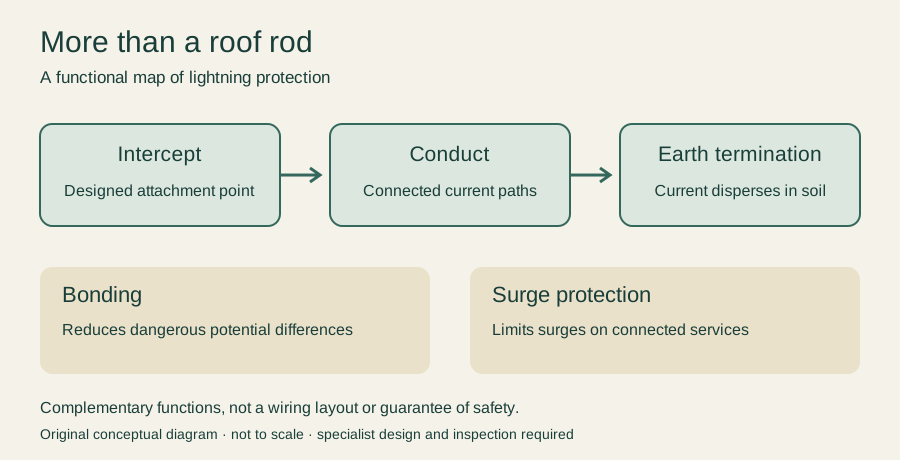
A complete system has several jobs. A roof terminal provides a place for lightning to connect. Conductors carry the current towards the ground, where electrodes, conducting parts placed in the soil, help it enter the earth. Other connections and protective devices reduce hazards along the way. Bonding joins appropriate metal systems electrically. This reduces differences in voltage between them and the risk of a spark jumping across a gap. Surge protection limits sudden electrical disturbances entering through connected services, such as power lines.
The word “system” is therefore doing real work. A prominent roof point cannot compensate for missing connections elsewhere. Nor does protection of the structure automatically answer every question about its sensitive electronics. The Lightning Protection Institute's technical overview explains these complementary functions. Its detailed installation material is for qualified specialists, not a household experiment.
Why a good conductor is not an effortless path
Conductors still have resistance. When current passes through resistance, electrical energy is converted to heat. For a fixed resistance, doubling the current makes the instantaneous heating power four times greater, not twice. That square-law relationship helps explain why a brief but intense electrical event deserves serious engineering attention.
Duration matters too. Power describes how quickly energy is being transferred; total heating energy depends on that power over time. Two events with the same maximum current need not deposit the same energy. A current rating alone cannot tell their whole story. OpenStax develops the current, resistance and heating relationship.
There is another complication: lightning current changes rapidly. A changing current changes its surrounding magnetic field, producing a voltage through induction, the electrical effect of a changing magnetic field. Even with small resistance, this effect need not be small. The model below isolates that one relationship: keep the current increase fixed and shorten the time over which it happens. The calculated voltage rises. OpenStax explains self-inductance.
Optional calculation: the speed of the rise
The part a photograph cannot certify
A photograph can show a rod. It cannot establish that the whole installation is suitable, continuous or maintained. Materials weather, connections matter, and alterations to a building can change the original protection arrangement. Professional assessment, installation and inspection are therefore part of the protection story, not optional finishing touches. The LPI overview describes that lifecycle alongside the hardware.
Personal safety remains separate from admiring the engineering. If you hear thunder, seek suitable shelter immediately. Indoors, avoid plumbing, corded phones and contact with electrical equipment; do not start unplugging appliances during the storm. An open shelter is not equivalent to a substantial enclosed building. Follow the National Weather Service's indoor safety guidance.
The roof point is memorable because we can see it. The deeper invention is a way of thinking: identify the hazard, understand the routes it can take, and treat the connections as seriously as the component at the top. Franklin's legacy is not that a storm becomes harmless. It is that understanding nature can turn helplessness into practical, carefully limited protection.
EXPLORE THE IDEA
Same current rise, different speed
The graph ends at the selected rise time; it does not model what happens afterward.
Scroll the diagram sideways to see every label.
Illustrative linear ramp: 0–10 kA through fixed 1 µH inductance. Voltage magnitude = L × ΔI/Δt. Resistance, capacitance, branching and earth response omitted. Not measured lightning, a safety threshold or a design tool; no animation.
YOUR PERSPECTIVE
Join the discussion
What surprised you? Have a question or a correction? Share your thinking.
No comments yet. Start the conversation.
Sign in with ChatGPT to commentAnyone can read the discussion. Sign-in helps limit spam.