
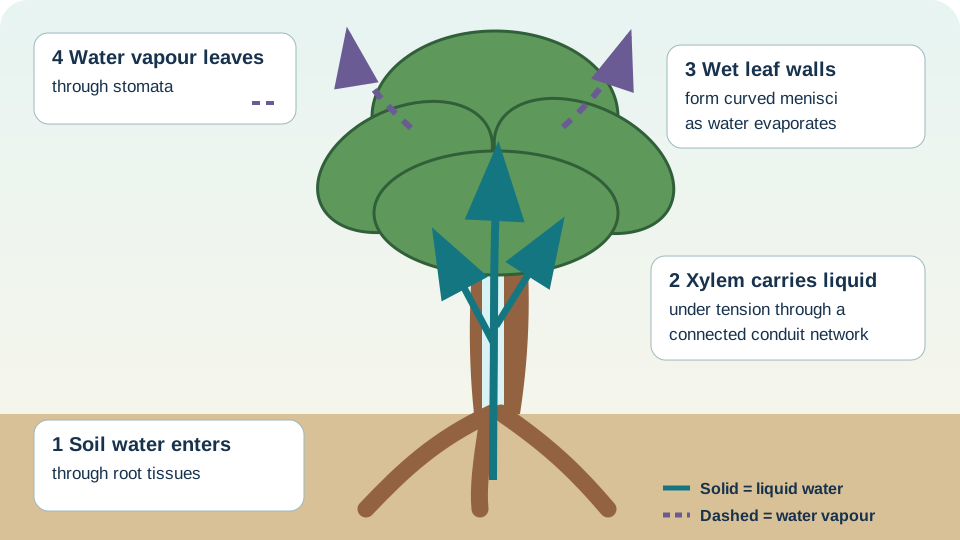
Look up into a tree and the plumbing problem becomes obvious. Its highest leaves need water, but the supply is mostly underground. A household building uses pressure supplied by pumps or an elevated tank. What drives water through a trunk that has neither?
For a tree losing water through its leaves, the main driver is a pull from above. Evaporation lowers the pressure of liquid water inside the leaf. Because water molecules attract one another, the liquid can transmit that pull through the tree. Roots supply an entrance, not a heart.
Begin with a wet leaf, not a thirsty root
A leaf admits carbon dioxide through adjustable pores called stomata. The gas supplies carbon for making sugars by photosynthesis, the process powered by light. Opening those pores also lets water vapour escape from the moist interior into drier air.
The water first evaporates from wet surfaces inside the leaf, including the walls of its cells. Vapour then travels through air spaces and out through the pores. This loss of water to the atmosphere is called transpiration. The distinction matters: the leaf is not squirting liquid through its stomata. Plant physiologists describe the pathway from soil to atmosphere.
Evaporation needs energy, supplied by sunlight and heat from the surroundings. The tree does not obtain upward movement for nothing. It couples a water supply to an evaporating surface, while living cells build and regulate the system.
How evaporation becomes a pull
Inside a wet cell wall, water meets air in tiny spaces between wall materials. The curved boundary between liquid and air is a meniscus, like the curved water surface beside the edge of a glass, only much smaller.
As water evaporates, the boundary retreats into the wall and becomes more curved. Water's surface resists being stretched, a property called surface tension. At these curved boundaries, that resistance lowers the pressure of the liquid behind them. Replacement water is drawn towards the evaporating surface. The US Forest Service explains this connection between evaporation, surface tension and pressure.
Water molecules attract one another through interactions called hydrogen bonds. Their collective tendency to stay together is cohesion. It allows liquid water to bear a pulling stress, called tension, without immediately breaking apart. The combination is the cohesion-tension mechanism: evaporation generates the pressure difference, and cohesion lets the connected liquid transmit the pull.
Imagine pulling a rope from its upper end. A pull applied at the top can affect the rope far below. The analogy stops there: water is a flowing liquid, not a chain of permanently joined links. Its molecules continually move and exchange neighbours. Nor is the leaf making an empty vacuum above the water. The low pressure is within the liquid itself.
Plumbing made from cells
The long-distance route is xylem, the plant tissue that carries water and dissolved minerals. Its main conducting cells lose their living contents as they mature, leaving hollow passages with reinforced walls. Living cells remain alongside them; not all wood is dead.
Water does not travel through one uninterrupted pipe from soil to treetop. It passes through a connected network. Thin, porous regions between neighbouring conduits, called pit membranes, allow water to cross while helping restrict the spread of gas. They also resist flow. A detailed review describes the conducting network and its connections.
At the lower end, water crosses root tissues from the soil before entering the xylem. At the upper end, leaf veins deliver it towards the evaporating tissues. A continuous liquid pathway can therefore exist across many cells and conduits without being one giant cell.
Evaporation lowers liquid pressure; water flows towards the leaves
Solid blue: liquid waterDashed teal: water vapour
Whole-plant route
Detail inside the leaf
Evaporation curves the water surface. Surface tension lowers liquid pressure.
The first panel begins with water in soil and a root. A solid blue arrow carries liquid upward through several connected conducting passages to a leaf vein. In the enlarged leaf view, liquid reaches a wet cell wall and sits below a concave surface in a tiny wall space. Air is above it. A dashed teal arrow carries water vapour from that surface through the leaf's internal air space and out through a stoma. The arrows show movement of water in two phases, not force or signal propagation.
Schematic, not to scale. Arrow sizes do not show speed or volume. Root and leaf pathways are simplified; no pressure measurement or maximum tree height is shown.
Sources: US Forest Service: evaporation, menisci and tension; Venturas and colleagues: xylem hydraulics. Original diagram by The Daily Wonder.
Why a drinking straw is the wrong model
When you suck through a straw, you lower the air pressure above the drink. Atmospheric pressure on the drink's exposed surface pushes liquid upwards. Even an ideal vacuum-based arrangement can lift water only about ten metres at sea level. A tall tree cannot rely on that mechanism alone.
The tree instead lowers pressure directly in liquid water using tiny curved surfaces in its leaves. Water can remain liquid while under tension, although this state is vulnerable to bubbles. The relevant small spaces are in the leaf walls, not simply the much wider transport passages in the trunk. Researchers explain why leaf pores and transport conduits have different jobs.
Ordinary capillary rise, the upward movement of water in a narrow wettable tube, is therefore not a sufficient explanation by itself. Capillary forces matter greatly at the leaf's evaporating surfaces, but a trunk is not just an oversized paper towel.
Some plants also develop root pressure: dissolved substances accumulate in the root's xylem, and water entering across membranes creates a positive push. This can matter when transpiration is low. It does not explain the main upward flow in a tall, transpiring tree. Georgia Tech compares these mechanisms.
Count the cost of height
Consider an illustrative tree with leaves 30 metres above its roots. Supporting a water column against gravity requires a pressure difference of approximately 0.01 megapascals per metre. A megapascal, abbreviated MPa, is a unit of pressure.
Thirty metres therefore requires about 30 × 0.01 = 0.30 MPa just for height. Doubling the height doubles this gravitational requirement. Real flow needs an additional pressure difference to overcome resistance through roots, conduits and leaves, and to extract water from soil. This is a calculation of one requirement, not a measured leaf pressure or a prediction of maximum tree height. The hydraulic review separates gravity from these other costs.
Check the height arithmetic
The danger of pulling too hard
As soil dries, supplying water becomes harder. Leaves can reduce loss by narrowing their stomata, but that also restricts carbon dioxide entry. Saving water can therefore limit sugar production.
If tension becomes too great, a gas bubble can grow and interrupt a water-filled conduit. The break in the liquid is called cavitation; the resulting gas blockage is an embolism. Losing enough conducting routes compromises the tree's water supply. The physiological account explains bubble formation and its consequences.
Recovery is not an automatic nightly reset. Some plants refill conduits when tension eases or positive pressure develops; others replace lost capacity by growing new xylem. Refilling while neighbouring water remains under tension is a more difficult, debated question. In 2026, scans of intact sunflowers found no refilling after rewatering, despite recovery of some leaf functions. That result concerns the studied plants, not every species. Read the sunflower study.
A tree's water supply depends on keeping evaporation, liquid connections and replacement water in balance. The canopy's smallest wet surfaces help move water through its largest structure. What looks like a quiet trunk is part of a flowing connection between soil, leaves and air.
YOUR PERSPECTIVE
Join the discussion
What surprised you? Have a question or a correction? Share your thinking.
No comments yet. Start the conversation.
Sign in with ChatGPT to commentAnyone can read the discussion. Sign-in helps limit spam.