
A peat bog can look like a stack of brown pages. Slice one page thinly enough, process it in a laboratory and a few transparent splinters may appear under a microscope. They can be smaller than grains of sand and too scattered to form a visible stripe. Yet their chemistry may point to an eruption hundreds or thousands of kilometres away.
These hidden traces are called cryptotephra: volcanic particles present in concentrations too low to see as a layer with the unaided eye. Scientists use them to connect records that otherwise keep different clocks. The everyday question is how a nearly invisible dusting can justify saying that two distant places share one moment in their histories.
The answer needs four steps. An eruption disperses glassy ash. Sediment preserves some of it. Laboratories compare individual shards. Only then can a matched layer transfer an age constraint from one archive to another.
A horizon that eyesight missed
Volcanologists had long used thick, visible ash beds as time markers. In the late 1980s, Andrew Dugmore reported a roughly 4,300-year-old microscopic Icelandic ash layer in Scottish peat. That work helped establish that useful layers could exist far beyond the area where ash was obvious in the field. Siwan Davies reviews the development of cryptotephra research.
An explosive eruption can break magma into fragments and carry fine material high into the atmosphere. Winds spread the cloud; particles eventually fall through air or arrive with rain. Volcanic ash means fragments smaller than 2 millimetres, not the soft residue left by a fire. Many useful cryptotephra shards are much smaller still.
The fall can cover a wide region during a short episode compared with the centuries or millennia represented by a sediment core. That makes an ash horizon an event marker. It is not literally instantaneous everywhere. Settling takes time, and later water, wind, burrowing animals or human activity can move grains. Researchers therefore inspect the sediment context rather than treating every shard as an untouched timestamp.
Find a signal without inventing one
A core from a lake, bog or ice sheet is sampled in narrow depth intervals. In an archaeological excavation, sediment is taken from carefully recorded layers. Laboratory preparation removes or separates much of the surrounding organic matter and mineral material, concentrating the volcanic glass. Methods vary with the deposit, so preparation itself must be documented.
Under a microscope, an analyst counts likely shards and records features such as shape and bubbles frozen into the glass. An electron microprobe can then measure major elements in individual shards. The result is a set of chemical proportions rather than a photograph of the source volcano. The US Geological Survey describes separation, analysis and correlation of tephra samples.
People sometimes call that composition a chemical fingerprint. The analogy is useful because several elements are compared together. It also has a limit: eruptions from the same volcano can look very similar, a single eruption can contain varied magma, and weathering or laboratory treatment can alter what is measured. Chemistry must be considered with shard appearance, mineral evidence, geographical reach, plausible age and the order of layers. USGS work at Owens Lake shows chemistry used alongside petrography and stratigraphic sequence.
When a match carries time
Suppose glass from a thin layer in a lake core matches a well-studied eruption. The eruption's age might be constrained by historical records, radiometric dating or material above and below the layer. If glass with a compatible composition and context appears in an archaeological site, the shared event can align the two archives.
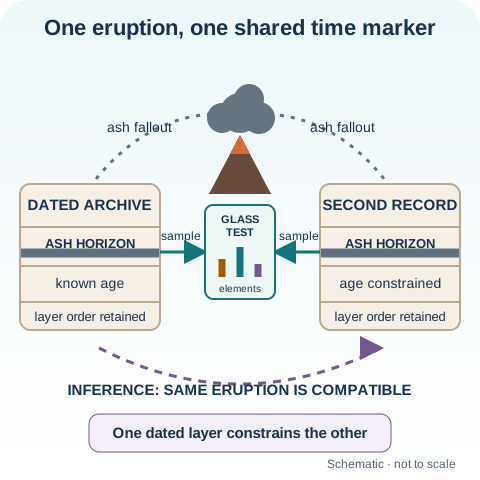
The figure below separates what moves, what is measured and what is inferred.
A matched ash layer transfers an age constraint
- 1. Sample the same thin horizonGlass shards are separated from sediment at Site A and Site B.
- 2. Measure individual shardsSeveral elements, shard form and context are compared.
- 3. Test a correlationA compatible match supports the inference that both layers record one eruption.
- 4. Transfer only the justified constraintAn independent age at Site A constrains the ash horizon at Site B; layers above and below retain their relative order.
Two sediment columns contain a thin ash horizon. Samples from both horizons lead to a laboratory comparison of individual glass shards. Matching multi-element patterns, supported by context, permit an inference that the layers came from the same eruption. The independently dated archive then supplies an age constraint to the archaeological horizon, while nearby layers remain earlier or later according to their undisturbed order.
Schematic and not to scale. Bar heights are symbolic, not measured compositions. Sediment thickness is not elapsed time. Reworking, alteration, natural glass variation and similar eruptions can weaken a correlation.
Sources: USGS Tephrochronology Project; Davies: cryptotephra research review; community best-practice recommendations. Original diagram by The Daily Wonder.
At an imaginary Site A, the matched ash lies below a settlement layer. At Site B, it lies above a worked surface. If the deposits have not been disturbed, the settlement at A is later than the ash fall and the surface at B is earlier. This is a relative ordering. The centimetres between layers do not automatically equal a number of years, because sediment can accumulate at changing rates.
When one occurrence has an independent age, the correlation can give the other occurrence an age constraint. It does not date every object in the layer to a single day. Nor does it prove that the eruption caused a cultural change merely because the two are close in time. A 2014 archaeological review explains both the chronological value and the interpretive limits of cryptotephra links. Read the review by Christine Lane and colleagues.
A match is an argument, not a barcode scan
The strongest correlation combines several compatible observations and reports uncertainty. Laboratories need shared reference materials and comparable measurements so that a difference between datasets is not merely a difference between instruments or procedures. A community effort involving more than 100 tephra researchers published recommendations for reporting and standardising geochemical data in 2022. The open best-practice paper explains those recommendations.
Disagreement is valuable when it exposes a weak link. A proposed identification of ash in Greenland ice with the AD 79 eruption of Vesuvius did not survive detailed chemical comparison. Researchers found that the glass was not a convincing match. The USGS publication summary explains why source attribution requires chemical characterisation.
That correction does not make cryptotephra unreliable. It shows the method working as evidence should: a memorable historical label cannot outrank incompatible measurements.
Why there is no universal match score
One event, many archives
The same eruption can leave traces in ice, marine mud, lake sediment, peat and excavated ground. A secure match lets researchers place changes recorded in those archives onto a common sequence. They can ask whether an environmental shift came before or after an occupation layer without pretending that both archives accumulated in the same way.
This is why the smallest shards can carry a large historical role. They do not narrate what people saw, thought or did. They provide something quieter: a line that can be drawn across separate records, backed by glass chemistry and checked against the order of the ground. An invisible layer becomes useful not because it tells a dramatic story by itself, but because it helps many incomplete stories share a clock.
YOUR PERSPECTIVE
Join the discussion
What surprised you? Have a question or a correction? Share your thinking.
No comments yet. Start the conversation.
Sign in with ChatGPT to commentAnyone can read the discussion. Sign-in helps limit spam.